
CP funding setback puts EEC high-speed rail contract at risk
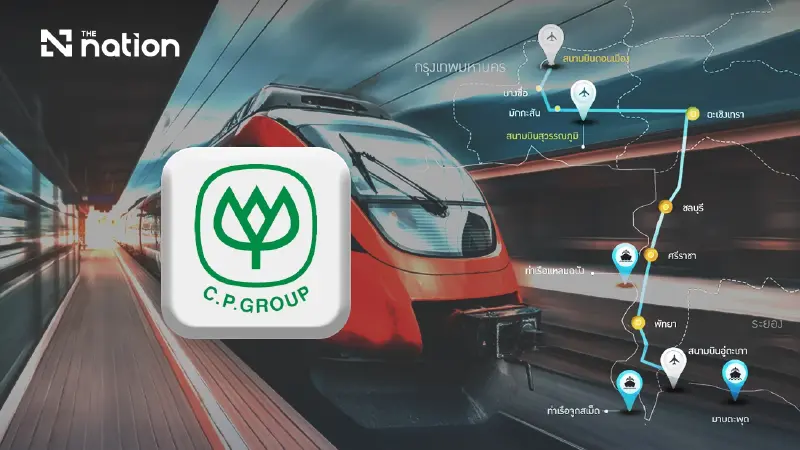


SRT says Asia Era One has been unable to secure financing for the three-airport high-speed rail project, leaving contract revision or termination as the final options
- The CP Group-led consortium, Asia Era One, has failed to secure financing for the high-speed rail project because financial institutions view it as too risky.
- Due to the funding setback, the Eastern Economic Corridor (EEC) Policy Committee must now decide between two options: amending the joint-investment contract or terminating it.
- The private partner has stated that the project cannot proceed without a contract amendment, putting the agreement at risk of termination.
- Terminating the contract would also negatively impact the Airport Rail Link and shared infrastructure with the Thai-Chinese high-speed rail project.
Thailand’s long-delayed high-speed rail project linking Don Mueang, Suvarnabhumi and U-Tapao airports faces a critical decision, as the State Railway of Thailand prepares to ask the Eastern Economic Corridor Policy Committee to decide whether the joint-investment contract should be revised or brought to an end.
The project was signed under a public-private partnership agreement between the State Railway of Thailand (SRT) and Asia Era One Co Ltd, a CP Group-led consortium, on December 22, 2018, during the first government of Gen Prayut Chan-o-cha.
The rail link was designed as a flagship EEC infrastructure project, connecting Bangkok with the Eastern Economic Corridor through the country’s three main airports. However, the project was later hit by the Covid-19 pandemic, which affected the issuance of the notice to proceed, or NTP, prompting the private partner to seek relief measures from the state.
The Cabinet approved relief measures, including a proposed amendment to the joint-investment contract, on October 19, 2021.
Contract-revision talks have continued across several governments, from Gen Prayut’s second administration to the government of Srettha Thavisin and then the administration of Paetongtarn Shinawatra. The Cabinet approved the principle of amending the contract on October 11, 2024.
However, the issue remained unresolved under the first Anutin Charnvirakul government, after concerns emerged that the proposed contract revision could conflict with public-private partnership principles. The dispute has continued into the second Anutin administration.
Anan Phonimdang, acting governor of the SRT, said a three-party discussion involving the SRT, the Eastern Economic Corridor Office (EECO) and Asia Era One had narrowed the options to two proposals for submission to the EEC Policy Committee, chaired by Prime Minister Anutin.
The first option is to amend the contract in line with the original resolution of the EEC Policy Committee. If the committee approves this approach, the project will proceed under the conditions already discussed and under the draft revised contract reviewed by the Office of the Attorney-General.
The next step would be to seek Cabinet approval to amend the principle of the contract revision, before moving towards the signing of a new amended joint-investment agreement.
The second option is to end the contract. This would apply if the EEC Policy Committee concludes that the contract cannot be amended under its previous resolution. In that case, the SRT and the private partner would have to examine the legal grounds for terminating the agreement.
They would also have to study the joint-investment contract in detail to determine what would trigger termination, what obligations each side would carry under PPP law, which parts of the project had already been invested in and which party would be responsible for each area.
Anan said the outcome of talks with the private partner showed that Asia Era One had been unable to secure financing because financial institutions lacked confidence in the project and viewed it as carrying excessive risk.
“The result of negotiations with the private sector showed that the private partner acknowledged it could not find a source of financing because financial institutions lacked confidence and viewed the project as too risky. The private partner has therefore set a condition that if the original contract is not amended, the project may not be able to continue, which would be grounds for ending the joint-investment contract,” he said.
Anan said the SRT would present the outcome of the three-party talks to its board for acknowledgement in July. The matter would then be prepared for submission to the EEC Policy Committee, a process expected to take around two months. The proposal is therefore expected to reach the committee by August.
If the contract is terminated, the SRT is preparing a contingency plan to ensure rail transport services into the EEC are not affected. The agency will discuss with the EECO the area’s urban development plans and future rail transport demand.
The SRT already operates double-track rail services into the EEC, with trains capable of reaching speeds of up to 120 kilometres per hour. It would therefore prepare a plan to increase service frequency and adjust train formations to meet demand.
“Whether the high-speed rail project continues must wait for the EEC Policy Committee’s decision. If the joint-investment contract with the existing private partner ends, the SRT will discuss with the EECO whether high-speed rail is still necessary, because the investment situation has changed and the SRT already has double-track rail ready for service,” Anan said.
The SRT is also looking for a solution for the Airport Rail Link. Anan said that if the joint-investment contract with Asia Era One is terminated, the Airport Rail Link operating contract, which is due to expire in September 2026, would also have to end because the SRT would not be able to extend the contract with Asia Era One if it was no longer the joint-investment partner.
He said the SRT was urgently seeking a way to ensure Airport Rail Link operations continue without disruption and insisted that public services would not be affected.
The possible termination could also affect shared infrastructure under the Thai-Chinese high-speed rail project, particularly contract 4-1 covering the Bang Sue–Don Mueang section.
The SRT plans to ask the Cabinet to revise its previous resolution so the agency can separate the construction work and carry it out itself. The SRT would open a tender and invest in the construction under the Thai-Chinese high-speed rail project.
The agency has already designed structures that are not connected to the three-airport high-speed rail project. These can be adjusted and put out to tender quickly to avoid affecting the overall Thai-Chinese high-speed rail project, which is under construction and scheduled to open in 2031.
The joint-investment contract for the three-airport rail link sets out five conditions under which the agreement may be terminated.
The first is when the 50-year concession period expires. The second involves problems with site handover or the inability to issue the notice to proceed, although this has not yet occurred. The third covers force majeure events affecting the project. The fourth concerns breaches by either the private sector or the state. The fifth involves a change in government policy.
Chula Sukmanop, secretary-general of the EECO, told BangkokBizNews that the three-party working group had earlier considered four possible solutions.
These included (1) moving forward under the EEC Policy Committee’s resolution by amending the joint-investment contract, (2) state assistance in securing low-interest loans, (3) separating overlapping construction work under the Thai-Chinese high-speed rail contract 4-1 on the Bang Sue–Don Mueang section for the SRT to carry out, and (4) ending the joint-investment contract.
After continued discussions, and after the private partner held talks with several financial institutions, only two realistic options remained following a meeting on June 24, 2026. These are to proceed with the contract amendment under the EEC Policy Committee’s resolution or to terminate the contract.
Chula said the private partner had confirmed after talks with financial institutions that lenders would not provide financing.
If the joint-investment contract is terminated, and if any party must take responsibility for damages or lost opportunities arising from the project, the EECO must first wait for the EEC Policy Committee to set the appropriate direction. The details of the joint-investment contract would then be reviewed to determine each party’s responsibility.
Source: Bangkokbiznews
