
Three-airport rail deadlock clouds Thailand’s THB140bn PPP pipeline
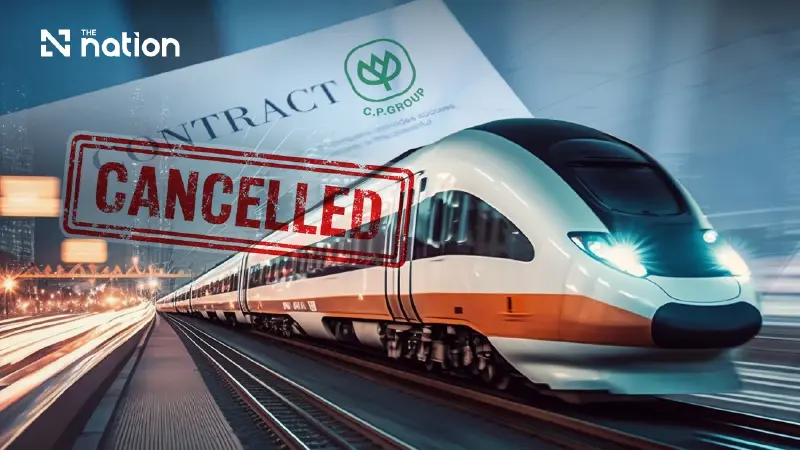


Possible termination of the three-airport rail contract raises questions over Thailand’s planned THB140bn transport PPP pipeline
- The potential termination of a long-delayed high-speed rail agreement is a major test of investor confidence in Thailand's Public-Private Partnership (PPP) model.
- The outcome of the rail dispute could impact a planned pipeline of new PPP transport projects valued at over THB140 billion, including motorways and a cruise terminal.
- Problems with the rail project have highlighted the need for future PPP contracts to be more flexible and better structured to manage long-term risks and unforeseen events.
Thailand’s possible termination of its long-delayed three-airport high-speed railway agreement is emerging as an early test of investor confidence ahead of a planned 140-billion-baht pipeline of public-private partnership transport projects.
The high-speed line linking Don Mueang, Suvarnabhumi and U-Tapao airports was intended to become one of the Eastern Economic Corridor’s principal transport arteries. However, the project is now moving towards a decision on whether the joint-investment agreement between the State Railway of Thailand (SRT) and CP Group-linked Asia Era One Co Ltd can continue.
Concern has centred not only on the prospect of ending the contract, but also on earlier proposals to revise its payment arrangements. Critics have questioned a suggested shift from paying state construction support after the private partner completed the project to making payments progressively as construction advances, arguing that this could weaken the original allocation of risk under the public-private partnership, or PPP, model.
The dispute comes as the Transport Ministry prepares to rely more heavily on private capital to accelerate infrastructure development while reducing pressure on the government budget.
Deputy Transport Minister Siripong Angkasakulkiat said the ministry planned to fund major projects through PPP arrangements and the Thailand Future Fund, or TFFIF, which raises money through the capital market for infrastructure investment.
The approach is intended to allow projects capable of generating commercial returns to attract private investment, leaving more public money available for infrastructure primarily designed to provide public services.
“Projects offered for private-sector joint investment will mostly be those capable of generating revenue and financial returns, making them attractive to investors,” Siripong said.
“This will allow the government to direct its budget towards infrastructure focused on public services. Such projects can then proceed more quickly and support rapid development, including the expansion of the highway network.”
Long-term PPP agreements face changing risks
Siripong acknowledged that experience from earlier PPP contracts had shown how external shocks could disrupt projects and undermine assumptions made when agreements were signed.
The Covid-19 pandemic, which sharply reduced passenger numbers and commercial activity, was among the factors that affected the three-airport rail project. More recent conflict in the Middle East and its effect on oil prices had also demonstrated how unexpected developments could change construction costs and project economics.
These events should prompt the government to reconsider the way future PPP agreements are structured, he said.
Contract terms would need to address contemporary risks and provide enough flexibility to respond to changes that may occur over agreements lasting several decades.
The three-airport high-speed rail project had been delayed for years without construction beginning, but Siripong argued that its problems should not automatically be seen as damaging the credibility of Thailand’s wider PPP programme.
Each infrastructure project had different sources of revenue, levels of demand and commercial appeal, he said.
Future PPP agreements would also be written under conditions different from those used seven or eight years ago, with clauses designed to reflect present economic circumstances and lessons from earlier projects.
Ministry prepares 262 projects for 2027
The Transport Ministry has set out an investment programme covering 262 projects in 2027, with a combined value of 229.769 billion baht.
A large share of the programme is expected to be financed through public-private partnerships to reduce the burden on the annual state budget.
Projects considered sufficiently advanced for private-sector bidding have a combined investment value of more than 140 billion baht. They include motorway extensions, an elevated highway in western Bangkok, a Phuket expressway and a cruise terminal on Koh Samui.
1. M5 Rangsit–Bang Pa-in motorway
The proposed M5 motorway would extend the Don Muang Tollway from Rangsit to Bang Pa-in, with an estimated investment of 31.358 billion baht.
A selection committee is considering the draft request-for-proposal documents. The government expects to issue the invitation to tender by the end of 2026 and aims to sign the joint-investment agreement by the middle of 2027.
2. M9 Bang Khun Thian–Bang Bua Thong motorway
The M9 project is an elevated motorway planned between Bang Khun Thian and Bang Bua Thong, with an estimated cost of 56.035 billion baht.
Authorities are preparing its bidding documents and expect to invite private investors to submit proposals during 2027.
Construction is expected to be accelerated with the goal of opening the route in 2032.
3. Phuket expressway extension
Another project in the pipeline is the second phase of the Phuket expressway, running from Muang Mai through Koh Kaew to Kathu.
The project has an estimated investment value of 46.812 billion baht and is intended to improve transport connections across the island.
4. Koh Samui cruise terminal
The ministry is also preparing a large cruise-terminal development on Koh Samui in Surat Thani province.
The project is valued at approximately 12.172 billion baht and is among the transport schemes being considered for private participation.
Together, the four projects carry an estimated value of about 146.38 billion baht, although the ministry describes the wider ready-to-tender PPP pipeline as worth more than 140 billion baht.
TDRI warns rail project carried unusually high risks
Dr Sumet Ongkittikul, research director for transport and logistics policy at the Thailand Development Research Institute, said PPP arrangements remained an effective way of developing infrastructure more quickly than waiting for full government-budget allocations.
However, Thailand’s more successful PPP projects had generally been those with clearly identifiable sources of income and established operating models, including urban railways and expressways.
The three-airport high-speed railway was fundamentally different, he said.
Thailand had not previously developed a project of this type, while its scale, passenger assumptions, construction requirements and integration with other infrastructure created a much higher level of risk.
Applying a conventional PPP structure to such a project meant the private partner was required to absorb more risk than the government, Sumet said.
The stalled railway should therefore be treated as an important lesson for future state investment rather than as evidence that the PPP model itself had failed.
“The use of private investment in state projects is a sound form of investment,” Sumet said.
“However, if it is to be used more extensively, the government must recognise that circumstances and risk factors are constantly changing.
“PPP contracts normally run for 20 or 30 years. If the government intends to use this model for many projects, it must establish conditions that can respond to different situations and changing contexts that may arise.”
Contracts must account for technological change
Sumet said future PPP agreements should do more than allocate construction and financial risks at the time they are signed.
They should also contain mechanisms allowing projects to adapt when new technology could improve performance, reduce costs or change the way infrastructure is operated.
Technological development should be assessed and incorporated into the contract from the beginning, he said.
When significant changes occur, the public agency and private partner should have a clearly defined process for considering system upgrades and maintaining operational efficiency throughout the concession period.
Without such provisions, long-term agreements risk locking projects into systems or assumptions that become outdated well before their contracts expire.
Airport rail contract approaches critical decision
Asia Era One has submitted a letter to the SRT invoking its contractual right to seek termination discussions, although the company has stressed that this does not amount to an immediate withdrawal or automatic cancellation.
The company has cited its inability to secure all the conditions needed for the SRT to issue a notice to proceed with construction, including complications surrounding its Board of Investment promotion certificate.
Asia Era One said its original BOI application received approval in principle in 2022, but the application expired in 2024 before the project’s terms and proposed contract revisions had been finalised. A new application would require clearer details of the project and its investment conditions.
The SRT, the Eastern Economic Corridor Office and Asia Era One have been considering two main paths.
The first would involve amending the PPP contract under principles previously considered by the EEC Policy Committee and using a draft amendment already examined by the Office of the Attorney-General.
That option would still require further policy and Cabinet approvals before the revised agreement could be signed.
The second would begin a formal process to examine termination, including the legal grounds, the obligations of both parties, any compensation claims and the treatment of investments already made.
Ending the agreement would also create questions over the Airport Rail Link, whose operation is tied to the wider three-airport railway contract. The current operating arrangement is due to expire on September 30, 2026.
The outcome could also affect shared civil works between the airport railway and the Thai–Chinese high-speed rail project on the Bang Sue–Don Mueang section.
The SRT has been considering separating that work and conducting its own tender to prevent the dispute from causing further delays to the Thai–Chinese railway.
The three-airport contract was signed on October 24, 2019, after the CP-led consortium won the tender by seeking 117.226 billion baht in state co-investment.
Negotiations over relief measures and contract revisions have continued since the Covid-19 pandemic, passing through several governments without producing a final agreement.
The pending decision will therefore carry implications beyond the railway itself.
For Thailand’s next generation of PPP projects, the central question is whether the government can demonstrate that major long-term contracts are commercially realistic, adaptable to unforeseen events and capable of protecting both public interests and investor confidence.
Source: Bangkokbiznews
