
Over 10,000 old Bangkok shophouses face Rama IV-style subsidence risk
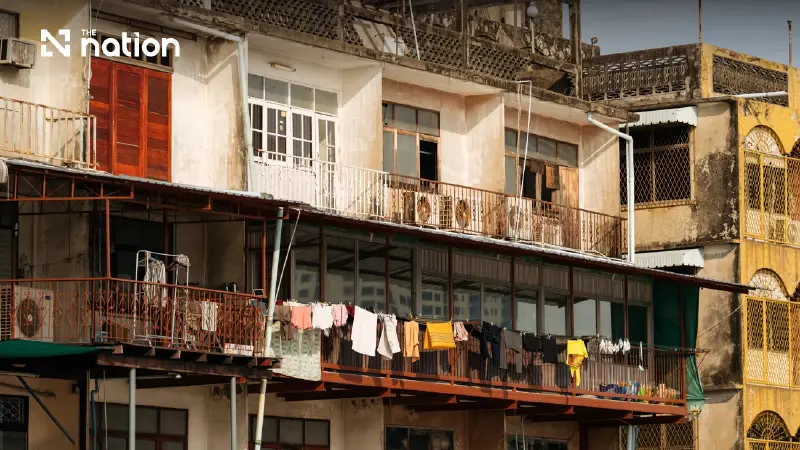


More than 400,000 ageing shophouse units are deteriorating, raising safety concerns as structures may be unable to bear sufficient weight, risking a repeat of Rama IV.
Many old shophouses in Bangkok, built decades ago, are facing deteriorating conditions and are nearing the end of their service life, creating safety risks, particularly where building structures may no longer be able to bear enough weight.
The building subsidence incident in the Rama IV area reflects the problem of old buildings lacking proper maintenance and renovation.
However, many building owners are unable to modify or extend their buildings because, when they apply for permission for major renovation, they must comply with the current building control law, including requirements for parking spaces and fire-protection systems under new standards.
This has pushed costs beyond what owners can bear.
Many sites have therefore been left derelict or, if they are in high-potential locations, are often sold to private developers for condominium projects or other forms of property development.
To address the problem, the Bangkok Metropolitan Administration (BMA), when Chadchart Sittipunt was Bangkok governor, proposed revising the relevant by-laws to allow shophouses and old buildings to be repaired, renovated or partly modified, with some relaxation of parking, fire-escape and fire-prevention system requirements in certain cases.
The aim was to ease owners’ cost burdens and encourage the safe rehabilitation of old buildings for reuse, rather than leaving them derelict or demolishing them solely to develop new projects.


Push for old shophouses among Bangkok’s 400,000-plus units to be renovated without parking spaces or fire escapes under the building control law
Chadchart Sittipunt, an independent candidate No 9 for Bangkok governor and a former Bangkok governor, gave an interview while campaigning in Min Buri District on the issue of a shophouse subsidence incident in Samphanthawong on June 20.
He said the incident took place at an old building, probably about 100 years old, and involved a canopy, which was already a weak point of the building.
The building was also privately owned.
A similar incident had previously occurred once at Pratu Phi.
He said the principle was that district offices must go out and survey areas at risk.
In his assessment, district offices must mainly look at old buildings and first visually examine where damage has occurred.
Building owners should also help carry out checks.
If they are unsure, they should notify the district office.
Bangkok has more than 400,000 shophouse buildings, while old shophouses are believed to number in the tens of thousands, close to 100,000.
He therefore asked everyone to help.
District offices themselves must go out and inspect shophouses in the city centre, Yaowarat, Samphanthawong and Phra Nakhon.
Owners must also help on their side.
If both sides act, the situation should improve.
In the future, the by-law on row houses may need to be adjusted so they can be modified and improved.
At present, renovation is difficult because of legal restrictions, such as requirements to arrange parking and fire escapes if renovations are made.
This causes people to abandon changes, meaning they no longer want to make improvements and have to tolerate the existing conditions.
As a result, the number of deteriorating old shophouses is increasing.
"During the period when I was Bangkok governor, there was a proposal to amend the by-law so shophouse owners could repair their buildings without having to provide parking spaces and fire escapes. It was submitted to the Bangkok Metropolitan Council in 2025, but it did not make it in time as the council’s term ended first. If the rules can be improved, old row houses will become stronger and create new economic opportunities for the public. They could be both homes and shops," Chadchart said.
Safety problems in old buildings are a hidden danger for Bangkok residents
Professor Dr Amorn Pimanmas, president of the Thai Structural Engineers Association and a lecturer at the Faculty of Engineering, Kasetsart University, said Bangkok has many old buildings, especially in inner-city areas.
Some are more than 100 years old.
Although these buildings are not very tall, they have certain structural features that are not strong, namely projecting parts such as balconies and canopies.
These are concrete slabs that are heavy and are sometimes used as places to put various items.
According to engineering principles, buildings have a service life of 50-60 years.
This is because construction materials deteriorate over time, especially concrete and reinforcing steel.
In the past, these construction materials were also not produced with technology that yielded good-quality, high-strength and durable materials.
For example, old concrete had low load-bearing strength, while reinforcing steel in the past used smooth, round bars with little bonding to the structure.
These materials inevitably deteriorate, especially when exposed to the environment, sun, rain and humidity, which can cause steel to rust.
The collapse of the projecting balcony floor at the shophouse on Rama IV Road was not the first such incident.
In October 2025, the canopy of an old shophouse at the mouth of Soi Samran Rat in Phra Nakhon District also collapsed.
This shows that the problem is hidden, and that many more old buildings of this kind in Bangkok could collapse at any time, making it an unavoidable hidden danger for city residents.
Five factors behind the shophouse-collapse problem
From the information gathered, the collapse of projecting structures can be summarised into five main factors:
- The structure is old and has exceeded its normal service life, such as 50 years or more. Materials such as concrete and reinforcing steel deteriorate over time and rust when exposed to moisture.
- The projecting structure is anchored on only one side, making it prone to falling.
- There are a few anchor points, and the anchors are not strong, or there is no bracing to a strong internal structure.
- Heavy objects are sometimes placed on the structure.
- There may have been extensions to the projecting part.
These five points are factors, and each incident may result from one factor or several factors together.
In the case of the collapse of the projecting part of the building on Rama IV Road, it was likely caused mainly by the first three factors.
The factor involving extensions cannot yet be confirmed.
Calls for the BMA to prepare a response plan
The problem of old buildings has a significant impact on public safety because buildings grow older as time passes.
The BMA must therefore have a systematic plan to respond to and prevent incidents of this kind, using powers under the Building Control Act, which gives local authorities such as the BMA authority under the 2020 ministerial regulation on correcting buildings whose condition or use may pose a danger to health, life, body or property, may be unsafe from fire, may cause nuisance, or may affect the maintenance of environmental quality.
The BMA should therefore act systematically to address the problem of old buildings as follows:
- Survey all old buildings, especially those more than 50 years old and those with projecting structures such as floor slabs and balconies, and prepare a database of old buildings.
- Conduct systematic assessments of building strength by assigning civil works technicians, inspectors and building inspectors under the building-inspection law, and seek cooperation from professional organisations to send volunteer engineers to join inspections of building structures and report survey results to local authorities.
- If a building is found to be structurally unsound, issue an order for the building to be corrected and enforce the law strictly.
