
Used Cooking Oil Fuels Thailand’s Sustainable Aviation Shift
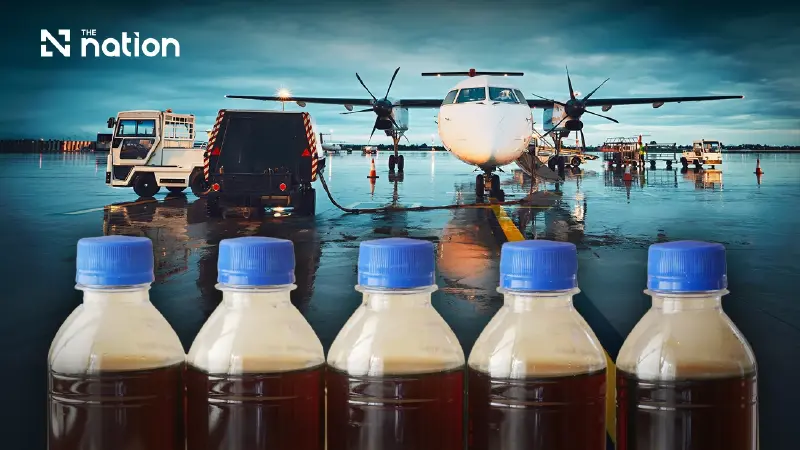


Thailand’s aviation sector is turning used cooking oil into SAF as CAAT, GC and Bangchak push cleaner jet fuel and low-carbon flights.
A fuel once poured away after cooking is becoming part of Thailand’s cleaner aviation future, as used cooking oil moves from kitchens and food businesses into the country’s emerging sustainable aviation fuel supply chain.
The shift comes as global airlines face growing pressure from energy security risks and climate commitments. Conflict in the Middle East has underlined how vulnerable aviation remains to fuel shocks, with jet fuel prices pushed sharply above pre-war levels and reserves in parts of Europe coming under pressure.
That volatility has strengthened interest in alternative fuels, particularly sustainable aviation fuel, or SAF. Produced from renewable resources, SAF can be made from several types of feedstock, but used cooking oil and animal fats have become among the most closely watched because fat molecules store high levels of energy and can be reprocessed into high-quality diesel and kerosene suitable for commercial aircraft.
For aviation, SAF is not simply a cleaner fuel. It is also a way to reuse carbon already circulating in the atmosphere, rather than extracting new fossil carbon from underground.
Depending on feedstock and production method, SAF can reduce lifecycle greenhouse-gas emissions by up to 80% compared with conventional fossil jet fuel, while helping cut waste oil and fat that would otherwise end up in landfill or contaminate soil.
Modern production technology has also narrowed the performance gap with conventional jet fuel, making SAF suitable for large commercial aircraft, including wide-body jets such as the Boeing 777.
Thailand prepares its aviation sector for SAF
Thailand’s aviation sector has begun laying the groundwork for wider SAF adoption, with the Civil Aviation Authority of Thailand (CAAT) signing a memorandum of understanding with eight Thai airlines on 17 November 2025.
The airlines are Thai Airways International, Bangkok Airways, K-Mile Air, Nok Air, Thai AirAsia, Thai AirAsia X, Thai Lion Air and Thai VietJet. The cooperation is aimed at reducing carbon dioxide emissions from international aviation and preparing the industry for the clean energy transition.
Under the framework, SAF use remains voluntary. Airlines are free to choose their suppliers and refuelling airports, giving the sector flexibility while the supply chain continues to develop.
The initial target is for SAF to account for 0.5–1% of total fuel use on international routes from 2026, with the target to be reviewed and potentially raised in later phases.
If achieved, the target is expected to reduce emissions from Thailand’s international aviation sector by around 60,000 tonnes of carbon dioxide equivalent in 2026.
That reduction would also ease pressure on airlines to purchase CORSIA Eligible Emissions Units, or CEEUs, under the Carbon Offsetting and Reduction Scheme for International Aviation, the global emissions framework led by the International Civil Aviation Organization.
GC turns waste oil into high-value fuel
PTT Global Chemical, or GC, has positioned itself as Thailand’s pioneer in commercial SAF production through a biorefinery model based on co-processing technology.
Rather than building an entirely new facility, GC has upgraded and adapted existing refinery infrastructure to convert used cooking oil into cleaner fuel and bio-based feedstock. The approach allows the company to cut investment costs and shorten development time while building a lower-carbon business line.
GC says its SAF can reduce carbon dioxide emissions by up to 85% compared with conventional aviation fuel, depending on the production method and lifecycle assessment.
The company is starting with SAF production capacity of 6 million litres per year and plans to expand to 24 million litres per year. Once fully expanded, the project is expected to help reduce carbon emissions by around 60,000 tonnes annually.
GC’s biorefinery is not limited to aviation fuel. It can also produce more than 10 types of high-value biochemical and bioplastic products, including Bio-Propylene for toys and automotive parts, Bio-Butadiene for tyres, and Bio-PTA for PET plastic. These materials offer performance comparable to fossil-based products, but with a significantly lower carbon footprint.
Pukpong Wungrattanasopon, chief operating officer of GC’s base and intermediate chemicals business, described used cooking oil as a resource that can be brought back into the economy through technology.
He noted that GC’s co-processing biorefinery can produce SAF and extend into Bio-Circular Polypropylene, or Bio-PP, a material with properties comparable to conventional plastic. Its possible uses range from food trays and nappies to industrial products, with the potential for recycling in the future.
For GC, the message is that sustainability is not only about cutting emissions. It is also about using resources more efficiently, reducing dependence on petroleum-based feedstock and helping move Thailand closer to its net-zero emissions goal by 2050.

Bangchak adds a stand-alone SAF route
Following GC’s co-processing route, Bangchak Group has begun commercial SAF production from Thailand’s first stand-alone HEFA-SPK SAF unit at the Bangchak refinery in Phra Khanong, Bangkok.
HEFA-SPK stands for Hydroprocessed Esters and Fatty Acids Synthetic Paraffinic Kerosene. It is a form of SAF made from renewable feedstock such as used cooking oil and is among the key production pathways being used to support low-carbon aviation worldwide.
Chaiwat Kovavisarach, group chief executive officer and president of Bangchak Corporation, described the SAF unit as a long-awaited project that has now been completed and brought into full commercial operation.
The unit was developed as a new system to meet international standards and support the future market for low-carbon aviation fuel. It also forms part of Bangchak Group’s broader net-zero strategy.
Beyond the SAF production unit, Bangchak has been building a used cooking oil ecosystem that covers collection, feedstock management and processing into both SAF and renewable diesel, also known as hydrogenated vegetable oil, or HVO.
The company sees this as part of a wider effort to strengthen energy security while supporting cleaner energy sources.
Together, the moves by CAAT, GC, Bangchak and Thai airlines show how used cooking oil is moving from a waste stream to a strategic fuel source. For Thailand, SAF is no longer only an environmental idea. It is becoming an industrial opportunity tied to aviation competitiveness, cleaner energy and the country’s long-term net-zero ambitions.
Source: www.thailand.go.th
