
Thailand, Huawei Launch AI Ecosystem Drive to Build ASEAN Hub
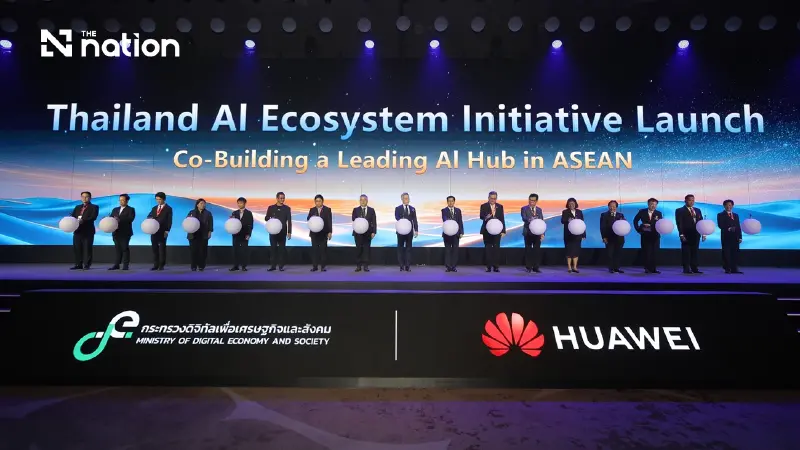


Government and Huawei leaders used the opening of Bangkok's AI summit to unveil a national ecosystem initiative and pledge tens of thousands of new AI-trained workers
- Thailand's government and Huawei have launched the "Thailand AI Ecosystem Initiative," a national program aimed at establishing the country as a leading artificial intelligence hub in the ASEAN region.
- A key component of the initiative is talent development, with Huawei pledging to train at least 40,000 AI developers to support Thailand's ambitions.
- The Thai government's strategy for the AI drive is based on three pillars: strengthening infrastructure, building trust through an AI governance sandbox, and developing a skilled workforce.
- The initiative is an open platform designed to foster collaboration between government, industry, academia, and technology providers to accelerate AI innovation.
Government and Huawei leaders used the opening of Bangkok's AI summit to unveil a national ecosystem initiative and pledge tens of thousands of new AI-trained workers.
Thailand's government and Huawei set out a shared roadmap for the country's artificial intelligence ambitions on Thursday as the Huawei Thailand Digital & AI Summit 2026 opened in Bangkok under the theme "Advancing ALL Intelligence Thailand" — with the two sides using the occasion to launch a new national AI ecosystem initiative alongside fresh economic and talent figures.
Over the two-day event's opening session, Thailand's Minister of Digital Economy and Society, Chaichanok Chidchob, addressed delegates in a recorded video message, while Austin Zheng, deputy managing director of Huawei Thailand, and Patchara Anuntasilpa, permanent secretary of the Ministry of Digital Economy and Society (MDES), spoke in person on how the country intends to translate that vision into practice.

A minister's vision from afar
Chaichanok could not attend in person — by the time the video played, he was in Chengdu for the World AI Conference and the APEC digital and AI ministerial meeting — but his message laid out what he called three pillars underpinning Thailand's AI journey: infrastructure, trust and people.
He stressed that the future of AI "cannot be created by any single organisation alone" but requires collective effort across government, industry, academia and innovators.
On infrastructure, he said Thailand's operational data centre capacity had reached roughly 350 megawatts by the end of 2025, with long-term planned capacity of 2.8 gigawatts, backed by nearly 40 strategic data centre and cloud projects approved by the Board of Investment.

On trust, he said Thailand is "advancing as a real-world AI Governance Sandbox, where companies, researchers and regulators can work together to translate global principles into practical implementation" — alongside continued efforts to guard against online scams and digital fraud. And on people, he said Thailand wants AI that "speaks the Thai language, understands Thai context" and creates opportunities for Thai businesses and entrepreneurs.
Chaichanok also referenced a recent visit to Huawei's research campus in Shanghai, extending "a simple invitation" to companies at the summit: "Come and build with Thailand."
He closed with a line likely to resonate beyond the summit hall: the success of AI, he said, "will not be measured by the intelligence of our machines. It will be measured by the confidence of the people who use them."

The economics behind the ambition
Permanent secretary Patchara Anuntasilpa, delivering an address under the theme "Scaling Thailand's Digital Economy through Trustworthy AI", said AI and digital technologies are becoming a key engine for transforming Thailand's economy and strengthening national competitiveness.
According to figures released alongside the summit, Thailand's Broad Digital GDP is projected to grow 4.2% to more than THB 5.6 trillion in 2026, while the country ranked second among ASEAN nations in the Government AI Readiness Index 2025, published by Oxford Insights — a result Patchara said reflects Thailand's strong underlying policy foundation.

To build what he called a sustainable "Trustworthy AI" ecosystem, Patchara set out three priorities: strengthening AI governance in line with international standards; developing secure and accessible AI infrastructure; and deepening collaboration between government, industry, academia and technology partners such as Huawei.
On infrastructure specifically, he pointed to the government's National Cloud initiative, run through the Government Data Centre and Cloud service (GDCC), which he said has already cut public-sector cloud resource use by more than 30% by pooling demand across agencies, alongside plans for a National Data Centre and continued development of a homegrown, Thai-language large language model. Thailand has also partnered with UNESCO to establish an AI governance operations centre in the country.

Huawei's pitch — and a warning on inaction
Speaking on behalf of Huawei, Austin Zheng argued that Thailand's AI adoption is moving from experimentation toward large-scale industrial deployment, requiring stronger foundations in computing power, data quality, governance and talent.
"We are entering a rapidly evolving AI era, but speed alone is not enough," he said. "We need AI that is reliable, practical, and capable of delivering real value in real-world scenarios."
He set out a five-point framework for accelerating that shift: identifying high-value AI scenarios; developing trustworthy AI models; establishing trusted data foundations; implementing full-lifecycle AI governance; and cultivating AI-native talent – while cautioning Thai businesses against a scattergun approach to investment.
"The greatest risk in the AI era is not making the wrong move," Zheng said. "It is making no move at all."
Huawei used the summit to formally launch the "Thailand AI Ecosystem Initiative: Co-Building a Leading AI Hub in ASEAN", an open platform intended to bring together government, academia, industry, research institutions, startups and technology providers to accelerate AI innovation and talent development.
On skills specifically, Zheng pledged during his keynote to train 40,000 AI developers in Thailand in the coming years; Huawei's broader statement on the summit put the goal even higher, saying its regional academy aims to help cultivate 100,000 AI talents in support of Thailand's ambition to become the AI Talent Hub for ASEAN, delivered through the Huawei ASEAN Academy and partnerships with local universities and government agencies.

A wider showcase
Beyond the keynote speeches, the summit doubled as a showcase of Huawei's AI hardware and a hub for its local supply chain. The company displayed its Atlas 950 SuperPoD, designed for next-generation AI computing, alongside open-source large language models and separately hosted the Huawei Thailand Suppliers Convention 2026, drawing more than 500 representatives from over 130 supplier companies under the theme "One Ecosystem, Collaborating for Success".
Huawei also launched a Thailand Data Center Ecosystem Alliance aimed at supporting the country's growing demand for AI-ready infrastructure.
Closing his keynote, Zheng reaffirmed Huawei's long-term commitment to the market, framed under its "Grow in Thailand, Contribute to Thailand" philosophy.
"Together," he said, "let us embark on the journey toward All Intelligence Thailand and ignite the AI Hub for ASEAN."
