
Huawei links AI infrastructure to Thailand’s industrial transformation
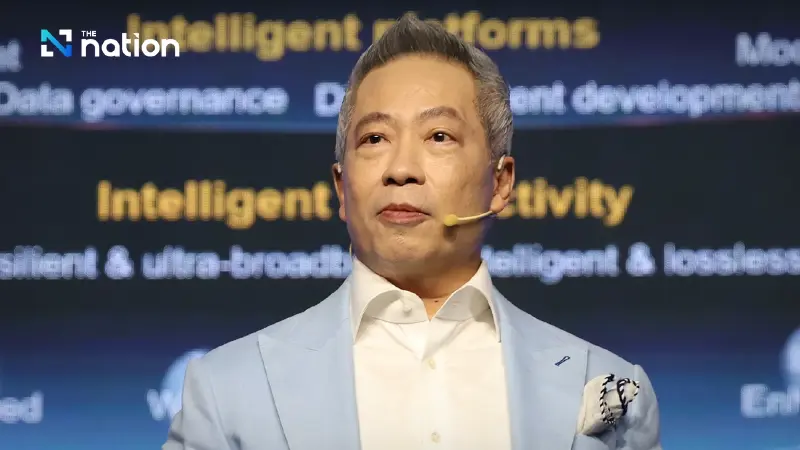


Huawei is promoting its “In Thailand, For Thailand” vision, using AI and digital technology to create sustainable economic impact through industry-specific solutions in finance, smart manufacturing and energy.
Huawei sees digital technology not as a passing trend or temporary fashion, but as a tool for creating sustainable economic impact, said Dr Chawapol Jariyawiroj, president of Huawei Technologies (Thailand).
He made the remarks during the AI Revolution Shift 2026: Shaking the Global Economy seminar, organised by Bangkokbiznews on Tuesday (March 31).
As a technology company working across multiple dimensions of the digital landscape, Chawapol said Huawei has set a clear vision of using these technologies to create “sustainable impact” for the economies of individual countries, particularly Thailand, under the concept of “In Thailand, For Thailand”.
This concept means that every technology brought into the country must meet the practical needs of both the public and private sectors and must help drive the country forward in a tangible way, rather than simply appearing modern without generating real economic impact.
Chawapol said Huawei’s view of AI and digital transformation therefore focuses on developing industry-specific AI, designed around the needs of each sector. Over the past two to three years, many solutions have moved beyond the trial stage and are now being deployed in real-world settings and maturing across several industries.
This is particularly evident in the financial sector, which is undergoing a major transition, from core banking systems and credit card systems to the use of AI in fraud detection. These solutions are already in use in many countries and have begun to expand more clearly in Thailand over the past year.
Beyond finance, AI technology is also being applied in smart manufacturing, oil and gas, and other large-scale industries.

He stressed that AI is not the whole answer, but only one part of a much broader technological ecosystem. Equally important is data capture. In the past, large volumes of data were lost or left unused. As a result, devices and device-level technologies capable of collecting raw data from real usage behaviour have become a crucial foundation of the digital economy.
Data drawn from real behaviour is far more valuable than information gathered through conventional surveys and can be used to create new services and customer experiences, especially in the public sector, which needs to upgrade public services, and in the private sector, which must understand customer behaviour more deeply.
Chawapol explained that when data volumes become enormous, two further layers of technology are needed to support its use: connectivity and networks, such as 5G, Wi-Fi 7 and other networking technologies, to link data from every home, organisation and device. Only then does it move to the next layer of cloud, AI computing and AI models.
Without the first two infrastructure layers, talking about AI alone could be superficial, because the underlying systems would not yet be ready to support long-term growth.
As an example at city level, he said smart cities have now been developed in around 100 countries worldwide. Many major cities have been able to build digital twins, enabling city administrators to view real-time data on utilities, transport, safety and public services, and to assess both current and future city conditions more accurately.
He added that smart camera technology can also detect unusual behaviour, such as fights, illegal parking or abnormal incidents in public areas, while immediately identifying vehicle registration plates and locations. These systems can operate around the clock, effectively acting as permanent city surveillance staff.
Another example is high-speed rail. In China, robots are used to inspect components beneath trains every time they arrive at a station, taking images and analysing them immediately to identify which parts are beginning to show faults.
Cameras mounted on the trains can also inspect tracks along the route, making it possible to detect abnormal sections in advance, even across routes stretching thousands of kilometres.

In healthcare, digital technology and AI are already among the most widely adopted tools, from health monitoring through wearable devices and patient care outside hospitals to the use of behavioural data in diagnosis.
Today’s health devices can collect data throughout the day, allowing doctors to see patients’ real-life patterns rather than relying solely on verbal accounts, leading to more accurate diagnoses.
At the same time, as the world moves into an ageing society, the number of medical personnel will become insufficient relative to the number of patients.
Technology is therefore helping to shoulder the burden, whether through smartwatches, telemedicine, digital medical imaging or AI-assisted interpretation of test results, some of which can reach accuracy levels as high as 98%.
Chawapol also referred to digital human technology, which can create digital representations of doctors or specialists that speak multiple languages, use voices and faces resembling real individuals, and interact naturally in conversation.
This concept is now expanding into conversational banking, conversational healthcare and conversational retail, because conversation is the most natural form of communication for human beings.
In the retail sector, AI can evolve into smart retail, analysing customer behaviour in stores, monitoring employee performance, tracking products in real time and generating insights that help businesses and suppliers make more accurate decisions. The same concept can also be applied in manufacturing and other industries.
In the entertainment industry, AI is increasingly being used to create content, allowing smaller players with creative ideas to gain access to production tools and compete more easily with large companies. This represents a new opportunity for Thai SMEs.
On making these technologies a reality in Thailand, Chawapol said infrastructure investment is central. Huawei has continued to develop AI computing and chipsets, citing the CloudMatrix SuperPod as an example. It supports 384 NPUs and can scale up to supercluster level with vast numbers of chips, enabling large-scale AI processing for enterprises.
However, not every organisation can place its data on a public cloud, especially government bodies and organisations holding critical information. As a result, private AI computing architecture is necessary to ensure security and data sovereignty.
Meanwhile, the growth of AI computing also brings energy challenges. This makes energy technology for AI data centres another critical issue, particularly clean energy such as solar power and batteries, to support the long-term growth of AI while aligning with Thailand’s environmental goals.
Chawapol concluded that what matters most to Huawei is not declaring that AI has succeeded in any particular country, but ensuring that such technologies create genuine positive impact for the country concerned.
The goal of digital technology and AI does not end with showcasing innovation, but must extend deeply into the economy, industry, the public sector and the quality of life of Thai people, he concluded.
