
EEC links data centres to Thai growth over next five years
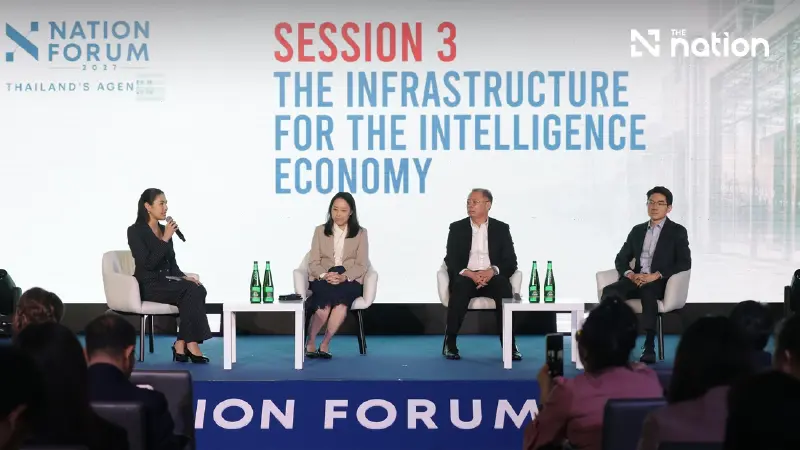


Chula Sukmanop expects healthcare services and efforts to attract skilled overseas professionals to drive Thailand’s growth over the next five years.
- The Eastern Economic Corridor Office (EECO) identifies data centres as an essential foundation for Thailand's intelligent economy and a key driver of national growth over the next five years.
- To attract digital investment, the EEC is prioritizing infrastructure development by designating specific zones for data centres, preparing tailored utilities like recycled water, and improving regulations for faster business setup.
- Energy provider PTT is preparing to supply the 300–800 megawatts required by data centres, while private developers like Frasers Property are building smart industrial estates with reliable dual-source power supplies.
- The growth strategy leverages Thailand's existing industrial ecosystem and strong supply chains, with leaders calling for accelerated workforce upskilling and flexible regulations to support high-tech investment.
Dr Chula Sukmanop, Secretary-General of the Eastern Economic Corridor Office (EECO), explained that data centres would provide an essential foundation for the intelligent economy. Looking ahead over the next five years, he expected Thailand's growth to be driven by the development of interconnected service sectors, including medical services and healthcare, alongside efforts to attract skilled professionals from overseas.
Chula was speaking during “The Infrastructure for the Intelligence Economy”, a data centre panel at Nation Forum 2027, organised by Nation Group on Tuesday (October 20, 2026).
EEC aligns utilities and zoning with digital investment

Infrastructure development in the Eastern Economic Corridor (EEC) must extend beyond manufacturing to cover the entire supporting ecosystem, including electricity, water, transport and communications, Chula said.
Chula outlined three priorities for the EEC: designating areas for digital industries and data centres near energy networks and underground power cables without affecting other areas; preparing utilities tailored to different industries to make investment more targeted; and improving laws and regulations so businesses can establish operations quickly.
The EEC’s current land-use planning framework falls within its 2023–2027 five-year development plan, Chula said. Modern industrial-estate management must also consider the relationship between core industries, their supporting businesses and neighbouring communities.
Chula compared the main factories to an egg’s “yolk” and the surrounding supply chains and industrial ecosystem to its “white”. Alongside these two layers, local communities must be supported so residents and industrial operations can coexist sustainably.
On water management, Chula said the EEC was working with financial institutions, securing reserve water sources and developing ways to treat community wastewater for supply specifically to data centres.
Two recycled-water projects have reached the contract-signing stage, Chula said. The projects are intended to reduce costs for investors without competing with residents for tap water.
Frasers Property develops 1,200-rai industrial project

Kamonkarn Kongkathong, managing director of Frasers Property Industrial Estate Co, Ltd, outlined an approximately 1,200-rai development designed as an industrial city, combining an industrial park, ready-to-rent hybrid factories, commercial space and a community centre at the heart of the project.
Smart industrial estates represent a new business direction for the company, Kamonkarn said, drawing on experience in property and industrial-estate development in more than 20 countries.
The Frasers Property project targets global customers in high technology, advanced manufacturing, data centres and electronics, Kamonkarn said. The development emphasises environmental, social and governance (ESG) principles, environmental protection and sustainable development alongside neighbouring communities.
Frasers Property’s infrastructure partners include PTT Public Company Limited for gas pipelines, Advanced Info Service (AIS) for 4G, 5G and fibre-optic networks, the Metropolitan Waterworks Authority and the Metropolitan Electricity Authority (MEA), Kamonkarn said.
MEA is providing 115-kilovolt and 24-kilovolt power connections to the project, which prioritises a dual-source electricity supply to maximise reliability for high-tech industries, Kamonkarn said. Green spaces and facilities supporting work-life balance are also being incorporated to meet the needs of skilled personnel.
Kamonkarn identified Thailand’s established industrial ecosystem and strong supply chains as competitive advantages. Thai workers could build on existing capabilities in semiconductors, electronics and the automotive industry, supported by investment policies she described as clear and accessible to foreign companies.
“Thailand’s appeal lies in the strong ecosystem and supply chains we already have. When foreign investors enter the country, they can build on these foundations quickly and gain immediate access to business partners,” Kamonkarn said.
PTT prepares energy supplies for 300–800MW data centres

Apiwat Detwarasiti, executive vice president for natural gas business planning at PTT Public Company Limited, said the company was ready to plan energy supplies for power-intensive industries, including data centres requiring 300–800 megawatts (MW).
Maintaining Thailand’s energy standards and security remains PTT’s core responsibility, Apiwat said. Although the country has domestic natural gas resources, additional imports of liquefied natural gas (LNG) are needed to meet rising demand and manage risks.
Apiwat described natural gas as a transitional fuel that would help maintain stability in both energy prices and supply volumes.
“Securing and importing additional energy is not simply about meeting rising demand. It is also about managing risks associated with both prices and supply volumes,” Apiwat said.
PTT has used cold energy available during LNG regasification to grow cold-climate plants and is exploring cooling applications for data centres and factories near LNG terminals through sandbox projects, Apiwat said.
Apiwat outlined three approaches to PTT’s net-zero objective: reducing emissions from existing production processes; increasing the share of investment in clean and renewable energy; and studying and developing carbon capture and storage (CCS) and carbon capture, utilisation and storage (CCUS) projects.
“PTT is working towards net zero by studying CCS projects,” Apiwat said, describing research into capturing carbon dioxide for storage in the Gulf of Thailand to respond to global technological developments and carbon requirements.
Nation Forum speakers call for skills and regulatory reforms
Kamonkarn called for faster workforce development, while Chula identified flexible regulations as the most important requirement for supporting high-tech investment. Kamonkarn said the government, private sector and educational institutions should work together to accelerate upskilling and reskilling in line with industry needs.
Apiwat called for greater clarity over energy-pricing structures, government policy and designated investment locations so large infrastructure projects can be planned and developed as efficiently as possible.
Chula said laws and regulations must keep pace with emerging technologies and innovation, enabling policymakers, regulators and operators to work together quickly.
