
Robotics could lift Thai productivity but require careful planning
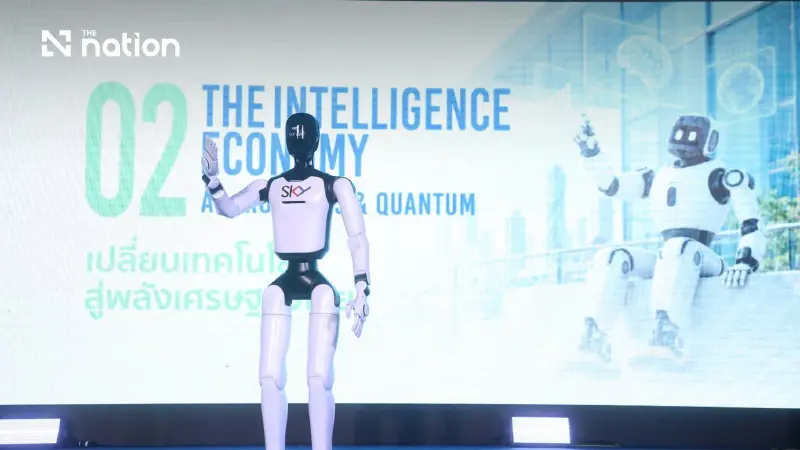


Executives at Nation Forum 2027 explain how Thai businesses can adopt AI-powered robots, improve productivity and manage investment and workforce risks.
- AI-powered robotics could boost Thailand's productivity and ease labour shortages, but their success depends on strategic planning and integration into core business operations.
- For businesses to benefit, investments in robotics must deliver measurable results, such as improved efficiency and cost savings, rather than being adopted for technology's sake.
- Careful planning involves preparing the workforce by retraining staff for higher-skilled roles that complement automation, instead of simply making them redundant.
- Developing local skills through training initiatives is vital to support the technology's growth and ensure long-term success without relying solely on imported machines.
AI-powered robots could help Thai businesses increase productivity, ease labour shortages and develop new sources of income, but technology executives warned that the gains would depend on measurable returns, workforce preparation and integration into everyday operations.
The opportunities and risks were explored in a discussion titled “The Intelligence Economy: AI, Robotics and Quantum” during Nation Forum 2027: Thailand's Agenda in Bangkok on Tuesday (October 20). The speakers were Sithidej Mayalarp, chief executive officer of SKY ICT Public Company Limited, and Abel Deng, president for Asia-Pacific and the Middle East at AGIBOT.

Adoption must deliver measurable results
Sithidej argued that Thai businesses should move beyond using artificial intelligence (AI) for isolated tasks and instead embed it in their core operations. Investments, he explained, should be judged by measurable improvements in efficiency and productivity, as well as reductions in costs. Successful applications should then be expanded across the organisation.
“What matters is whether you can integrate your AI investment and produce measurable results, including efficiency, cost savings and higher productivity. The next step is to scale it, integrate it and move faster.”
He predicted a widening competitive divide from 2027 between countries able to put AI to work throughout their economies and those still struggling to adopt it.
To illustrate Thailand's challenge, he contrasted Thailand’s projected economic growth of 2.1% this year with Vietnam’s growth rate of about 8%. Although Thailand has ASEAN’s third-largest economy, he warned that its comparatively weak growth showed it could no longer rely on past advantages.
Sithidej acknowledged that calculating the return on investment from AI-powered humanoid robots remains difficult because there is no widely established benchmark. He compared the technology’s early development with that of cloud computing, whose business benefits became clearer as adoption expanded.
For now, companies could concentrate on immediate gains from reducing costs and repetitive work, while developing longer-term products and services that could generate new revenue within three to four years.
Robotics and the future of work
A SKY ICT subsidiary employs about 14,000 cleaning staff, and Sithidej identified robotic cleaning as a practical response to labour shortages.
He stressed that introducing machines need not mean dismissing employees, who could be reassigned to other sites or trained for better-paid work requiring greater judgement.
“When I talk about replacement, I do not mean letting people go. Staff can move to other sites or acquire higher-level skills for better-paid work that requires decisions rather than repetitive tasks.”
At airports, SKY ICT uses AI-based biometric identification, facial recognition and passenger validation to help passengers move more smoothly through security checkpoints. It also analyses live passenger data to help operators organise terminal space, shops and services more efficiently and increase commercial income.
Sithidej described humanoid robots that welcome passengers, provide directions and answer questions in more than 30 languages while working alongside airport ground staff. Such applications could enhance customer service without removing human involvement.
More complex work still requires substantial training. Through its collaboration with AGIBOT, SKY ICT is developing local robotics training capabilities and an AI data factory, alongside plans for an AI academy to build Thai skills rather than depend solely on imported machines.
One project involves teaching robots to lift, scan and place bags of different shapes and sizes on airport conveyor belts. Sithidej hoped the technology could be commercialised with major international aviation partners if development succeeded within the next one or two years.
Sithidej also proposed using robots for border patrols and hazardous tasks, such as bomb disposal and operations in areas with dangerous chemicals or radiation. The robots could undertake high-risk work in place of personnel while transmitting live video and immediate alerts to command centres.

From demonstrations to commercial deployment
Deng described 2026 as a turning point for embodied AI, which combines intelligent software with robots capable of performing physical tasks.
He identified three developments behind this change: connected generative AI models, improved hardware and batteries, and continuous data gathered from real-world deployment. According to Deng, some AGIBOT robots can operate continuously for as long as 10 hours.
“We see this year as the turning point of this AI embodiment because, for the first time, three key factors converge together in the same window.”
He distinguished three stages of corporate AI adoption: using it to complete individual tasks, integrating it into decision-making and services, and applying intelligent agents or robots directly to production.
The third stage, he argued, offered the greatest prospect of lasting productivity gains.
“As a business, if we aim for AI transformation, nobody can lag behind; everybody has to catch up. The faster you adopt technologies into your core processes to improve efficiency or creation, the better.”
Deng explained that humanoid robots need to do more than walk and communicate to be commercially useful. They must also manipulate objects and carry out physical work reliably, which makes real-world data and repeated training important.
As evidence of growing commercial use, he cited shipments of more than 8,600 AGIBOT robots in the first half of 2026 and more than 300 robots working in factories, where they had performed over 64,000 tasks.

Thailand's opportunity as a robotics hub
Deng pointed to Thailand 4.0, manufacturing promotion policies and the country's openness to new technology as foundations for adoption.
Sithidej also welcomed investment support from the Board of Investment, while stressing that firms still had to establish a workable business case.
Deng maintained that cooperation between technology developers, local businesses and investors would determine whether the country could become a regional centre for AI and robotics.
Both speakers emphasised that adoption should begin with practical business needs, not the appeal of owning advanced machines.
For Thai companies, the challenge is to identify tasks for which robots can deliver demonstrable benefits, prepare employees for changing roles, train systems for local conditions and expand successful uses before competitors move ahead.
