Sihasak Phuangketkeow leads Thai officials and businesses in Moscow, seeking wider trade, investment and progress on a Thailand-EAEU FTA
A high-level Thai delegation, led by its Foreign Minister, is visiting Moscow to renew a push for a free trade agreement (FTA) with the Eurasian Economic Union (EAEU).
During meetings with Russian and EAEU officials, Thailand urged the acceleration of technical preparations needed to begin formal FTA negotiations, a process that has seen little progress for a decade.
The FTA initiative is part of Thailand's strategy to diversify its economic partners and expand trade and investment with the five-nation bloc.
The talks also addressed removing existing bilateral trade barriers with Russia, the EAEU's largest member, focusing on issues like financial payments and agricultural standards.
Deputy Prime Minister and Foreign Minister Sihasak Phuangketkeow is leading Thai government and business representatives in Moscow to expand trade and investment with Russia while renewing Thailand’s push for negotiations on a free trade agreement with the Eurasian Economic Union (EAEU).
Sihasak is visiting Russia from August 12–15 and is due to co-chair the ninth session of the Thai-Russian Joint Commission on Bilateral Cooperation (JC) on Friday (August 14, 2026).
The commission has been identified by both governments as an important mechanism for advancing bilateral cooperation.
His delegation includes businesses in agriculture and food, energy, health and wellness.
Sihasak also held preparatory talks in Moscow with Thai private-sector representatives led by Poj Aramwattananont, chairman of the Thai Chamber of Commerce and Board of Trade of Thailand, and Kitti Tangjitrmaneesakda, senior vice-chairman of the Federation of Thai Industries.
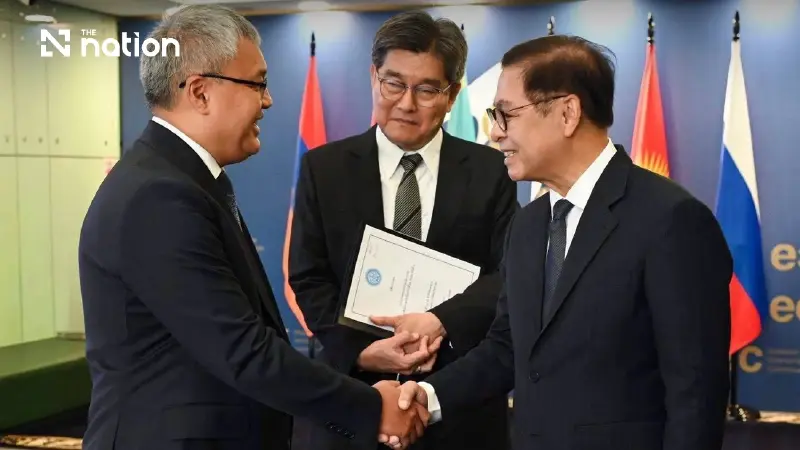
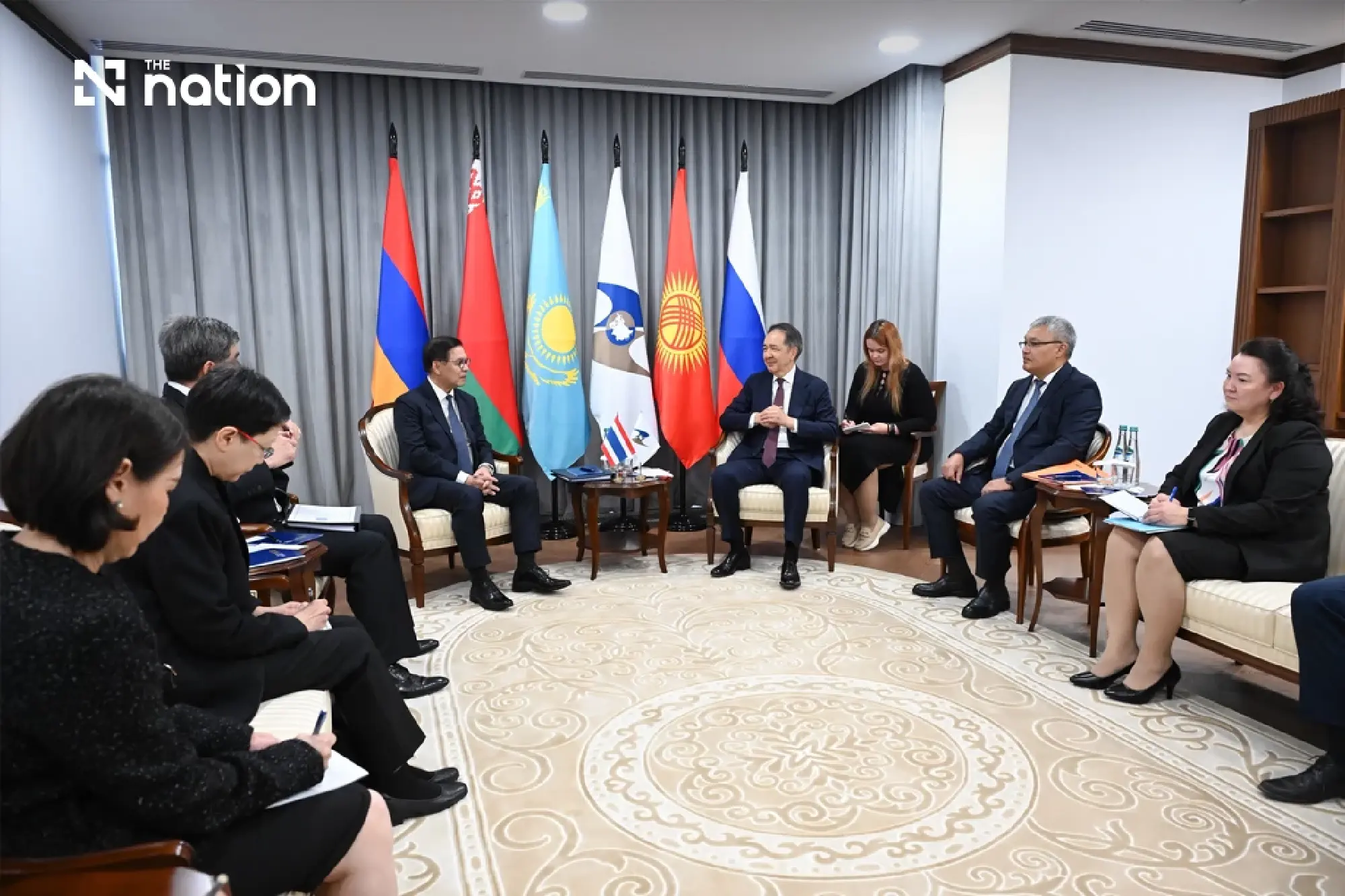
The visit has included meetings with Russian Deputy Prime Minister Alexander Novak and Bakytzhan Sagintayev, chairman of the Board of the Eurasian Economic Commission, focusing on trade, investment, agriculture, energy and ways to move the proposed Thailand-EAEU FTA forward.
Thailand renews decade-long EAEU FTA push
Sihasak told Sagintayev that Thailand wanted to begin FTA negotiations with the EAEU and called for technical work to be accelerated.
Thailand first signalled its intention to pursue an agreement with the bloc about a decade ago, but Sihasak said there had been little movement.
He renewed the issue during a visit to Kazakhstan two months ago and received support from Astana, which holds the chairmanship of EAEU governing bodies in 2026.
Technical work remains before formal negotiations can begin.
Sihasak said a joint study could take more than a year, followed by a further negotiating process if the study concludes that an agreement would be beneficial.
He therefore asked the EAEU secretariat to help accelerate preparations.
Thailand and the EAEU already have a joint working mechanism covering economic and trade issues, although Sihasak noted that it had not met for some time.
The two sides intend to revive cooperation through that mechanism in parallel with the FTA effort.
His talks with Sagintayev also covered artificial intelligence, e-commerce, connectivity and green energy, as well as closer cooperation between businesses.
The EAEU comprises Armenia, Belarus, Kazakhstan, Kyrgyzstan and Russia and operates a single economic integration framework covering the movement of goods, services, capital and labour.
The Eurasian Economic Commission is the bloc’s permanent regulatory body.
Thai-EAEU trade totalled US$2.047 billion in 2025, while the five-member bloc has a population of more than 180 million.
Thailand had already backed efforts to start Thailand-EAEU FTA negotiations during Prime Minister Anutin Charnvirakul’s talks with Russian President Vladimir Putin in Kazan in June.
Payments and standards remain barriers
Sihasak’s meeting with Novak focused on expanding Thai-Russian trade, investment, agriculture and energy cooperation while removing practical obstacles to doing business.
Russia wants Thailand to consider its potential as a major source of energy, including oil, gas and nuclear technology, Sihasak said.
Payment and financial transactions remain a significant obstacle.
Sihasak said the Russian side believed transactions could be structured without breaching sanctions, but the issue would require further discussions with Thai businesses over which payment arrangements they considered acceptable.
Agricultural trade presents another opportunity but also faces non-tariff barriers.
Thailand wants to increase agricultural and food exports to Russia, where Sihasak noted that Thai restaurants are popular and require Thai ingredients and seasonings.
Sanitary requirements and factory inspections remain an obstacle.
Russian authorities have already inspected Thai production facilities, while Thailand has yet to complete the corresponding process for Russian facilities seeking to export beef and pork to the Thai market.
A senior representative of Thailand’s Agriculture and Cooperatives Ministry joined the JC delegation to work on these issues.
Russian-language documentation is another practical hurdle identified during the visit, with both sides discussing ways to make trade and investment procedures easier.
Russia is Thailand’s 36th-largest trading partner and its largest trading partner within the EAEU, according to figures cited during the talks.
Thailand looks to diversify economic options
Sihasak described the EAEU market as an opportunity for Thailand to diversify its economic links at a time when trade negotiations with the United States remain difficult.
He said economic diplomacy had become a central task for the Foreign Ministry alongside its traditional political and security work.
Thailand is also positioning itself as a potential investment base for EAEU businesses as the Thai economy moves further towards digital and green industries.
“They see Thailand as a gateway to the ASEAN market,” Sihasak said, adding that ASEAN was attracting greater attention at a time of continuing geopolitical tensions, including conflict in the Middle East.
Thailand has previously promoted itself as a gateway for Russian businesses seeking wider access to Southeast Asia, while both governments have identified energy, technology, agriculture and investment as areas with further potential.
Sihasak and Novak also discussed cooperation through multilateral economic frameworks including BRICS, in which Thailand participates as a partner country.
Businesses seek deals in food, health and energy
Sihasak also met representatives of the Russia-Thailand Business Council, whose members expressed interest in expanding commercial links with Thailand.
Russian businesses taking part represented sectors including food, pharmaceuticals and energy, while Thai companies accompanying Sihasak are exploring opportunities to expand trade and investment in Russia.
Financial transactions and business regulations remain among their main concerns.
Sihasak said closer government-to-government contact could help remove some of those obstacles by improving rules and facilitating business, but private companies would ultimately drive actual trade and investment.
While Thai officials held government-level meetings, businesses accompanying the delegation also met Russian private-sector representatives to explore possible deals.
Sihasak described the parallel discussions as a starting point that could lead to further trade, investment and joint ventures if businesses continue to follow up after the visit.