
Saving Surin's Elephants, One Herbal Block at a Time
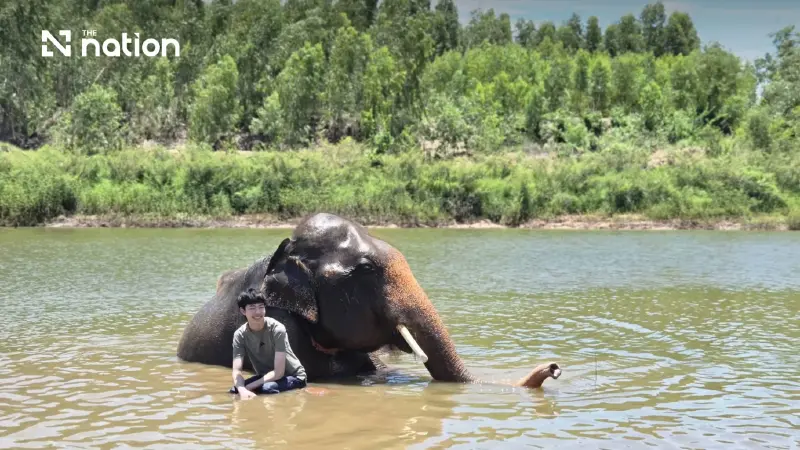


A 17-year-old Bangkok student blends traditional Thai herbs and biochemistry to fix a mineral deficiency threatening 200 domesticated elephants in Surin
- A 17-year-old student developed a herbal supplement block to address a mineral deficiency in over 200 domesticated elephants in Surin, which was causing them to eat dirt and suffer from gastrointestinal distress.
- The block is made from nine locally sourced Thai ingredients, such as tamarind and moringa, making it an affordable and sustainable solution that elephant keepers can produce themselves.
- Specifically formulated for elephant physiology, the supplement provides essential minerals and uses anti-inflammatory herbs to treat gut problems, proving more effective than the expensive, generic livestock blocks previously used.
- The supplement has successfully reduced bloating and diarrhoea in the elephants, and the project is now expanding to other provinces in Thailand.
By Nathakorn Pongsak (Papang),
Year 12, Shrewsbury International School Bangkok Riverside
A 17-year-old Bangkok student blends traditional Thai herbs and biochemistry to fix a mineral deficiency threatening 200 domesticated elephants in Surin.
Surin lies about 450 kilometres from Bangkok, in Thailand's lower northeast. It is flat, agricultural country: rice paddies stretching to the horizon, sugar palms standing like sentinels along the roads, and the occasional water buffalo chewing at overgrown grass.
The heat there is nothing like Bangkok's, which is filtered, bouncing off concrete and glass. Surin's heat is direct, pressing down from a wide, open sky with no towers to interrupt it. When I first stepped off the bus in Surin, my shirt was damp within minutes.
The elephant village I had come to visit sat a few kilometres outside the main town. A mahout — the traditional term for an elephant keeper — met me at the roadside, and we drove along a red dirt path between rows of palms until it opened onto a clearing where three elephants stood beneath rain trees.

A Bond Two Thousand Years in the Making
Thailand's domesticated elephants are no longer, in any meaningful sense, wild animals. Generations of captive breeding and human contact have altered them fundamentally.
Unlike their counterparts in the forests of Borneo or the savannahs of Sri Lanka, Surin's elephants have lost the instincts, the knowledge, and the physical conditioning needed to survive independently. They do not know how to find water across a dry season or which forest paths lead where. They have never had to.

This was the essential context for the nutritional problem I had come to investigate. These are not animals that can simply forage for what they need. They eat what their keepers can provide — within the limits of what those keepers can afford and access.
The Problem Beneath the Surface
An adult Asian elephant eats around 150 kilograms of food a day and needs a continuous supply of key mineral ions — sodium, calcium, magnesium, and phosphorus — for bone strength, muscle function, nerve signalling, and digestion.

In the wild, elephants top up their plant-based diets at natural salt licks, mineral-rich deposits in the soil. But in Surin, decades of soil depletion and shrinking forest cover have sharply reduced the mineral content of local salt licks.
To compensate, elephants resort to eating far more dirt — a behaviour known as geophagy — simply to reach the mineral intake they need. The result is chronic gastrointestinal distress: bloating, diarrhoea, and reduced appetite.
Mahout families typically respond by buying generic mineral blocks made for cattle and pigs, imported from outside the region. These offer only partial relief at best, since they are not formulated for elephant physiology, and their cost puts consistent use out of reach for many smallholder families. As things stand, only one specialist elephant doctor is responsible for the health of more than 200 elephants across Surin.

Building a Formula from Thai Soil
Working with the AKAYA Polyclinic Thai Traditional Medical Council and local agricultural researchers, I set out to develop a herbal supplement made entirely from plants native to, or widely grown in, Thailand. My aim was a product that was scientifically sound, tailored to elephant physiology, and cheap enough for mahout families to produce themselves—ideally from herbs they could grow on their own land.
Each 1.5-kilogram batch combines nine ingredients: ripe tamarind, which supplies calcium, magnesium, phosphorus, and sodium while supporting digestion; rice bran, an anti-inflammatory source of fibre, magnesium, phosphorus, and calcium; sea salt, for direct sodium replacement that removes the drive to consume excess soil; moringa leaf powder, one of the most calcium-dense plants available; black sesame powder, rich in calcium and magnesium; nut grass powder (haeo mu), traditionally used to treat gut inflammation and diarrhoea; fresh Tinospora crispa (boraphet), whose berberine alkaloids act as a natural anti-inflammatory and antimicrobial; turmeric, whose curcumin reduces gastrointestinal inflammation; and ripe banana with honey, which binds the mixture and makes it palatable.

A domesticated elephant's typical diet of sugarcane, banana stems, and grass supplies enough energy but is consistently short of sodium and often deficient in calcium, phosphorus, and magnesium.
This formula was designed to close those gaps directly, while the combined anti-inflammatory properties of tamarind, nut grass, turmeric, and Tinospora crispa address the gut inflammation that geophagy leaves behind.
Once mixed, the blocks can be dried at 50–60°C, giving them a shelf life of up to two months — long enough for mahout families to prepare batches in advance and store them affordably.

Results, and What Comes Next
Through collaboration with Play la Ploen, Elephant Kingdom Surin, the Zoological Park Organisation of Thailand, and the Surin–Ban Ta Klang Elephant Village — which works directly with mahout families for whom elephants are kept as household animals — the supplement has now been fed to more than 200 elephants across the Surin area.
Mahout families have reported fewer episodes of bloating and diarrhoea and noted that the elephants take to the blocks without resistance.
Each batch costs around 150 baht to produce, a fraction of the price of imported cattle and pig mineralblocks andd one that smallholder families can realistically sustain.
With the AKAYA Polyclinic Thai Traditional Medical Council having validated the formula's safety and its grounding in traditional practice, the project is now being extended into other provinces across Thailand.

Looking Ahead
This project began with a simple question about soil and salt licks, but it taught me something larger about how closely human and animal welfare are intertwined, especially in communities where resources are scarce.
I hope to keep researching and expanding my knowledge of food chemistry so that I can make a meaningful contribution to the food industry and to society more broadly. My goal is to take what I learn and turn it into sustainable, practical solutions — ones that improve the well-being not only of people but also of animals across the many ecosystems we share with them.
