
The Shot She Never Expected to Take
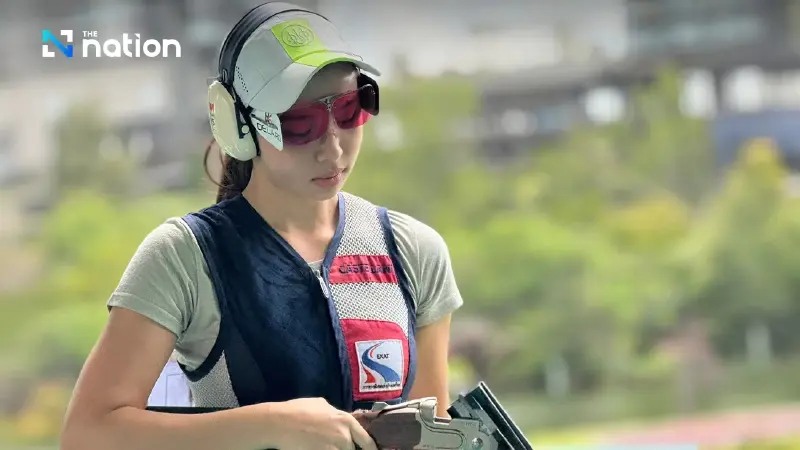


When a decade of swimming came to an abrupt end, Namon Eiamamornpan did not mourn for long. She picked up a shotgun — and discovered she was rather good with it
- Namon Eiamamornpan, a former competitive swimmer, unexpectedly took up trap shooting after her decade-long swimming career was cut short by injuries and the pandemic.
- She discovered her skills from swimming, such as focus and emotional control, translated surprisingly well to the new sport of shooting clay targets.
- Within four years of starting, the 18-year-old has won multiple gold and silver medals in trap shooting competitions across Southeast Asia.
- Alongside her rigorous athletic training, she successfully completed a science-mathematics program and gained admission to the prestigious Faculty of Law at Chulalongkorn University.
- The "shot" refers not only to the literal act of shooting but also to the unforeseen and successful new path she took in her life and athletic career.
When a decade of swimming came to an abrupt end, Namon Eiamamornpan did not mourn for long. She picked up a shotgun and discovered she was rather good with it.
She speaks softly, smiles easily, and carries herself with the unhurried composure of someone who has long since made peace with pressure.
Sitting across the table, Namon Eiamamornpan looks every bit the eighteen-year-old she is – shy, quietly luminous, and a little amused by the fuss.
Then she opens her mouth, and you understand immediately how she has spent the past four years collecting gold and silver medals across Southeast Asia while simultaneously finishing a science-mathematics programme and clearing the entrance examination for Chulalongkorn University's Faculty of Law.
The story begins not at a shooting range but in a swimming pool. From childhood, Namon was an athlete first. A serious illness at the age of two or three led her doctor to prescribe regular exercise; competitive swimming became the natural answer.

For years, the discipline of early mornings, repetitive laps, and race-day nerves shaped her sense of self. Then came COVID-19 and injuries and the quiet realisation that the path she had followed for a decade could not continue.
Around the age of fourteen, in Grade 8, she was introduced to trap shooting – the Olympic discipline in which a clay disc is launched from a mechanical thrower and the competitor has a fraction of a second to shatter it before it disappears from range.
The sport demanded exactly the qualities swimming had already instilled: focus, rhythm, and the ability to reset after a miss.

"Unlike swimming, trap shooting is heavily based on focus, emotional control, timing, and consistency under pressure," she says. "I realised that the athletic foundation I had built throughout my childhood translated surprisingly well."
That pivot — from a sport she had loved for a decade to one she had never considered — could have felt like defeat. She refuses to frame it that way.
"It was never something that came easily to me, and I still have many things to learn. Most of my progress came from constant practice, learning from my mistakes, and asking coaches for both technical and mental advice. What kept pushing me forward was not only the competition itself but also the satisfaction of seeing gradual improvement, little by little."

The work nobody sees
For the uninitiated, trap shooting can appear deceptively simple — raise the gun, call for the bird, and pull the trigger. Elite competitors know otherwise.
Training weeks for Namon extend well beyond time on the range. Gym sessions, swimming, yoga, and meditation sit alongside technical drills at the Hua Mark range – part of the Sports Authority of Thailand's national sporting complex – where she most commonly practises, and the more bucolic Photharam facility she privately prefers.
"The background, atmosphere, and variety of targets help me focus better," she says of Photharam. "Sometimes, being able to train quietly and think clearly is just as important as the shooting itself."
Away from the range, the sport follows her home.
"Most of the time, I am still 'shooting' in my head," she explains — visualising the stance, the call, the target, the trigger pull. Mental rehearsal, she insists, is not supplementary to physical practice; at the highest level, it is inseparable from it.
"I think many people only see the medals or competition results, but a lot of the real work happens quietly behind the scenes, both mentally and emotionally."

Lessons from Germany
Competing internationally before her eighteenth birthday, Namon has represented Thailand in the Philippines, Taiwan, and — most formatively — at the ISSF Junior World Cup in Germany, a trip made possible through the generous sponsorship of the Expressway Authority of Thailand (EXAT), whose support enabled her to compete on the world stage.
Europe presented conditions that no amount of Bangkok-range training could have prepared her for: cold air, fog, and an unfamiliar atmosphere. Her results disappointed her. She returns to the subject without self-pity but with remarkable clarity.

"Mental strength is not about never feeling nervous or uncomfortable. It is about continuing to perform and adapt even when conditions are difficult."
The experience sharpened her understanding of precisely what still needed fixing — technically and mentally both. That forensic honesty about her own shortcomings is striking in someone so young, and it points to a temperament built for two of the most demanding arenas imaginable: elite sport and the law.
On the subject of bad days more generally, she is equally clear-eyed.

"Failure is knowing you still have a dream but choosing to walk away from it because things became difficult." When a competition goes wrong, she allows herself to feel it fully. "I cry sometimes, even during practice or after a bad competition day. But I don't think crying means weakness. I think it means you cared enough to be hurt by it."
Then she comes back the next morning, because, as she puts it, one difficult period cannot decide her future unless she allows it to.

Targets and textbooks
Balancing international competitions with a science-mathematics curriculum required the same advance planning she applies to competition preparation.
Knowing the semester schedule from the outset, she would begin studying topics early, building a foundation before the pressure of exam season arrived.
"By managing my time early and staying disciplined with my schedule, I was still able to train seriously, prepare for competitions abroad, and also have some balance in my personal life."

There were sacrifices. She acknowledges without complaint that her teenage years looked quite different from those of her classmates — fewer late evenings out, more pre-dawn range sessions.
Yet she rejects any suggestion of regret.
"I chose this path by myself, and I always knew that my number one priority was shooting and achieving my goals. I understand myself quite well, and I know this lifestyle is better for me and for the future I want."

Next chapter: Chulalongkorn, Faculty of Law
This coming semester, Namon joins the Faculty of Law at Chulalongkorn University — one of the most competitive academic institutions in Thailand. The choice, she explains, was personal long before it was professional.
She has always been drawn to the questions beneath the surface of things: why fairness looks different depending on who you are, why opportunities are distributed so unevenly, how written rules can simultaneously protect and fail real human lives.
"Law speaks more to my inner thoughts — the side of me that is curious, observant, and always trying to understand the deeper reason behind things," she says.
She sees clear parallels with shooting: both require the ability to hold focus under pressure, both punish complacency, and both reward the competitor or advocate who has done the less visible work long before the decisive moment arrives.

Looking further ahead, she speaks of one day contributing to sports development or athlete welfare in Thailand — using law, as she puts it, to create better opportunities for the young athletes who will come after her.
"I understand personally how much athletes sacrifice and how many struggles people do not see behind the scenes."
For now, she will continue doing both — training with the national squad, reading cases, visualising the next target. For a young woman who rebuilt her sporting life from the rubble of one career's end, the idea of carrying two demanding paths simultaneously does not appear to frighten her in the slightest.
"One bad match cannot erase years of work," she says, with that same quiet smile, "and one difficult period cannot decide my future unless I allow it to."
She has not allowed it to yet. By any measure, she is only just beginning.
