
From Grandma's Near-Miss to National Impact: Meet the 16-Year-Old Who Is Rewriting the Rules of Tech for Good
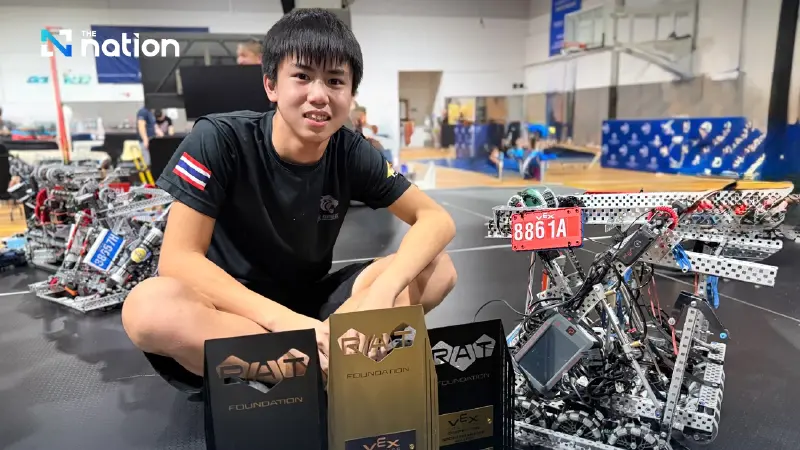


Alin Kasemtanakul, a 16-year-old from International School Bangkok, is turning robotics trophies and heartfelt family moments into technology that protects and heals communities
- Inspired by his grandmother nearly falling for an online scam, 16-year-old Alin Kasemtanakul created WhosSafe, an initiative that has taught over 300 elderly people in rural Thailand to recognize and avoid digital fraud.
- He developed a companion app, FraudGuard, which allows users to practice identifying scams in a safe, simulated environment, and partnered with Whoscall to provide free protection.
- Observing his grandmother's post-surgery recovery, Alin also designed a wearable rehabilitation tracker to help physicians monitor patients' exercises at home, winning an award at an MIT competition.
- His other projects include co-founding Sudor, a concept for a low-cost glucose monitor, reflecting his focus on creating simple, affordable, and accessible technology for communities in need.
Alin Kasemtanakul, a 16-year-old from International School Bangkok, is turning robotics trophies and heartfelt family moments into technology that protects and heals communities.
When Alin Kasemtanakul's grandmother nearly fell victim to an online scam, most teenagers might have brushed off the incident as a cautionary tale. Alin, 16, a student at International School Bangkok (ISB), saw it as a call to action.
"She wasn't careless," he says of his grandmother. "If someone tried to trick her face-to-face, she would be quick to identify it. But online scams work differently — they manipulate trust, kindness, and unfamiliarity with technology."
That moment planted the seed for WhosSafe, a community initiative that has since reached more than 300 elderly people in rural Thailand through hands-on workshops teaching them how to recognise and resist digital fraud.
It is just one chapter in a remarkable story of a young person who has made a habit of turning personal observations into tangible solutions.

Teaching Grandma — and Everyone Else
At the heart of WhosSafe is a simple but urgent premise: technology is advancing faster than many elderly Thais can keep up with. Younger generations grew up alongside smartphones, QR codes and online banking. Older generations did not, and scammers know it.
"They grew up in an analogue world," Alin explains. "Their trust and judgement were built from face-to-face conversations. Online, the scammer is basically invisible — you cannot judge whether they are really a bank officer, a police officer, or a government official just by reading or listening."


To address this, Alin secured a partnership with Whoscall, one of South-East Asia's leading scam-detection platforms, to provide free app subscriptions to workshop participants.
He also developed a companion mobile application called FraudGuard, which simulates real scam scenarios — fake SMS messages, suspicious links, and impersonation attempts — in a safe, consequence-free environment.
"Even if they understand the information, they need to be able to put it into practice," he says. "FraudGuard lets them make mistakes where the cost is not as high as it would be in a real scenario."

Wearables, Knees, and the 99 Per Cent Problem
Alin's grandmother appears again in another project — this time recovering from knee surgery. Watching her skip rehabilitation exercises at home because of the pain, Alin identified what he calls "the 99 per cent problem": almost all post-surgical rehabilitation happens at home, unsupervised, yet healthcare systems focus their attention on the one per cent that takes place in a clinic.
His response was a wearable rehabilitation tracker using dual IMU motion sensors to monitor patient movement over seven-day cycles, paired with a companion app that feeds data back to physicians.
The project earned second place at the prestigious MIT Media Lab Visionary Pitching Competition, where he presented a fully functioning prototype to an international panel of faculty.
"Wearable technology can bring healthcare into a patient's daily life instead of making them depend on hospital visits," he says. "The goal is to make health management more accessible—not only at the hospital."

Simplicity as Innovation
In 2025, Alin co-founded Sudor, a concept for a low-cost, non-invasive glucose monitoring system aimed at making continuous health tracking affordable for people in developing countries. The project reached the global Top 30 out of more than 23,000 entries in the Blue Ocean Competition.
Existing continuous glucose monitors can cost upwards of $200 and require repeated purchases of sensors, phone connectivity, and replacement parts — a serious barrier for those without robust health insurance.
Sudor stripped away the electronics entirely.
"Instead of asking how many advanced features we can add, we had to change our mindset to: what is the simplest version that can still actually help people?" Alin says. "Sometimes, innovation is making something simple, affordable, and reachable for the people who need it most — not just adding features."

The Robot Captain
Beyond his social impact projects, Alin is also one of Thailand's most decorated young robotics competitors. As team captain of VEX Robotics team Steel Panthers 8861A, he has led his squad to three consecutive Thai National Championships (2023, 2024, and 2025) and three World Championship qualifications, setting a record for the most awards won by a Thai team in a single season – ten in total.
His philosophy as a leader mirrors his philosophy as an engineer: assemble the right people, cultivate the right mindset, and never stop learning.
"I had to bring together people with different areas of expertise — programmers, strategists, notebookers, builders," he says. "One person cannot make a robot team successful. The real strength came from combining many skill sets into one complete team."
He also established a mentorship structure within Steel Panthers, where experienced members train newer recruits, ensuring the team's knowledge outlasts any individual.
The lessons from competing at VEX World Championships against the best teams on the planet were equally formative.
"The biggest lesson was that there is always someone who is better than you," he reflects. "The first time we went, we were immediately humbled. After that, we maintained the mindset that there is always someone better — and that kept us striving to improve."

Technology That Serves People
Across all of his projects, a consistent theme emerges: Alin is not interested in technology for its own sake. He is interested in what it can do for people who need it.
"I do not want technology to only be advanced or impressive," he says. "I want it to be practical, affordable, and useful to communities in need. The future should be about technology that is not only more advanced but also more human-centred."
For him, a successful project must be both technically robust and genuinely impactful. "Technical feasibility is the foundation. But the human impact — seeing the elderly participants become more confident, watching their expressions change — that is the most important part."
His advice to other young Thais with technical skills who do not know where to start? Begin with what you truly care about.
"The strongest projects came from problems I personally cared about. Because of that, I was willing to spend a lot of time on them — and I actually enjoyed the process. If you do not enjoy the work, it is really hard to create an impact you are truly proud of."
