
Senate panel urges scrapping of MOU43, citing legal flaws and disputed maps


An ad hoc Senate committee has unanimously urged Thailand to revoke MOU43, arguing the Thai-Cambodian border pact may be legally flawed and has failed to resolve disputes rooted in French-era maps.
Committee says border pact may never have been properly approved
An ad hoc Senate committee has unanimously called for the revocation of MOU43, saying the Thai-Cambodian border agreement may be legally flawed because it was never properly approved by Cabinet or Parliament, while its reliance on disputed French-era maps has deepened boundary disputes.
The Senate is due on Monday (May 18) to consider the committee’s study report on the pros and cons of revoking MOU43 and MOU44 as part of efforts to address long-running Thai-Cambodian border problems.
The report was prepared by the ad hoc committee chaired by Senator Noppadon Inna, which was set up to study whether Thailand should cancel the two memorandums of understanding with Cambodia.
MOU43, also known as MOU 2000 or MOU 2543, concerns the survey and demarcation of the land boundary between Thailand and Cambodia. It established a framework for both countries to work through the Joint Boundary Commission, or JBC, rather than drawing a new border by itself, according to Thailand’s Public Relations Department.
Cabinet ‘only acknowledged’ MOU43, report says
The committee said MOU43 had problems regarding its constitutionality and compliance with relevant laws because the Cabinet in 2000 allegedly only acknowledged the agreement, rather than formally approving it.
It also said the agreement was not submitted to Parliament for approval, even though the committee believes its acceptance of certain maps could affect Thai territory or state jurisdiction. The Senate agenda for May 18 includes the committee’s report and the panel has cited alleged constitutional problems as one of its key reasons for proposing revocation.

The committee argued that this made MOU43 more than a normal policy issue, as it raised questions over whether the agreement had been validly adopted in the first place.
French-era maps at centre of dispute
The study report said one of the most serious flaws in MOU43 was its reference to maps at a scale of 1:200,000, which the committee said were prepared by France and were not, in its view, maps formally produced from the work of the Siam-Indochina Boundary Demarcation Commission.
The committee said Thailand had never accepted before the signing of MOU43 that the 1:200,000-scale maps were binding maps produced from the boundary demarcation work. It also argued that the Thai-Cambodian boundary line shown in the Dangrek section of the map deviated significantly from actual geographical conditions.
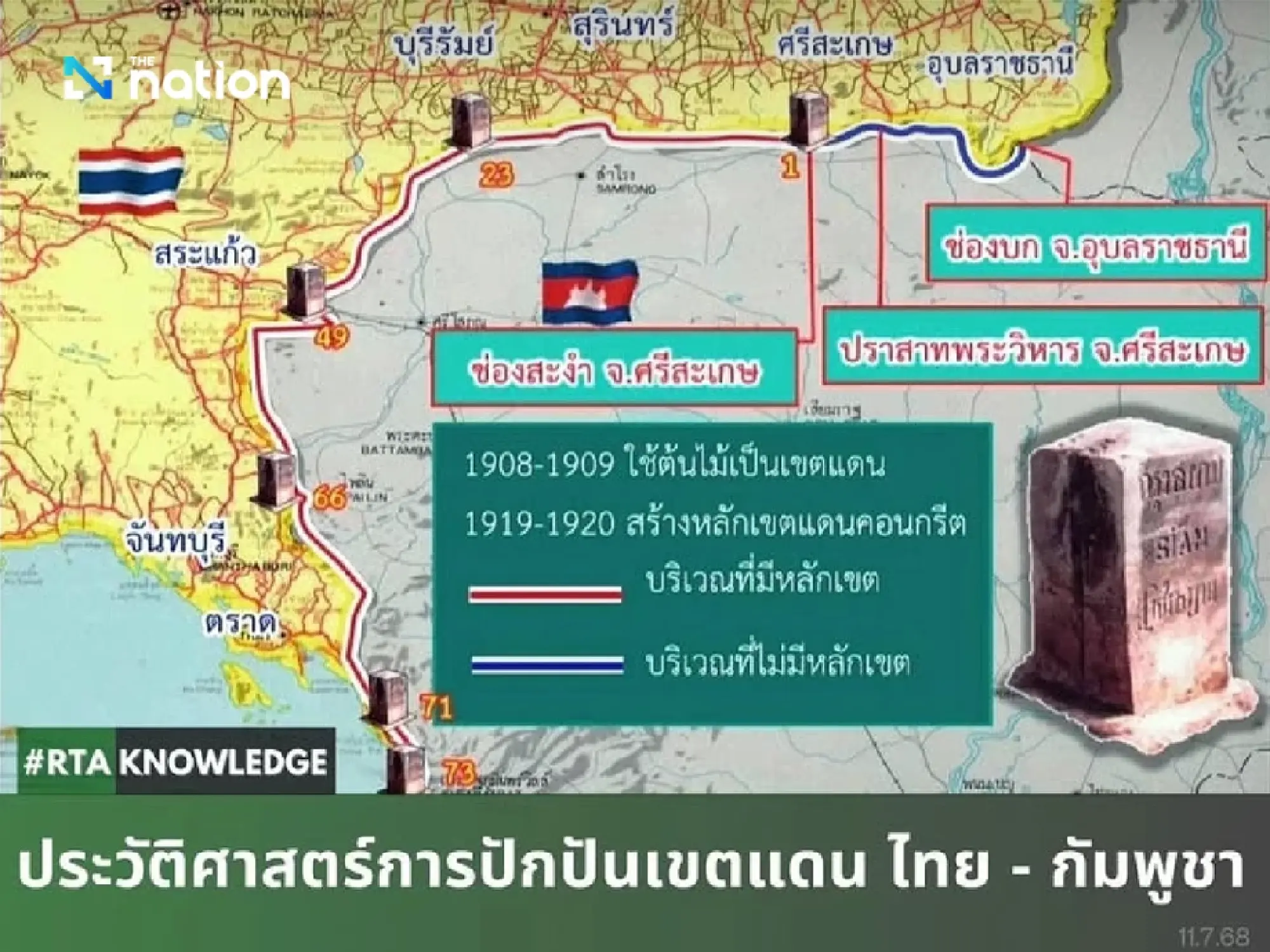
The map issue has long been central to Thai-Cambodian border tensions. Historical background published by Stanford University notes that the 1904 Franco-Siamese treaty referred to the watershed line of the Dangrek Mountains, while a later French-produced map showed a boundary that deviated from that watershed line and placed Preah Vihear on Cambodia’s side.
Panel says JBC lacks power to deal with encroachment claims
The committee also criticised MOU43 for defining the powers of the JBC too narrowly.
Although the JBC is the body responsible for dealing with the Thai-Cambodian land boundary, the committee said MOU43 did not give it sufficient authority to address alleged breaches involving encroachment or changes to the physical condition of border areas.
The study report alleged that Cambodian officials had repeatedly allowed or encouraged people on their side to move into border areas and alter local conditions. It said Thai officials had held talks and submitted protest letters many times, but that these efforts had not stopped the alleged actions.

Committee argues MOU43 has failed to deliver
The report said progress under MOU43 had been slow despite nearly 26 years since the agreement was signed in June 2000.
The committee said the survey and demarcation process remained far from complete and argued that the agreement had failed to prevent renewed tensions along the border.
It also said the situation had changed fundamentally after major clashes in 2025, making the old negotiating framework under MOU43 inadequate. A ceasefire has been in place since late December after two eruptions of fighting along the Thai-Cambodian border in 2025.
Joint Statement should be new reference point, panel says
The committee said Thailand and Cambodia should instead rely on the Joint Statement issued after the third special session of the General Border Committee, or GBC, on December 27, 2025.
Thailand’s Foreign Ministry said both countries reached an agreement at that GBC meeting, with the ceasefire taking effect at noon on December 27, 2025. The ministry also said the agreement included monitoring and mechanisms related to demining before any further boundary survey and demarcation.
The committee said Thailand should clearly state that the Joint Statement, the ceasefire framework and Thailand’s border-control measures should remain in place until negotiations on both the land and maritime boundaries are fully completed.
Cambodia’s constitution also cited
The committee also argued that maps produced under MOU43 may ultimately fail to receive approval from either side.
It said Cambodia’s 1993 Constitution refers to territorial integrity within borders defined by 1:100,000-scale maps made between 1933 and 1953 and internationally recognised between 1963 and 1969. Article 2 of Cambodia’s Constitution contains that map reference.
The committee argued that if new maps based on actual survey work followed the watershed line, Cambodia might not accept them because they could differ from the maps referred to in its Constitution. On the other hand, if the maps followed the disputed 1:200,000-scale maps, Thailand might not accept them.
For this reason, the committee concluded that continuing the MOU43 process could become futile.
Thailand could revoke MOU43 unilaterally, report says
The committee said Thailand could unilaterally revoke MOU43 by notifying Cambodia at least three months in advance.
During that period, Thailand could still negotiate with Cambodia to revise the agreement. If negotiations succeeded, Thailand could withdraw the revocation. If they failed, the revocation would proceed and Thailand would no longer be bound by MOU43, the committee said.
The report added that terminating MOU43 would not affect matters already agreed before the revocation.
Other border mechanisms would remain
The committee said Thailand and Cambodia would still have other treaties and bilateral mechanisms available after the cancellation of MOU43.
These include the 1904 Siam-France Convention, the 1907 Siam-France Treaty, the Thailand-Cambodia agreement of September 29, 1995, and the December 27, 2025 Joint Statement.
However, Thailand’s Public Relations Department has previously noted another view: that ending MOU43 would not free Thailand from obligations under the 1904 and 1907 treaties, and that the 1:200,000-scale map associated with those treaties would remain relevant.
Why the Thai-Cambodian border remains disputed
The Thai-Cambodian border dispute dates back to the early 20th century, when Siam and France, then the colonial power in Cambodia, signed treaties in 1904 and 1907 to define the frontier.
One of the most contentious areas is the Dangrek Mountains, including the area around Preah Vihear temple. Thailand has historically emphasised the watershed line, while Cambodia has relied heavily on French-era maps.
The dispute flared again in recent years, fuelled by competing historical interpretations, nationalist pressure and disagreement over whether unresolved areas should be handled through bilateral talks or international legal mechanisms.
MOU44 already revoked
The Senate debate also refers to MOU44, or MOU 2001, which concerns overlapping maritime claims in the Gulf of Thailand.
Thailand officially terminated MOU44 on May 5, 2026. The agreement was intended to create a framework for joint offshore energy exploration and maritime boundary talks, but had made little progress since it was signed in 2001.
The Senate will allow members to debate the committee’s report before voting on whether to forward it to the government and Cabinet for further consideration.
