
Bangkok steps up flood defences as extreme rain intensifies
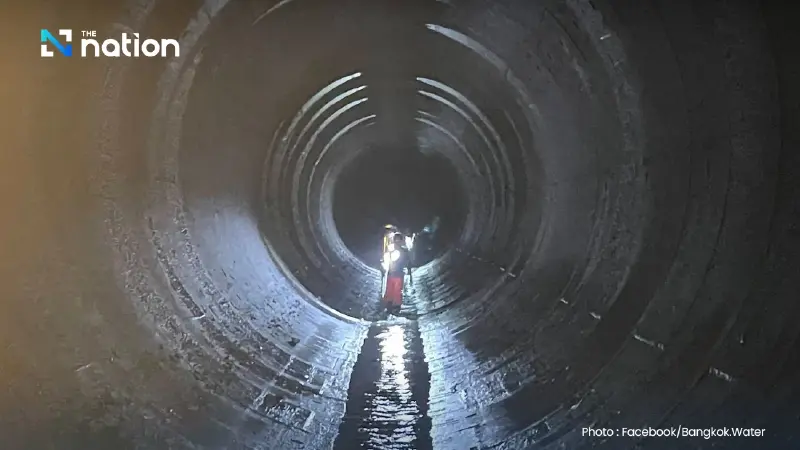


Bangkok is expanding its drainage tunnels, underground water banks and real-time monitoring systems to tackle extreme rainfall and reduce flood risks.
- Bangkok is upgrading its water management plan by developing large drainage tunnels and underground "Water Bank" retention systems to combat extreme rainfall and flooding.
- The city has increased its rainfall drainage capacity from 60mm to 80mm per hour, supported by new flood barriers that are higher than the 2011 peak flood levels.
- Advanced technology, including real-time monitoring at over 300 locations and weather radar for forecasting, is being used to improve response accuracy.
- To ensure continuous drainage, major pumping stations are equipped with dual power sources, while backup generators are ready for smaller stations in case of power failures.
“Rain bombs” and more frequent extreme downpours are becoming one of Bangkok’s key challenges, as the capital continues to face physical constraints due to its low-lying location close to sea level.
The city remains under pressure from three major water-related risks: runoff from the North, high tides and heavy rainfall, all of which continue to test Bangkok’s drainage system.
Jessada Chantharaprapha, director of the Bangkok Metropolitan Administration’s (BMA) Drainage and Sewerage Department, explained that the BMA was accelerating efforts to upgrade its “three waters” management plan through the development of large drainage tunnels, underground water-retention systems and real-time monitoring technology.
The measures are designed to improve drainage efficiency and reduce the risk of flooding across Bangkok.
Jessada was speaking at the seminar “Bangkok 2023–2034: The Next Great Flood”, organised by the Senate Committee on Public Administration.

Bangkok’s geography and the challenge of ‘three waters’
According to Jessada, Bangkok is located on the Chao Phraya River delta, with ground levels ranging from just 0 to 2 metres above mean sea level.
Survey data show that several areas on the Phra Nakhon side are low-lying basins, including parts of Ramkhamhaeng and Phetchaburi Road, while the Thonburi side is slightly higher.
The main causes of flooding today are linked to the so-called “three waters”:
- northern runoff flowing down major rivers;
- high tides affecting riverside areas;
- rainfall, which is now the most concerning factor due to “rain bomb” conditions and the urban heat island effect — phenomena that often trigger heavy evening rain in Bangkok.
Infrastructure and technology upgrades
Bangkok currently has a comprehensive flood-prevention system, including flood barriers along the Chao Phraya River that stand 2.80 to 3.50 metres high. These barriers are higher than the peak flood levels recorded in 2011.
The city has also introduced “giant tunnels” to serve as drainage expressways, carrying water from inner Bangkok directly into the river.
Four such tunnels are already in operation, while another at Bueng Nong Bon is undergoing system testing. Jessada noted that the project has helped ease flooding in the Udom Suk and Khlong Bang Na areas.
In addition to drainage tunnels, the BMA has introduced “Water Bank” systems, or large underground water-retention tanks, in low-lying areas. These include tanks beneath sports grounds and public parks around the Ratchada–Vibhavadi area, designed to absorb excess water during the first 15 minutes of heavy rainfall.

Drainage capacity increased
Jessada also confirmed that Bangkok had increased its rainfall drainage capacity from 60 millimetres per hour to 80 millimetres per hour.
The city has deployed automatic monitoring technology at more than 300 locations to track water conditions in real time, along with weather radar capable of forecasting rainfall up to three hours in advance to improve operational accuracy.
“We have drawn lessons from 2022, when rainfall was 40% above average, and used them to improve the system. Flood-risk spots have now been reduced from 481 to 256, and all remaining locations are being addressed under the 2025 budget plan,” he added.

Power supply and emergency readiness
Addressing concerns that power failures could affect water pumping, Jessada assured the public that major pumping stations are equipped with two power sources. If one supply fails, the other can immediately take over.
For smaller stations and roadside pumping pits, the BMA has prepared backup generators and mobile power-generation vehicles that can be deployed to ensure continuous drainage operations.
The public can monitor water and weather conditions in Bangkok around the clock through the Drainage and Sewerage Department’s website and the BMA Flood Control Centre’s social media channels.
