
NESDC urges wider senior housing options for ageing Thailand
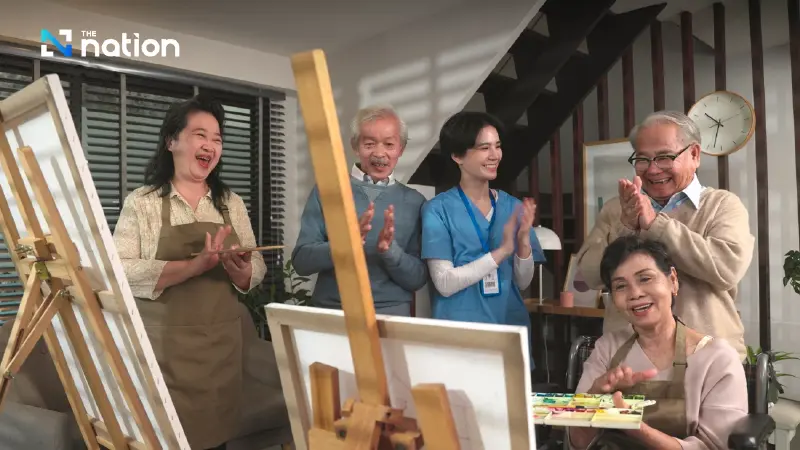


NESDC says ageing in place may not suit every case as more older Thais live alone and Gen Y and Z workers eye senior complexes.
- Thailand's shift to a super-aged society, with a rising number of seniors living alone, is making the traditional "ageing in place" model insufficient.
- Current senior housing facilities are limited, concentrated in large cities, often cater to high-income groups, and face overwhelming demand with long waiting lists.
- The NESDC proposes diversifying housing by involving the private sector and communities, citing international models like intergenerational living and family-based care.
- The government's "Older Persons Plus" policy aligns with this by planning to establish nationwide elderly care centers through private investment and tax incentives.
The Office of the National Economic and Social Development Council (NESDC), in its Thai Social Outlook report for the first quarter of 2026, reflected on senior housing in Thailand, saying a super-aged society is a major challenge in health, income and housing.
The state has focused on ageing in place, including home modifications, the development of care systems for dependent older people and schools for older persons.
Childless Gen Y and Z eye Senior Complex
But the migration of working-age people into economic hubs has made households smaller and reduced families’ capacity to care for older people.
National Statistical Office data found that older people living alone doubled from 6.3% in 2002 to 12.9% in 2024.
Ageing in place may therefore not answer every case.
A 2022 survey by the Institute for Population and Social Research at Mahidol University on expectations, planning and preparation among working-age people of different generations and living arrangements for later life found that 5.7% were interested in integrated senior housing, or Senior Complexes, while 1% expected to live in an older persons’ welfare home, especially Gen Y and Z, as they tend not to have children.
Another 56.1% wanted to remain in their existing homes.

Senior homes face constraints
Residential homes for older people who can care for themselves appear to be one option for older persons.
Thailand has 96 such projects, accommodating 16,000 people, with an overall occupancy rate of 87.8%.
Many projects focus on high-purchasing-power groups.
For state-run Ban Bang Khae, the 2026 data said applicants must wait 15 years, with around 6,000 people in the queue, while the capacity is 250.
However, senior homes still face key constraints.
- They are concentrated in large cities. Some provinces where the share of older people not working is higher than the national average, such as Nakhon Nayok, Phuket and Phang Nga, together have only 1% of service units nationwide.
- They are separated from original communities and familiar social networks. Some groups cannot build new relationships in new housing and lack interaction with other age groups, leading to depression and cognitive decline. If physical safety is overemphasised, the setting may resemble a medical facility more than a home.
Three proposals for senior housing development
The NESDC cited examples of interesting service models overseas, including:
- France: family-based care, or famille d’accueil, in which older people stay with carer families.
- The Netherlands: the Humanitas Deventer project, where students stay in older persons’ homes free of charge in exchange for spending time together.
- Germany: multi-generational meeting houses, community spaces where all age groups do activities together.
Thailand has the Lam Sonthi Model in Lop Buri province, involving collaboration among all sectors, including public health, local administrative organisations, village health volunteers, community carers and families.
The private sector and social enterprises (SEs) are also beginning to play a greater role, such as Joy Ride, an older persons’ transport service, and Yuenyen, a home-based end-of-life care service for older people.
It also proposed approaches for developing senior housing.
- Promote more diverse senior housing, allowing the private sector and communities to play a role through conditional support measures. Unused buildings could be developed into care centres.
- Develop community care networks, aimed at improving quality of life with broader coverage of social dimensions.
- Support SEs in developing intergenerational housing systems, particularly for older people living alone with spare space, such as housing-sharing systems with SEs acting as management intermediaries.
Watch the government’s “Older Persons Plus” policy
With the NESDC’s Thai Social Outlook report for the first quarter of 2026 presenting the issue of senior homes in this way, the public will have to watch whether the “Older Persons Plus” policy, good skills, jobs, income and carers, used by the government-leading Bhumjaithai Party in the last election campaign will materialise in a way that is “on target and appealing” to older Thais.
The policy was described as designed to support Thailand’s ageing society.
It includes hiring older people for work, or income for older persons, with employers of older people allowed to deduct expenses at twice the amount, up to THB30,000.
Older people with an annual income of no more than THB1.5 million would be eligible for tax relief of up to 50%.
Crucially, it includes establishing “elderly care centres nationwide” to accommodate the rising number of older people by using state land in locations with potential, opening opportunities for private investment and building integrated elderly care centres for the long term.
The state would promote investment through the Thailand Board of Investment (BOI), providing tax assistance to reduce private-sector costs, which would lower elderly care expenses while also creating jobs, careers and investment.
