
The Hills Rehab recognised for addiction care standards in Chiang Mai
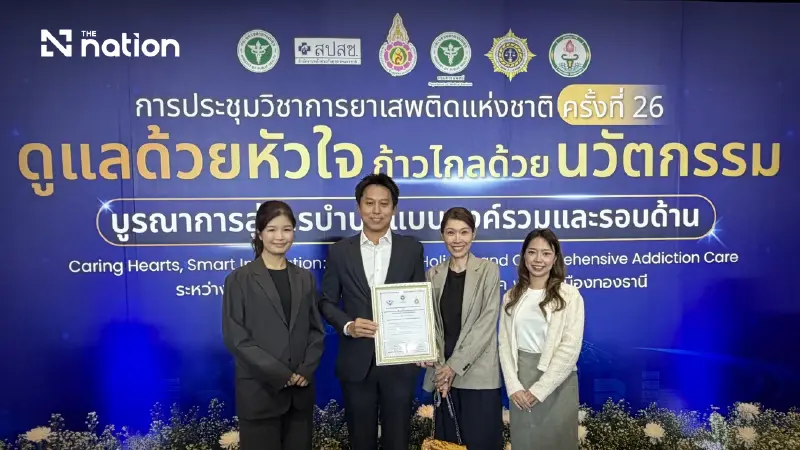


The Hills Rehab in Chiang Mai has received Thai public health certification, highlighting the role of screening, family support and relapse prevention in sustainable addiction recovery.
While tougher drug enforcement remains important, rehabilitation centres also play a crucial role in tackling addiction sustainably by helping people receive treatment and return to society with confidence.
The Hills Rehab, an inpatient treatment centre in Chiang Mai, has received certification as a drug treatment facility and drug rehabilitation centre, reflecting its role in supporting long-term responses to addiction in Thai society.
The certificate presentation ceremony was organised on Thursday (June 18) by the Princess Mother National Institute on Drug Abuse Treatment (PMNIDAT). The event, which recognises more than 400 quality-certified facilities each year, is regarded as one of Thailand’s major platforms for honouring drug treatment providers and strengthening safety standards in patient care.

In an exclusive interview with The Nation, Arina Lapsiriphon, Director of The Hills Rehab, described the certification as an important sign that the centre operates under Ministry of Public Health rules and standards, covering management, organisational structure, screening procedures and discharge planning.
“We follow public health standards at every stage,” she stressed. “This allows clients and their families to feel confident that if they send their loved ones to The Hills Rehab, they will receive proper care, remain safe and be supported in returning to society in a sustainable way.”
Arina added that the centre is inspected every three years, while staff must also keep pace with changing drug trends and new public health requirements, particularly those involving initial screening and relapse prevention. Clients entering rehab must be willing to receive treatment, she noted, while discharge decisions focus on whether they are ready to resume daily life safely.
The Hills Rehab is a 20-bed inpatient treatment centre for addiction and co-occurring conditions, with a focus on restoring both mental and physical health. The centre is located in the foothills of northern Thailand, in Chiang Mai, about 30 minutes from the airport.
The centre also plans to add 20 beds next year, expanding its capacity from 20 to 40 beds.
The centre has been operating for three years and has treated nearly 400 clients during that period. Most clients currently come from Canada, the United States and Europe, followed by Australia. Asian clients remain a smaller group, while Thai clients account for around 5-10%, depending on the period.

New substances make rehabilitation more complex
Asked about the challenges in rehabilitation, Arina highlighted the growing complexity of patient care and new forms of substance use.
Some clients are not addicted to only one substance, while others also have dual diagnoses, including mental health conditions linked to long-term substance use. She noted that some substances can affect brain function and contribute to mental health complications, making treatment more complicated.
“In the past, there was no vaping. There was only cigarette smoking. Later, vaping devices replaced cigarettes. Now we are seeing cases involving ketamine or other substances linked to vaping,” Arina explained.
She added that rehabilitation centres must continue studying emerging substances and usage patterns, especially during screening. If a client secretly brings substances into a rehab centre and staff fail to detect them, the treatment process may become less effective.
Another challenge for a centre serving many foreign clients is follow-up care after they return overseas. Unlike state rehabilitation services, which may have local officials who can visit patients at home, private centres face greater difficulty tracking foreign clients after discharge.
Arina said The Hills Rehab uses online follow-ups, AI-supported tools and virtual family sessions to continue monitoring both clients and families after treatment.

Holistic care covers mental health and families
Sansinee Chengthong, Head of Nursing at The Hills Rehab, explained that many addiction cases are complex and may involve both substance use and mental health symptoms.
She cited the example of a client who had used psychoactive substances for a long period and arrived with psychiatric symptoms. The centre’s psychiatrist assessed that the client first needed hospital care to stabilise their mental condition before returning to rehab.
Once the client returned, the centre continued to support both withdrawal management and psychiatric observation. Sansinee explained that close care includes monitoring symptoms, maintaining patient safety, creating a calm environment and ensuring regular psychiatric support.

The centre’s nurses are also trained in psychiatric assessment, allowing them to care for mental health symptoms alongside addiction treatment.
“Our care is holistic,” Sansinee explained. “That means we look after physical health and mental health, not only the addiction itself.”
Family involvement is another key part of the treatment process. Sansinee noted that while clients are receiving care at the centre, counsellors and psychotherapists stay in contact with families to update them on the client’s condition and conduct family therapy sessions.
Before clients complete the programme, the centre prepares a discharge plan covering medication, health follow-ups, ongoing care and issues that require caution. Support does not end immediately after discharge, as psychotherapists continue to follow up with clients after one month, three months or one year, depending on each case.

Family support seen as key to lasting recovery
Asked how rehabilitation can become more effective and help break the cycle of addiction in the long term, Arina said family support remains the most important factor.
She explained that while clients are at the centre, they are cared for by doctors, nurses and psychotherapists. But once they return home, families become the main source of support.
Families and communities must also change their attitudes, she added. People recovering from addiction should be seen as patients who need care, not as people who deserve punishment.
“I believe that if the people around them show understanding, solving this problem can become much more sustainable,” Arina concluded. “Once patients have received treatment, they will feel ready to return to life without pressure from those around them.”
The Hills Rehab added that families seeking help for loved ones can contact its specialist staff for a free and strictly confidential consultation by phone or WhatsApp at +66 80 387 8577, as part of efforts to help people recovering from addiction return to society with dignity and long-term support.
