
MRI scan for tiger in Bangkok hospital is 'first for Asia'
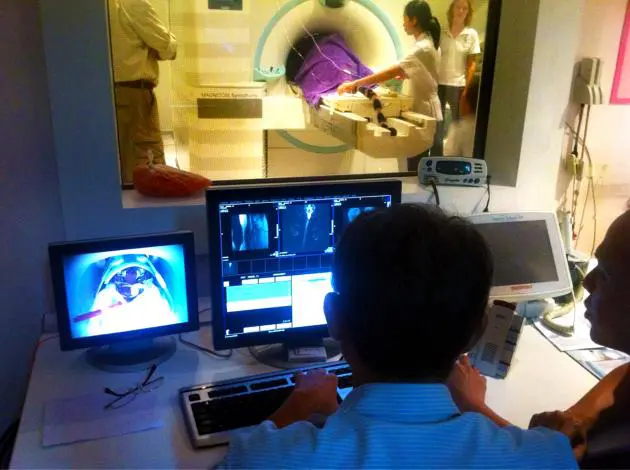


Getting an MRI scan is a fairly standard procedure for humans, but it's a rare event when it involves a fully grown tiger.
Doctors at a hospital in western Bangkok are believed to have set an Asian first last week when they did a scan – magnetic resonance imagining – to assess the condition of a tiger from a wildlife rescue centre in Phetchaburi.
The object of all this attention was Meow, a 12-year-old male tiger, who has lived for the past 11 years at Wat Khao Luk Chang, a reserve run by the Wildlife Friends Foundation of Thailand.
Meow was taken in for care after falling critically ill in 2001, when he was about 18 months old. WFFT secretary-general Edwin Wiek said Meow came from a petrol station in Cha-am, where he was kept on a chain and often photographed with customers.
The cub had suffered an unknown injury but recovered at the centre, where it could be seen walking around its large enclosure with a lopsided gait.
But to visitors and the many foreign volunteers working at the centre it was obvious that the animal had an affinity for Dutchman Wiek, the person who oversaw his care, and Nom, his keeper for over a decade. The animal was affectionate and would swim and play with its human friends in a nearby lake.
Things went well until a few months ago, when Meow became so ill he could no longer stand. Wiek was advised to put him down.
A resident in Thailand for 22 years, Wiek said he was aware that euthanasia “is not accepted within Buddhist culture”. He opted to change the cat’s medication and give it intensive physiotherapy, like they did when he first arrived.
Meow responded well, and got his appetite back, but Wiek wanted a full diagnosis. X-rays had shown abnormalities in its spine and neck, then a vet suggested he see if they could do an MRI scan. He rang a doctor at Chulalongkorn University, who got back to say it was possible – but it had to be done at night.
“The management was very happy to help us, but they were concerned that a tiger on a stretcher, even under sedation, would scare the human patients in the
hospital,” Wiek said.
Five vets and a nurse oversaw the process last Wednesday, which Wiek said was risky – Meow had to be anaesthetised and still for a 40-minute scan in a machine, into which he only just fitted.
The animal was calm, he said, despite the presence of many hospital staff “who couldn’t believe their eyes”. Meow stopped breathing, and for a moment he feared they had lost him, but the vets were prepared and got him breathing normally.
The process, at a hospital Wiek preferred not to name publicly because of some sensitivity, went smoothly and they were able to establish that “Meow has a fracture between Cervical 1 & 2 in his neck”.
Now, Wiek and surgeons are pondering an operation that would give the animal a good chance of living for another decade. The cost, he said, would be a lot more than the Bt25,000 it cost for the scan.
“But I think Chula will be very cooperative – everybody is thrilled about it,” Wiek said last night.
“They have done these – MRI scans – with juvenile tigers in the US. But it’s the first time this has been done in Asia. So it’s a bit of a first for Thailand.”
With the prospect of spinal surgery in the next 10 days, Meow is being fed well.
See: www.wfft.org/bears-nocturnal-animals/meow-a-tiger-undergoing-an-mri-scan/
