
Ties with Thaksin not behind rise to top of NSC: Paradorn
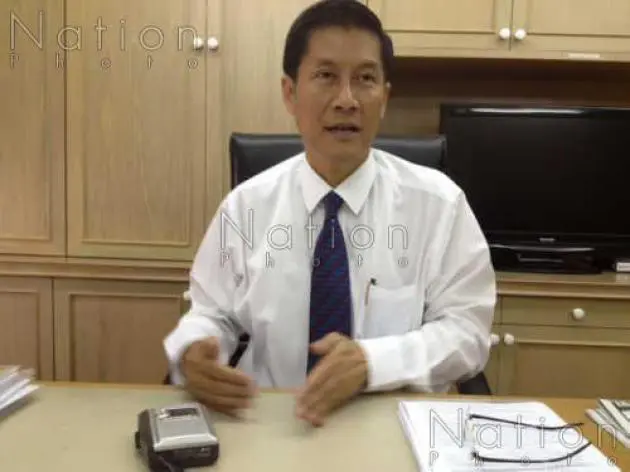


Lt-General Paradorn Pattanatha-butr is seen by his critics as having won the position of National Security Council (NSC) secretary-general because of his close ties with former prime minister Thaksin Shinawatra.
So they wonder whether he will be able to handle security affairs.He gave an interview to The Nation and introduced himself without waiting to be asked, saying straightaway:
Several people may be confused as to why I have risen to this position. I graduated from Class 14 of the Armed Forces Academies Preparatory School and graduated from Class 25 of the Chulachomklao Royal Military Academy. I am a classmate of Army Chief-of-Staff General Udomdej Sitabutr, Deputy Permanent Secretary for Defence General Nipha Thongle, Metropolitan Police Commissioner Pol Lt-General Khamronwit Thoopkrajang and the new commander of the National Peacekeeping Command. The Internal Security Operations Command (ISOC) and the NSC will have to work closely. I have been working for the NSC since 1991. I have been working here since I was a lieutenant-colonel. Compared to other former NSC chiefs, I have been working at the NSC far longer. I know officials here from the drivers to C-10 officials. So, some may feel worried because I know the characters of all NSC officials and know how they have risen up in their career path.
Have you been appointed because of political connections?
The most important qualification of an NSC chief is that he must win trust from the prime minister. This is a normal practice around the world, not just in Thailand. Knowledge and capabilities are debatable, but he must be trusted. This is because security affairs have to deal with “white”, “grey” and “black” operations. I am not saying they are unlawful, but they are confidential and cannot be made public, so the jobs need to be handled by a person that can be trusted so that secrets will not be leaked.
It has been rumoured that you were hand-picked for the NSC position by this government from the beginning.
It may be a case of multiple coincidences. First, I am qualified because I have been working here for years. Then, the government happens to wish to solve the security problems, especially problems in the deep South, which are being handled by the ISOC and the Southern Border Provinces Administrative Centre (SBPAC). I happened to be the best officer to co-ordinate the work of the ISOC and SBPAC. Pol Colonel Thawee Sodsong, the secretary-general of the SBPAC, was my junior colleague at the military pre-cadet school. I graduated from Class 14 and he gradated from Class 21. So, the situation required me in this position.
You are seen as having rising in your career path during the tenures of governments close to Thaksin.
It’s just coincidence. I happened to rise in rank when these governments were in office. If you ask about my ties with Thaksin, I’ll say Thaksin used to be a police officer who worked as an aide of my uncle, Preeda Pattanathabutr. Thaksin’s father, Lert Shinawatra, was a friend of my father, Lt-General Korbkul Pattanathabutr. … We have close ties because my parents live in Chiang Mai and our houses are not far apart so we know each other.
I have known Thaksin since we were young. Then, we studied in the military pre-cadet school together. [One of us was in Class 10 and the other in Class 14]. We happened to progress in our career path at the same time. It’s nothing more than that. Some might worry too much about this.
Have you met Thaksin recently?
To tell you the truth, I’ve not met him these days. I don’t have to meet him in person, but I think we know each other’s wishes. If you ask whether he helped push me to the position, I’ll say it’s true. But the situation also permitted it, so I was lucky.
What will your main missions as the NSC chief be?
Now, I must create unity between the ISOC, which is in charge of military operations, and the SBPAC, which is the development arm. I must find out how to have the two agencies move forward together smoothly in line with the main policies. If an experienced military officer, who has good understanding of civilians, police and military, works here, he will be able to create a balance and integrate the work of the two agencies. So, the operation centre for driving policies and strategies for solving the problems in the southern border provinces was set up, and I am now the secretary of the centre. We still have the same policies and strategies but we follow up on what has been done by all sides. What shall be done so that the ISOC and SBPAC will reach their goals fast? There must be a coordination centre. I’ll ensure that the central agencies will support the forward commands to solve the problems effectively. To do this, we will need support from 17 ministries and 66 agencies.
What do you think about the southern problems?
I think we are walking on the right path. All involved simply have to follow up on what has been done. We have clear strategies. The policy of understanding and reaching and developing the local people is a key strategy and we are using peaceful means. This strategy must continue and we will simply have to implement it with consistency. But we will have to have unity in the operations. Regarding the call for the lifting of the emergency decree, all of us have that goal because it is a special law. Don’t forget that the government has to view the situation in terms of the overall picture. But the government also has to set the condition for officials to work and to provide safety for the people. This special law is good in that it protects the officials in their operations. And military officers are not law enforcers but they have to come in to help police and civilian officials, whose number is inadequate. Since military officers step in to help, they must be protected by a special law.
All governments, including the Democrat administration, realised the call for the lifting of the emergency and wanted to do it but we have to consider the real situation. Even the Democrat-led government could not lift the emergency decree. The enforcement of a special law affected the confidence of the country. From now on, we will assess the enforcement of the emergency decree. Academics from Prince of Songkla University will help us evaluate and will conduct an opinion survey to find out whether the people want us to lift the emergency. The university has agreed to help us, as the academics also see the need to retain the emergency decree. But they see that the government must increase security measures to create safety zones. There are several conditions for lifting the emergency decree and after we lift it, we must not declare it again. It will create a lot of trouble if we declare the emergency again after lifting it for three or six months.
How do you view national security threats, which are caused by politics?
We have a policy that we will not lead the country to war – either internally or externally. The NSC must be in charge of the various political groups. We will be able to solve the problems better because we have learned lessons from the past. The past mistakes led our country to problems so we must solve the problems when they start brewing. We must do it by adhering to the laws. The laws must be respected and we must use both the rule of law and justice principle.
For example, when the clash between red-shirt and yellow-shirt people happened in front of the Crime Suppression Division, police should have made video records to see who was who. These were illegal acts and the case has a statute of limitations. The laws must be enforced fairly to both sides. Police must find out who hit whom first. Did the yellows hit the reds first? I’ve sent a message to police so next time this kind of incident must not happen. If it happens, police must enforce the laws strictly. Police could not be lenient because the violence could spread and the situation could get out of control and it would require a huge number of officers to handle the situation. In that case, police would not have enough forces and troops would have to be deployed to control the situation. We must prevent the situation from escalating to that point.
What are your security measures for dealing with terrorism?
Thailand is not a target of international terrorists. But Thailand is often used by terrorists because of our policy to promote tourism for the sake of the economy. Thais are hospitable and like parties so this could be a weak point. Now, they are protesting against a movie related to Islam. They want to use Thailand as a stage for holding protests. Now, we are monitoring these people. But it is lucky that those who are campaigning in Thailand have a record of using violence. If the issue is reported too often, they could be motivated to use violence. And if we warn them, those who like to use violence could join the fray. What should we do then? So, we have to send messages to foreign countries that we are ready to keep peace and in the mean time, we will have to seek understanding with these people as well.
Are there many real terrorists in Thailand?
Not many, I think. They just pass through and do not stay. We have to manage this well. If we think that it’s not good for them to be present in our country, we must push them out because they have not done anything illegal. We know they are present because the countries that they have problems with will alert us. We will push them out because problems could occur if they are arrested here. The case of Victor Bout [a Russian arms dealer sought by the US who was arrested in Thailand] was an example. It became entangled. We would be in trouble because we stand in the middle between two rivals, who are both superpowers. And we have interests in friendship with both countries, so we must be careful about our stand.
