
Bus operators risk passenger safety for profits: expert


Play
Most 8-wheel double-deckers are a lot higher than allowed, academic warns
Operators of private transport businesses in Thailand focus mostly on profits rather than passenger safety, while the assemblers of specially modified buses, particularly the widely used double-deckers, tend to use substandard materials and shun safety features to keep costs down, an expert on road safety and transport engineering said.
In the case of double-decker buses, the windows on the top deck have reinforced glass, which is difficult to break, making it tough for passengers to escape in case of an emergency, Assistant Professor Somprasong Sattayamallee said.
Plus, the additional weight of the reinforced glass on the top deck results in the bus not being properly balanced, he added.
As per Department of Land Transport requirements, modified double-decker buses with eight wheels, two of which are added on, should not exceed 4 metres in height, while buses with the standard six wheels should not exceed 3.6 metres in height.
Somprasong, quoting a bus assembler who did not want to be named, said most modified eight-wheel double-decker buses in Thailand were higher than 4.5 metres. Also, these buses seat between 50 and 55 passengers, when the standard is no more than 40, he said.
The assembly technician went on to say that up to 70 of the buses he had modified had a standard chassis with a normal 2.5-metre axle despite the additional height. To comply with safety standards given the extra height, the axle should be wider than 2.5 metres. However, wider chassis are only made overseas, which would make the job of modifying the bus more expensive.
“The tour-bus operators will not hire you if you use an expensive foreign-made chassis,” he explained.
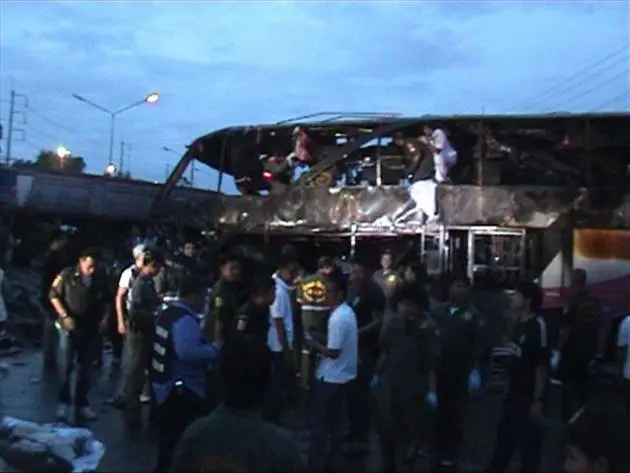
The safety of specially modified double-decked buses has raised concerns after several road accidents, especially the most recent one in Saraburi’s Kaeng Khoi district in which 19 people were burned to death and 22 others injured.
Transport Minister Chadchart Sittipunt, meanwhile, is encouraging private operators to install Global Positioning System devices on their buses as this would allow for efficient management of public transport and make it easier to track the vehicle in case of emergencies.
Of the 800 buses operating under the government concessionaire Trans-port Co, 731 have had GPS tracking devices installed. The ministry is aiming to require all new buses to be equipped with the system.
