
Marine agency plans to sue PTTGC


Play
Company told to take responsibility and provide full funding for recovery work
THE STATE MARINE watchdog agency is planning to file a lawsuit against PTT Global Chemical if it finds that the recent oil spill off Rayong has damaged the underwater ecosystem.
Meanwhile, the Natural Resources and Environment Ministry is calling on PTTGC to provide funding to help the coral reefs and marine life affected by the recent oil spill recover.
“We will most certainly file a lawsuit against PTTGC. We are now surveying the area to estimate the damage caused by the oil spill, and it will take about a year to work out the damage caused to the marine ecosystem,” Marine and Coastal Resources Department director-general Noppon Srisuk told a press conference yesterday.
He added that Natural Resources and Environment Minister Vichet Kasemthongsri had instructed him to monitor the impact of the oil spill on coral reefs and the marine system.
The minister, who formerly chaired PTT’s board of directors, has also asked PTTGC to take all responsibility to fund all the recovery work and help bring the damaged coral reefs back to normal.
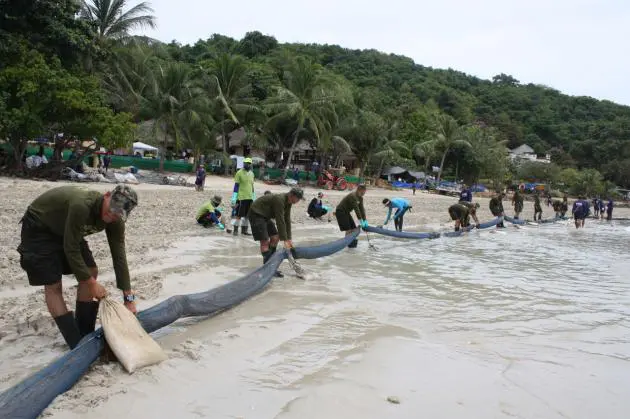
From August 2 to Wednesday, the department had been surveying Koh Samet’s Ao Phrao area to estimate the damage. The oil slick washed up in the area on July 28.
The survey team, which has covered an area of 50 square metres in the south of Ao Phrao, found that about 70 per cent of the coral reefs had suffered from bleaching.
“They [the coral] are not dead. They are just sick,” Noppon explained.
He added that though some kinds of coral would only take about a month to recover from the bleaching, others might take years depending on environmental conditions such as strong waves.
As a short-term measure to protect the coral, the department has installed several buoys to keep tourists and divers away from the area.
In a related development, the Aquatic Resources Research Institute of Chulalongkorn University will next week send a team of marine experts to conduct a parallel survey to study the impact of the oil spill in 13 spots surrounding Koh Samet and nearby areas. They will collect samples to study the existence of total petroleum hydrocarbon (TPH) and polycyclic aromatic hydrocarbons (PAHs) in the ecosystem.
Nantarika Chansue, a director of Chulalongkorn University’s Veterinary Medical Aquatic Animal Research Centre, said her team would also collect blood from sea turtles to look for contamination.
Fisheries Department recently revealed that the level of hydrocarbons in marine life near Koh Samet was normal.
