
Calls for end to stalemate


House Dissolution, PM's resignation, royal charter among solutions offered by experts
CALLS emerged yesterday for all the parties involved in the current round of political conflict to come together and attempt to find a way out for the country.
Some academics suggested a dissolution of the House of Representatives or the resignation of the prime minister.
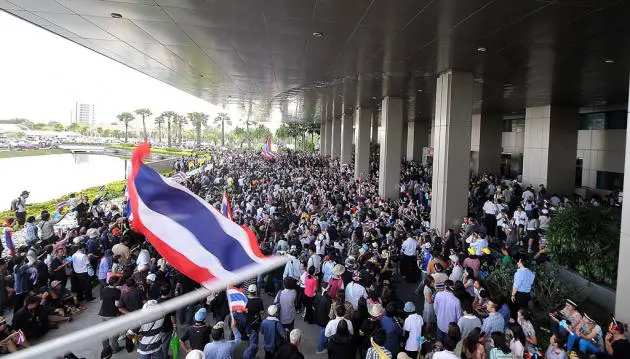
The calls for a solution came as the anti-government protesters laid siege to government offices in the capital for a third day yesterday.
The protesters besieged many ministries, calling on officials to join forces to help root out what they called the “Thaksin regime”. These included the ministries of Industry, Energy, Labour, Public Health, Commerce, Natural Resources and Environment, Social Development and Human Security, Science and Culture.
The protesters yesterday con-tinued to occupy the Finance Ministry and the Government Complex.
Respected social critic Prawase Wasi said the current political situation was so volatile it could lead to chaos and turmoil. He called on the government, the opposition and the protesters to come together and find a solution for the country.
“All parties involved have to help prevent violence,” he said.
Prawase called on the parties involved to hold talks to prevent the country from heading towards disaster, and urged them to sign an agreement for a peaceful solution to the crisis.
“We should not allow more lives to be lost. There should be no repetition of violence,” he said.
Call for reforms
Saying that it was time for national reform, he suggested a coordination committee be formed to carry this out. “You need social pressure for reform, and now such pressure has occurred,” he added.
According to Prawase, such a national reform effort covering many problem areas would be a sustainable way out of the political crisis.
Thammasat University rector Somkit Lertpaithoon urged the government to relinquish power, either through a House dissolu-
tion or the resignations of key
figures.
Srinakharinwirot University vice president Chanwit Tiamboonprasert said the prime minister and the speakers of both Houses of Parliament (the Parliament president and his vice-president) should step down to accept responsibility for the unconstitutional charter-amendment drive.
Some 20 elected and appointed senators called for the rival camps to seek a resolution to the conflict through talks.
The 20 voiced concern the protests would spiral out of control.
Senator Narumol Siriwat said the government should take a lead to initiate negotiations with its opponents.
Narumol suggested the government involve leading and respectable figures to facilitate the talks.
Senator Yootana Thaipakdi called on the government to dissolve the House following the censure debate.
Leading academic Amorn Chandara-somboon said yesterday the only way out of the political turbulence was to petition for a royally bestowed Reformed Constitution.
Amorn, also an honorary member of the Mahidol University Council, said his idea was not the same as a past call for a royally appointed prime minister.
“What I mean is to petition the King to name a security committee in charge of reforming Thailand,” he said.
He said the petition should also ask the monarch to appoint a legal panel comprising constitutional law experts tasked with framing a reformed charter.
The legal panel would handle the charter rewrite, while a security committee would administer and implement reforms during the transition, he said.
The Privy Council president would counter-sign the royal command for the interim administration as well as the charter rewrite, he said.
He said that without reforms, the country would never escape the recurring turbulence triggered by what he described as a domination of the parliamentary system by capitalists.
Following reforms and a charter rewrite to get rid of this capitalist dictatorship, a national referendum should be held to reflect the people’s will for a “true” democracy, Amorn said.
Petitioning for royal intervention could be done in one of three ways – by Parliament, through a coup, or by soliciting four to five million signatures.
