
CDC picks German system
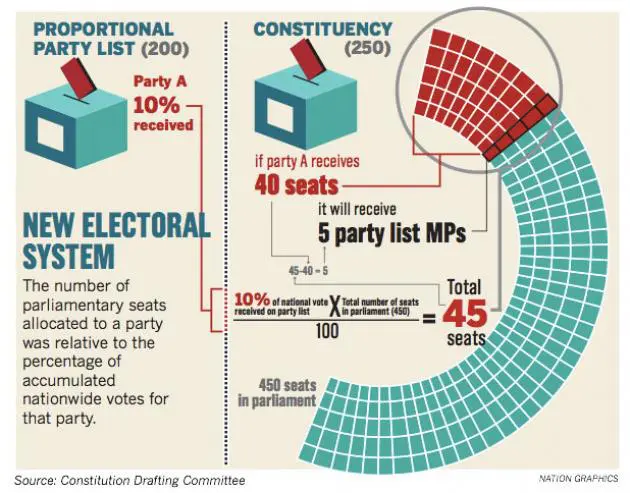


Change aims to make every vote count, encourage more independent candidates
The Constitution Drafting Committee (CDC) yesterday adopted the German style Mixed-Member Proportional (MMP) electoral system in Thailand to make an election reflect the aspirations of all voters while small parties and independent candidates would have a greater chance in the polls, CDC spokesman General Lertrat Ratanavanich said.
Like the previous system, there would be two types of MPs – 200 from proportional party list and 250 from constituencies, he said.
The party-list MPs would be elected by voters in eight geographical clusters throughout the nation, he said, adding there would be only one winner from one constituency, representing a population of 250,000.
Constituency candidates do not have to be members of any political parties but they have to represent a political group or association, he said.
As an example, Lertrat said the red-shirt United Front for Democracy Against Dictatorship, the yellow-shirt People’s Alliance for Democracy and the People’s Democratic Reform Committee can all field candidates in the election.
Thammasat University law lecturer Prinya Thevanarumitkul, who was invited by the CDC to give his opinion on the German-style electoral system, said there could be some independent candidates but in Germany it is very hard for them to win elections.
Asked if the CDC had considered the possibility of a political party buying independent MPs to seek their support for any particular cause, Lertrat said the committee would find some solutions to prevent such situations.
The previous electoral system usually produced clear majorities in the lower house, controlled by a few large parties. The downside, however, was that votes for the losing candidates counted for nothing, because of the “winner takes all” system.
The MMP system, in contrast, claims that every single vote will be taken into account, as the number of seats allocated to political parties in Parliament is commensurate with the proportion of votes each party receives nationwide. Hence the number of votes is better reflected in the House.
“The new system does not aim to weaken political parties but we don’t want too strong a government; the legislative and the
public should be able to perform checks and balance of power,” Lertrat said.
The number of parliamentary seats allocated to a party was relative to the percentage of accumulated nationwide votes in all eight clusters for that party.
If a party receives 10 per cent of votes in the entire country, the proportional calculation would allocate the party a total of 45 seats in the House of Representatives.
If the party won 40 seats in the constituencies, it would get an additional five seats for the party list. If the party won 45 seats or more, it would not get any more MPs from the party list.
“There could be a situation when parties could win seats from constituencies beyond their proportion and this could make the total number of MPs exceed 450,” Lertrat said. “In that case, we would allow the additional winners to sit in. If they comprise up to 30 [additional] seats, that would be okay.”
With the new electoral system, Lertrat said there would be no single party winning a huge majority in the lower house, adding the government would be formed by a coalition of few parties. “That wouldn’t be very different from the past when the government was always a coalition of many parties,” he said.
