
Drafting a charter for Thai-style democracy a challenge: Meechai


Play
Meechai invites public participation, but has banned the media
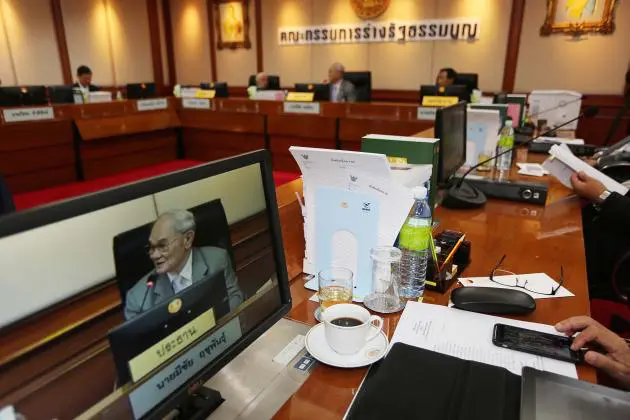
THE NEW chief charter drafter yesterday admitted it would be a challenge to write a new Constitution compatible with Thai-style democracy.
Constitution Drafting Committee (CDC)’s chairman Meechai Ruchupan said to write a new charter in line with Thai traditions, culture and lifestyle, would be very difficult – but the CDC would figure out how to do it and make it work.
“We [the CDC] agreed that it wasn’t possible to just follow or copy from Western constitutions. Thai society differed from other countries and we need to deliberate on how to make it work with Thai ways too,” he said.
The new CDC would trace as far back as the 1975 Constitution for a charter prototype, Meechai explained. The team considered the 1975 draft because it had been deemed the most democratic the country had ever drawn up.
Studying key principles
Concerning progress of the charter drafting, the chairman said that initially the team was looking at the main frameworks – Article 35 of the 2014 interim charter and the five principles passed down from the National Council for Peace and Order (NCPO).
After his team draws up the charter and its principles, they would pass the baton on to technical charter drafting groups. And finally, the 21-member CDC would give the draft its final touches, Meechai explained.
Asked if a new charter working alongside “Thai ways” would mean we needed some sort of a Big Brother to oversee us, Meechai replied he hadn’t yet thought about that aspect. He asked everyone to share their ideas as the panel was very open to opinions and participation.
The drafter chief went on to stress that the panel cared about the people’s voices. For example, should anyone have ideas about how the charter should be – or how to tackle corruption as one of the core principles the NCPO wished to see in the draft – the panel was ready to listen, he said.
Although the new committee gave importance to participation, Meechai insisted the CDC could not allow the media to observe meeting proceedings for now because of time limitations. However, he said he believed during its final processes the media could join in the meeting.
Meechai was seeking to have Borwornsak Uwanno as an adviser to his new panel but the former charter drafter chief was still hesitant.
After his draft was shot down last month, Borwornsak vowed not to take any role in the new round of Constitution drafting. He was reluctant to take the adviser role, fearing it might provoke criticism, Meechai said.
However, Meechai would ask his predecessor to the join the team as an individual who had worked with the 1997 charter drafting team – and not as the chief of the now defunct CDC.
“If you [the media] don’t mind, I will ask him again to reconsider. His acceptance could benefit the drafting,” Meechai said.
Eyeing previous drafters
The CDC chairman added he would also recruit some of those involved with writing of the 1997, 2007, and 2015 charters as advisers. The new panel could learn what the principles behind those drafts were. If there were some common points advantageous to the country, the new drafting panel would include them in the new draft, he said.
However, no official invitations had been sent to those people yet. The CDC was still waiting for the right time, Meechai said.
In a related development, CDC spokespersons Amorn Wanichwiwatana and Norachit Sinhaseni reported yesterday that to serve the framework and principles set for this new draft, they would invite agents from different affiliations to discuss problems facing the country, which the new charter could help solve.
Also, they said that the meeting agreed to set up another two sub bodies. One is to examine the legislative structure and the other for studying the executive, they said. Both bodies would work to study the pros and cons of different political regimes to help perfect the new Constitution, they said.
DRAFTING ROAD MAP
First working week-mid October: Charter drafting based on Article 35 of the interim charter and the five NCPO principles.
Mid October-November: Gathering of public opinion and various surveys
December: Article by Article charter deliberation.

