
Thailand cannabis draft law targets medical use and shop controls
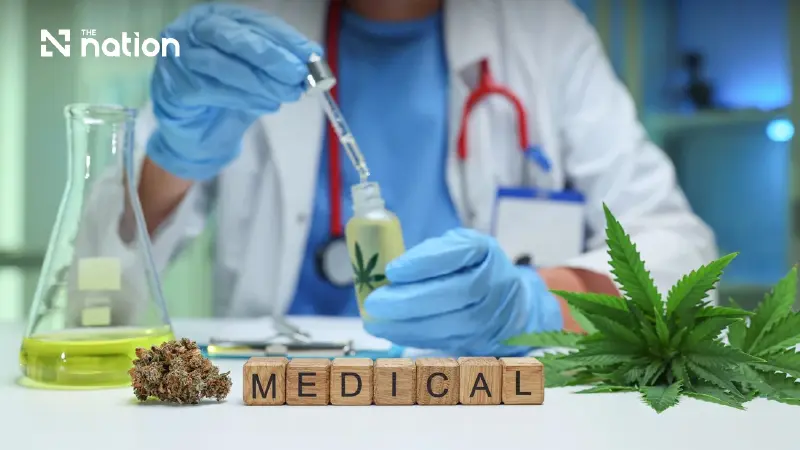


Public Health Minister Pattana Promphat says the draft law will cover cultivation, while officials move against unlicensed outlets and fake permits.
- Thailand is advancing a new draft law, the Cannabis and Hemp Act, to restrict cannabis use strictly to medical purposes and eliminate recreational sales.
- The bill will require cannabis shops to operate as medical facilities, with a doctor on-site to supervise the dispensing of cannabis products.
- Authorities are cracking down on thousands of illicit or unlicensed shops, using a GPS-based system to track legal outlets and increasing enforcement.
- The proposed legislation will expand controls to include the cultivation stage, which is not covered by current rules, and will impose high penalties for violations.

Pattana Promphat, Public Health Minister, pressed ahead with the draft Cannabis and Hemp Act on Tuesday (July 7, 2026), aiming to control cannabis for medical use only.
He ordered tighter oversight from source to destination after problems were found involving illegal transport abroad and the use of fake licences.
The ministry is also working with police and local authorities to accelerate a crackdown on illicit cannabis outlets and shops with expired licences, estimated at more than 6,000 nationwide, to prevent recreational cannabis use and speed up efforts to bring cannabis outlets into order through a GPS-based system.
Pattana confirmed that the Bhumjaithai Party’s cannabis policy would cover medical cannabis only.
He said the draft Cannabis and Hemp Control Act, which is set to go before Parliament, had already completed a public consultation early last month, but did not reach deliberation in the current session.
The bill would control cannabis from the cultivation stage.
The current framework relies on the Act on the protection and promotion of herbs and various ministerial regulations, which regulate sales, transfers and extraction, but do not yet cover cultivation.
The new bill would impose relatively high and serious penalties for violations.
Pattana stressed that both the Bhumjaithai Party and the government had a policy of medical cannabis only.
On the possibility of cannabis being returned to narcotics status, Pattana said the control bill must first be completed.
As for legislation that would return cannabis to narcotics status, it would likely fall under narcotics law, which is under the supervision of the Ministry of Justice.
On cases of cannabis flowing out of the country, Pattana said that although cannabis in Thailand is not currently a narcotic, it remains a narcotic in many destination countries.
Therefore, any movement must also be checked against the laws of the destination country.
For those illegally taking out large quantities for sale, the Department of Thai Traditional and Alternative Medicine has been coordinating continuously with the Customs Department and Airports of Thailand.
In the past, fake licences had been used in some cases, but the department now sends licences electronically only, which provides another layer of control.
He acknowledged, however, that if the volume was large, some cases might still slip through.
Pattana also referred to shops currently operating and selling cannabis. Since 2023, there have been 18,000 outlets, with about one-third, or around 6,000, expiring at the end of 2023.
Around 1,500 outlets had renewed their licences.
A licence is granted one period at a time, each for three calendar years, with around 6,000 outlets a year due to expire in 2026 and 2027.
The Ministry of Public Health has ordered an increase in authorised officers able to inspect and make arrests, including police and local administrative organisations, bringing the number to tens of thousands.
Regarding inspections, the Department of Thai Traditional and Alternative Medicine has placed all properly registered outlets on its website and pinned their GPS coordinates.
Details also show when each licence expires.
If any shop is not listed in these categories, it is considered not properly registered, and its operators can be arrested immediately.
Pattana added that properly registered outlets must adjust under the amended ministerial regulations by becoming medical facilities.
Doctors must be stationed there to supervise dispensing to people who need cannabis for medical use, making controls tighter.
This also aims to prevent large amounts of cannabis from being repeatedly supplied to the same person.
If such a pattern is found, it must be examined in detail, and if irregularities are found, legal action must follow.
For shops that have opened illegally and sell for recreational use, Pattana confirmed that they must face enforcement and arrest action.
If a shop is not registered and has not sought authorisation, action can be taken immediately.
