
From parking cars to wet laundry, bright young minds find an answer


Play
TO SOLVE daily household problems, smart high schoolers at Banna Nayok Pittayakorn School in Nakhon Nayok's Ban Na district have come up with prototypes of three inventions -an automatic watering machine, an automatic dry washing-collecting device and a
The three devices were unveiled last Friday during the Intel Galileo Gen 2 Board Toolkit workshop at Srinakharinwirot University’s Ongkharak campus, as part of the school’s computer course.
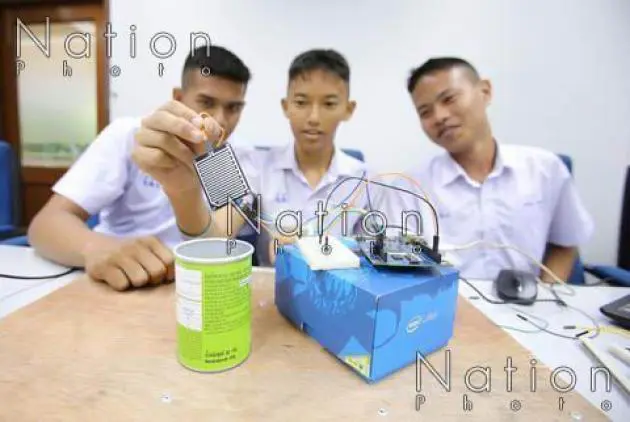
Mathayom 5 student Jatsada Iamdaad, who led the three-strong team which created the dry cloth-collecting device, told The Nation he was inspired by his mother’s request to collect dry laundry from clothes lines outside the house, while he was occupied playing a computer game.
“I was thinking that I needed something to help me get the task done, so I could continue playing my game without being interrupted,” the youngster said.
When the school launched a project calling for students’ original ideas to solve daily problems, Jatsada put his head together with friends Gittipich Ittipol and Thitipoom Gusolsong, while a teacher gave them guidance. They came up with a device prototype that could be built in two weeks and cost only Bt500 out of the Bt3,500 budget sponsored by Intel.
The youngster explained: “This device would be able to tell whether it was raining or not by measuring moisture in the air. It has a motor [which could then switch in] to run rolling lines of clothes that were drying outside, back indoors.”
For now, the prototype simply warned if it was raining, he said. It could be further developed by keeping records of air moisture levels on a daily basis or by access to the Meteorological Department’s data, he said. Eventually, he saw it as part of the team’s Smart House project to enable the electricity system in a house to easily support elderly residents.
Another team of Mathayom 5 students, Thananan Worrawongvuttikai, Sawate Sriwate, and Pennapa Sukpeng, built an automatic watering machine called “Water Plant”.
They told The Nation the initial idea was Sawate’s, who had been trying to work out the best time to water his vegetable garden. The prototype they created 10 months ago cost only Bt1,500 and had an Intel processor installed in it.
Sawate said the machine would measure moisture in the soil of the vegetable garden, and would automatically give water to plants when the soil was dry. It would stop watering when the measurement reading suggested a sufficient level of moisture in the soil.
Sawate also talked about developing this project further so the device’s watering system could be remotely controlled via a cell-phone.
The device could also have a function to measure temperature and light so as to boost the watering system’s accuracy, he said. A solar cell or a wind-wheel system could be adapted to generate power for the device, so it didn’t need to be plugged in to the main power supply.
Another team of Mathayom 6 students built a parking assistance system that can tell motorists where vacant parking lots are. The prototype cost students Nutthapol Wadkhian, Channarong Monmeesil, and Thanaphat Sanphet only Bt500 and took two weeks to make.
The prototype provided each parking lot with a sensor to detect cars. It will signal a red light if a car is already parked in a bay, while a green light signal meant space was available. The system could be also upgraded by adding more sensors to accurately detect cars, they said.
Computer science teacher Porntip Tongtidram said the project was part of a new computer course launched two years ago and backed initially by the Ministry of Information and Communication Technology and sponsored by Intel.
The project was aimed at encouraging students with high potential in computer and science studies, she said, adding the school had supported these students by providing computer coding courses, sending them to competitions, including some robot building contests.
The course started in 2013 with 180 selected students out of the school’s 2,600 students of Mathayom 1-6. Porntip said the school hoped to expand this kind of programme to other classrooms.
