
Chula’s new president plans a future of innovations for the top university


UNDER THE leadership of its new president, Chulalongkorn University (CU) has made it a mission to deliver a better life to people via innovations.
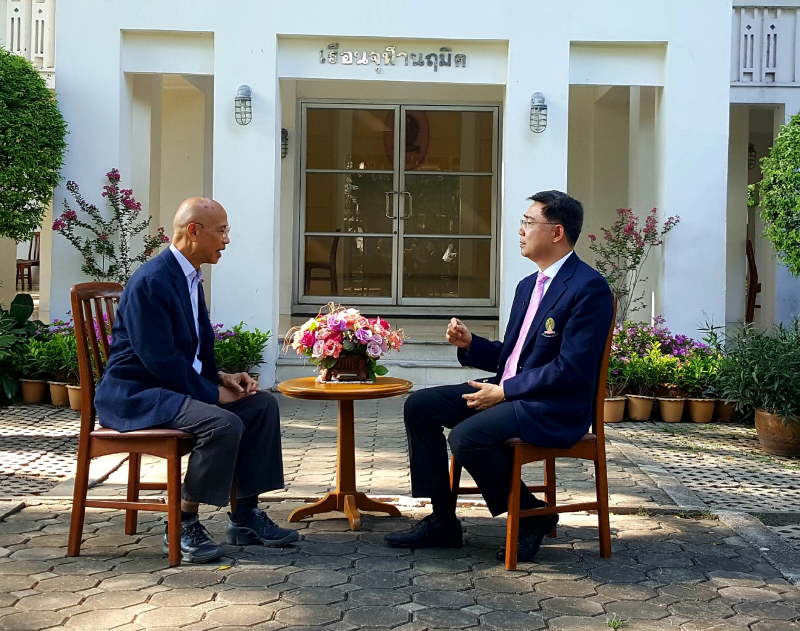
“We, together with our partners, will develop innovations so as to make it easier for people to live their lives or to enjoy a better quality of life,” Bundhit Eua-arporn, the university's new president, said in an exclusive interview with Suthichai Yoon, adviser to the Nation Multimedia Group's editorial board.
The interview will be broadcast on “Kom Chad Luek” show on Nation TV today.
In the interview, Bundhit said his vision is to transform CU into an “innovation centre”, which he says will not just enhance Thai society, but will also give the university a better spot in global rankings.
Last year, CU dropped 10 spots to the 253rd place in the QS University Rankings, with regional counterparts such as National University of Singapore (NUS) and Malaysia’ s University of Malaya (UM) outperforming it.
In QS's Asian university ranking, NUS and UM ranked 1st and 29th respectively, while CU – the best Thai academic institution – ended up in the 53rd place.
Years ago, CU and UM rankings were pretty close, but now UM has been rising fast with University of Indonesia trailing close behind CU, Bundhit noted.
He emphasised that CU has to start showing better performance if it aims to boost its ranking on the global stage.
“We [the university] have to help our society first, and the world will recognise that and accept us,” he said.
Bundhit took over as president of CU on Wednesday and has made it clear that he will pay attention to world standards as well as rankings.
He has recognised the need for CU to adjust itself in several aspects including resource management and curricula.
The CU president said Chamchuri Square, a high-rise complex comprising a shopping mall, offices and residence zone, will be modified to serve as an “innovation centre” where creations from CU and its partners can be showcased.
These innovations, he said, will ease people's lives. “For instance, Thailand is moving towards an ageing society, with the number of elderly people on the rise. They will surely encounter frustrations, and we will find what can eliminate this frustration. In other words, we will create innovations to provide solutions,” he said.
He added that CU would also pay attention to public health issues, for example, using research on tropical diseases to develop increasingly better treatments.
“As the innovation will be based on the society’s demand, we will listen to people’s voices. CU will integrate all concerned stakeholders it has at hand,” Bundhit said.
With CU’s research centres in Nan and Saraburi provinces, the university will be able to study local people's needs.
CU will also have its alumni association discuss what the public may need, while the university's corporate network will invest in selected projects, that will be carried out by its personnel, he said.
The university has talented people in a wide range of faculties and colleges, so it can complete the entire process – from finding capital to selling the final product, he said.
Bundhit said that ranging from the faculties of Engineering, Medicine, Commerce to Accountancy and Communication Arts, CU have creators, testers, sellers and distributors.
“We have invested more than a Bt100 million in technology for research purposes,” he said.
This huge budget, he said, came from several sources – 36 per cent from the government and the rest from corporate partnership and the university's assets.
Though it appears that CU has access to more money than other universities thanks to the fact it is located in the hub of the city, CU has far more expenses, he said.
CU’s assets will be modified in favour of promoting its innovations. The university is located in the heart of the capital with shopping centres such as Siam Square, Siam Centre, MBK (Ma Boon Krong) Centre and Chamchuri Square neighbouring it. Also, many of these shopping malls sit on land owned by Chula.
In line with its innovation strategy, CU will also focus on curriculum development and ensure it keeps pace with the rest of the world.
Digital technology and a third language appear to be necessary for new graduates now, he pointed out.
As for digital technology which allows people to learn anything anywhere, he said lecturers should be aware of the fact that students can learn from a wide range of sources, not just at the university.
Hence, he said, the professors have to make adjustments and guide students on effectively using learning sources rather than giving them academic knowledge.
“The lecturers should guide the students on how to use digital technology in the right way and teach them how to pick and analyse information as well as how to make the most of the resources,” he said.
Besides, he added, international integration is trendy. Thailand has cooperated with many countries in Southeast Asia and other parts of the world, he added, hence students have to learn a third language apart from English and Thai to have greater career opportunities.
CU is encouraging student-exchange programmes with its partner universities overseas in a bid to create an international atmosphere in the campus and send out its students to learn a third language, the rector said.
New graduates, he explained, should be ready to help drive Thai society forward.
Bundhit expects CU students to have all the tricks of the trade.
“On top of that, the new grads should be able to identify and fulfil their needs,” he said. “We aim to also entice talented people worldwide to join us to boost our position as innovation centre of Thai and international community.”
