
Rama IX ‘exercised power within limits’
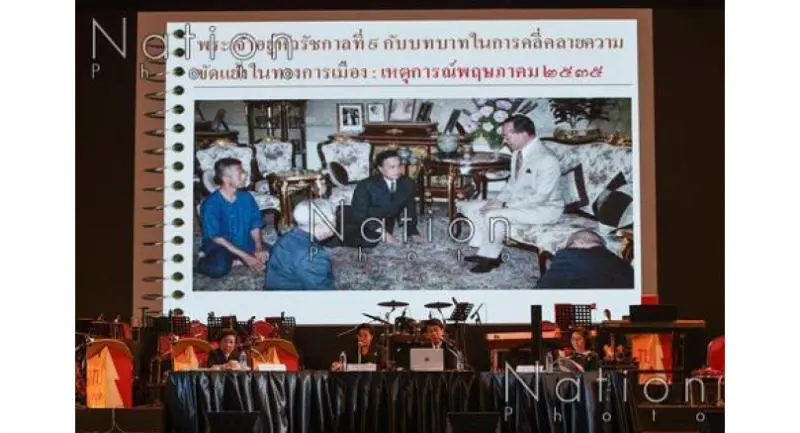


THE late King Bhumibol Adulyadej remained a constitutional monarch despite doubts about his role in the appointment of “royally appointed” prime ministers, a public lecture on the late King and democracy has heard.
The controversial appointment of outsider premiers such as Sanya Dharmasakti and Anand Panyarachun was constitutional and the late King had not exercised his power arbitrarily, law professor Parinya Thaewanarumitkul said yesterday.
In a public lecture at Thammasat University to mark Constitution Day as well as the recent passing of King Bhumibol, Parinya said that the late monarch had played a crucial role in bringing the country together and getting it through times of crisis.
King Rama IX had helped resolve major conflicts, such as in October 1973 and ‘Black May’ 1992, he said.
Both times the conflict ended after the King became involved, and the country was subsequently left with a non-elected prime minister, he said.
People had become accustomed to the practice so every time they encountered a political dead end, people would appeal to the King and asked him to exercise his power, Parinya said.
The recent crisis that followed the coup in 2006, for instance, resulted in people appealing to the King, asking for a royally appointed prime minister as a means to end the turmoil, he explained.
“However, the King responded that democracy did not work that way. It would be called a messy regime to just use power like that,” the law professor said.
He explained that each time the late King endorsed non-elected PMs, they were nominated by authorities such as the speaker of the Lower House or president of the legislative chamber.
“The King is under the constitutional monarchy. He could not just appoint anyone by his preference. He only endorsed as he was asked to,” he said.
The law professor said after the recent crisis, the King could not respond positively to a public petition requesting he intervene because it was beyond his capacity. The King never exercised his power without considering the constitution’s stipulation on the matter, he said.
“How could he respond when there were no authorities seeking his endorsement?” Parinya said.
He concluded that the late King Rama IX had full knowledge of his power as stipulated in the constitution and never exercised it undemocratically. Rather, everything followed due process, he said.
Another speaker at the seminar, Somlak Jadkrabuanpol, a former commissioner of the National Anti-Corruption Commission and a former judge, expressed concern over the use of Article 112 of the Criminal Code, or lese majeste.
Abuse of the law unnecessarily brought the revered King inside the circle of conflict, she said.
Nawawan Wutthakul, a lecturer at Chulalongkorn University’s Faculty of Education, said the late King had set a good example for the general public.
He was hardworking and excelled in many areas because of his industriousness, she said, adding that she wanted young people to be grateful for his dedication.
