
PM’s definition of ‘democracy’ based on ‘Thai way’ fails the test: analysts
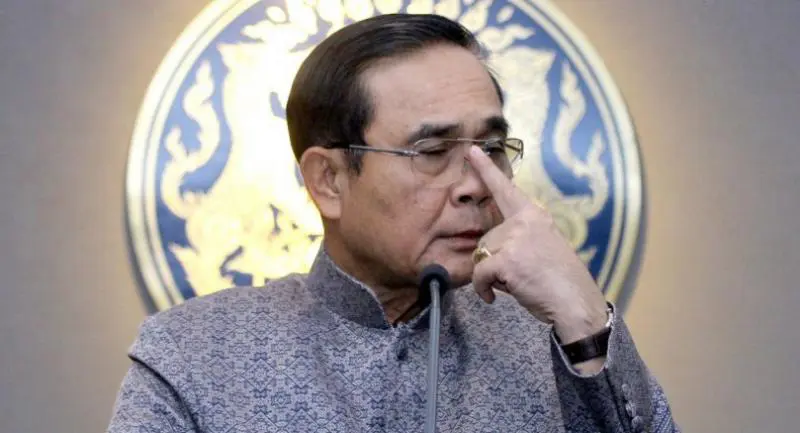


ACADEMICS SAY PRAYUT’S COMMENTS ARE MEANT TO BOOST THE JUNTA AND DISTRACT FROM REAL POLITICAL RIGHTS
IN RESPONSE to the prime minister’s call for a Thai-styled democracy, political scientists have agreed that a system cannot be a democracy without bare minimum attributes such as respect for human rights and freedom.
General Prayut Chan-o-cha, the government head and junta chief, first mentioned the term “Thai Niyom”, which can be translated as “Thai-ism” or “the Thai way”, in his Children’s Day speech last Saturday. This led to a lot of speculation about the meaning of the phrase and his real intentions.
In trying to decode Prayut’s remarks, Attasit Pankaew, a political scientist from Thammasat University, said yesterday that Thai-style democracy is a term produced from the infusion of Thai-style ethics to politics.
“Thai-style democracy is about how politicians must hold some ethical value or be good to other people,” he explained. “But ethics is an intricate subject. In politics, the definition actually must be based on the public interest.”
However, Attasit said, in a zero-sum game such as politics, players come up with new definitions and this is where the “ethics” is dragged in.
Attasit said he thought Prayut may have the impression that Thai voters lack political sophistication or are too easily persuaded, “hence, it was necessary that leaders be highly ethical [and] devoted”.
He said Prayut could be suggesting that for democracy to work under such conditions, it had to deviate from international norms.
However, if the localisation of democracy to match Thai culture meant a transformation to authoritarian rule, Attasit viewed that this was not illegitimate.
“It is not unusual for countries to have their own version of democracy. But core values such as free and fair elections, human rights and accountability are still indispensable,” Attasit said.
Meanwhile, anti-coup political scientist Sirote Klampaiboon and political science student Parit Chiwarak, said they do not believe Prayut knows exactly what he’s talking about.
“When he said the term Thai-styled democracy, I don’t think it meant anything special,” Sirote told The Nation. “General Prayut perhaps was merely unconsciously reproducing the same old discourse used by his predecessors, Field Marshal Sarit Thanarat, Field Marshal Thanom Kittikachorn and General Suchinda Kraprayoon.
“These people were all the same when it comes to addressing democracy – it must be Thai-styled.”
Prayut may have invented the relatively new term of ‘Thai-ism’, but the political scientist said it had the same basis as other coup leaders before him. They were trying to justify their rule as democratic although it had nothing resembling the western concept of democracy, Sirote said.
“There are no elections. No rights and freedom. No political parties. But this is their democracy,” Sirote said. “The heart of these notions is not about democracy or Thai-ism, it’s about claiming that what they’re doing is democratic.
“By using the term ‘Thai-style democracy’, Prayut is saying that what he has been doing in the past four years is good,” he said. The implication, Sirote added, was that this should continue into the future.
Parit, an activist and freshman political science student at Thammasat University, also said he thought Prayut did not really mean anything when he used the term.
“There’s no such thing as Thai-style democracy. It’s either democracy or it’s not,” he said. “I think he is just trying to distract us or make us feel that we’re not ready to go fully democratic. But we are.”
Parit said that Prayut was trying to tell young people what a democracy should be. But, as a young person, Parit said adults should not do that when they know very little about democracy themselves.
He stressed that democracy at the bare minimum should be based on equality.
“Everyone must decide together how democracy should be,” he said. “It should not be just one person to tell us what it is. It’s everyone’s business.”
Prayut said yesterday that he wanted Thai people to have a good understanding of democracy and to do good things for the benefit of the country.
He explained that was why he chose the term “Thai Niyom” to describe the country’s democracy.
“How much do Thai people take part in national development? How deeply do Thai people understand democracy? We don’t need to follow developed countries. Thailand may be different,” Prayut said.
“But basically, we need to play by the world’s rules – whether it is democracy or anything else. We must not forget the principles of democracy,” he added.
“This means we should elect governments with transparency and good governance,” he explained.
“We have to make democracy that is acceptable to everyone and doesn’t neglect the universal democratic principles,” he said.
The prime minister was speaking while presiding over an event to mark National Teachers’ Day at the Teachers’ Council of Thailand Auditorium.
“For me, the Thai way of democracy is about how to make Thai people have a good understanding about democracy, and how to make Thai people do good things for good results for the country,” he said.
