
How attractive is Asean to S Korea?


Play
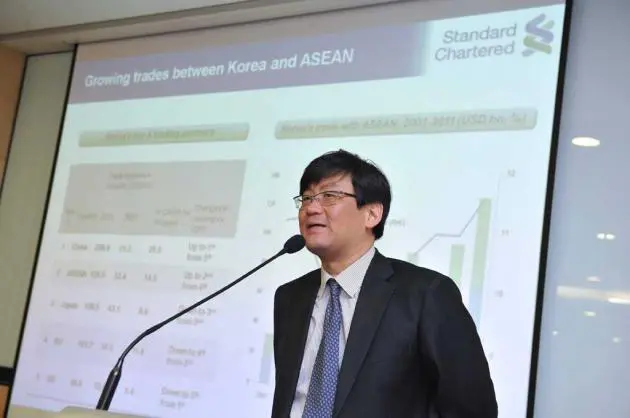
Trade between the two reaches almost $125 bn
The Association of Southeast Asian Nations (Asean) has maintained a steady share of South Korea’s trade, backed by strong economic growth and common strategic interests. In turn, Korea has cooperated closely with Asean, attending the Asean+3 Summit and signing a free-trade agreement (FTA) with the bloc.
Korea’s trade with Asean is unlike trade with other partners including China, Japan, and the US, whose share of Korea’s trade has fluctuated widely. Asean has maintained a steady share of 10-12 per cent, and this reflects a stable economic relationship.
Asean attracted almost US$80 billion (Bt2.53 trillion) of FDI in 2010, of which $7.2 billion was from Korea, making it the largest recipient of Korea FDI.
With trade flows reaching $124.9 billion – second only to China ($220.6) – Korea’s exports to Asean accounted for $71.8 billion, while imports from Asean totalled $53.1 billion.
Korea’s exports to Asean have grown quickly in the past decade, with high-tech products (semiconductors, mobile phones and computers) as the main drivers of strong growth. Surprisingly, Korea’s exports to Thailand are led by steel and chemical products, not the K-pop entertainment industry.
Imports from Asean to Korea have shown similar strong growth led by the energy/resources sector (crude oil, natural gas, coal and petroleum products). Korea has a trade deficit with commodity-exporting countries like Indonesia and Malaysia. Meanwhile, Korea is generally a net importer of computers from Singapore, Thailand and the Philippines.
Korea has recorded a consistent trade surplus with Asean. From 2000-2006, it stabilised in the range of $1.4-2.3 billion before widening sharply again in 2007, and it hit a new record high of $18.7 billion in 2011. A surge in petroleum product exports due to Japan’s tsunami appears to be the main reason for the doubling of Korea’s trade surplus with Asean from $9.1 billion in 2010.
Thailand is active in Korea’s bond market
Thailand and Malaysia have been active in the Korean bond market in recent years. Asean accounted for almost 40 per cent of Korea’s foreign bond holdings in 2009, largely due to Thai asset managers’ interests, and its share among foreign investors remained as high as 25 per cent in 2011. Thai investors aggressively bought Korean bonds in 2008 and 2009 as Thai asset management companies sold ‘kimchi funds’ to local investors to enjoy arbitrage gains. Thai investors began to reduce their holdings of Korean bonds in 2010 as arbitrage opportunities diminished. But overall Asean bond holdings have remained at around KRW 21 trillion, as Malaysian investors have increased their Korean bond holdings since 2009.
We expect bilateral trade and economic ties to boost Korea-Asean trade further. However, both Korea and Asean countries need to diversify their product offerings, given that bilateral trade has been concentrated in specific products in the high-tech and energy sectors.
The auto sector may be a channel for strengthening trade ties between Korea and Asean. Korea’s relatively weak presence in Asean’s auto market points to room for further growth, while Korea will eventually import cars from Asean that offer cost advantage. Korea and Asean also need to develop a supply chain for parts and components in the auto sector, following the example of the high-tech sector.
Suktae Oh is Regional Head of Research, Standard Chartered Korea.
