
Haircuts can be serious business for Myanmar women


Play
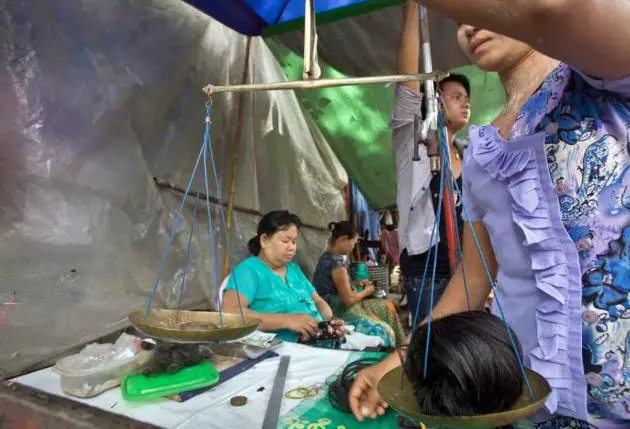
Yangon - Khin May Phyo, 18, fought back tears as shebickered with the barber over the length of her haircut.
"If you want to make 20,000 kyat (23 dollars), then it has to becut here," said Kay Aye Mon, chopping the girl's waist-length hair atthe base of her neck with her palm.
"But if you only want 18,000 kyat, we will cut it here," thebarber said, chopping 4 centimetres lower.
"Can't I get 20,000 kyat and keep it a bit longer?" Khin May Phyoasked while trying to maintain her composure. She ended up settling for 18,000 kyat.
In Myanmar, where a fourth of the population of 60 million peoplelives below a poverty line of 1.35 dollars a day and access tomicrofinancing is minimal, getting a haircut has long been a popularway for women to raise cash. "I will give the money to my mother," Khin said.
Khin, a garment worker, makes 50,000 kyat a month while hermother, a golf caddy, makes 3,000 kyat a day.
The hair is sold to wig factories in Yangon and Mandalay, whichexport the finished products to the better-off but similarlydark-haired populations of China, India, Pakistan and Singapore.
The price offered for Myanmar hair has been on the rise in recentyears as Myanmar's neighbours become more prosperous, said Pho Khwer,22, a hair "harvester" at Insein Market in Yangon, where there are atleast seven hair-buying shops.
"We usually get 10 sellers a day, but on the weekend, it goes upto 20 to 30, and during the Water Festival, we get even more becausemany women become nuns," he said, referring to the traditionalMyanmar New Year, celebrated in April.
Buddhist nuns, like male monks, are required to shave their headsupon taking their vows.
Long hair is still popular in Myanmar, a country that has beenrelatively isolated from Western culture for the past five decades,first by the xenophobic policies of former military strongman Ne Win,who ruled from 1962 to 1988, and thereafter by Western economicsanctions that were only eased this year.
According to Myanmar love lore, hair tops the list of the five keyattributes of female beauty. The others are fleshiness, fair skin,good bone structure and elegance.
Given the aesthetic value placed on beautiful, long hair andBuddhism's preachings against vanity, cutting one's hair to raisemoney for a pagoda donation has long been a common practice amongwomen.
About 100,000 women famously donated 2,400 kilograms of hair in2009 to raise funds to repair 16 bridges on a 26-kilometre roadleading to the Alaungdaw Kathapa Pagoda outside Yangon.
But for most women, selling their hair is just a question ofnecessity.
"I need the money to buy milk formula for my baby," said MyoThwin, 22, whose husband makes 4,000 kyat a day as a constructionworker in Yangon. "He doesn't mind me selling my hair because we need the money,"she said while sporting a bob after selling her hair for 35,000 kyat.
The hair business is not limited to Yangon. In fact, Mandalay, 570kilometres north of Yangon, is the traditional hub for the trade. The central city has about 50 hair-buying outlets, which send outtheir own harvesters into the surrounding countryside.
"We can't get much in a single village, so we have to visit manyto make a good profit," said Htun Aye, a hair merchant. "Poor womenneed money, and there is no other way for them to get cash." The banking system in Myanmar, which is also known as Burma, isone of the least-developed in Asia, and microfinancing is justgetting a start.
"The average person in Burma cannot get access to credit," saidSean Tunrell, an economist at Macquarie University in Sydney and aMyanmar specialist. "The government has so far been slow to respondto this." In fact, down at Insein Market, the economic reforms introduced byPresident Thein Sein since he took office in March last year have hadlittle impact on the hair business or life in general.
A few people have nice cars and houses, but we can't have thosethings," said Insein hair buyer Kay Aye Mon. "For most people,nothing has changed, but we are hoping for change in the future.
