
Couple applies Laos' silk-weaving tradition to carpet manufacturing


Play
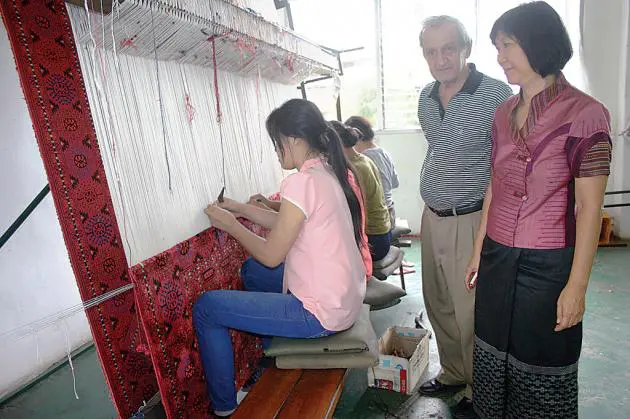
Carpet-making is one of the oldest known crafts in the world, notably in central Asia and Persia, but it just set its foot in tiny landlocked Laos some 15 years ago, and now is playing a role in the country's preparations for the Asean Economic Community.
The Lao and Turkmen pair Souvita Phaseuth and Ismet Murad Saryev not only joined their lives in Laos but also brought their cultural properties to start up Magic Lao Carpets, giving Lao silk a new life in the global market.
“This is very special. We use local silk and organic colours not only to promote local materials but also to create environmentally friendly products,” Souvita said.
Laos has had a tradition of silk and cotton weaving for centuries but making carpets in the central Asian or Persian style is something new. A Laotian, who has weaving skills, might take a few years to learn the whole process of carpet-making, she said. Souvita and Ismet spent time with many local artists to design and develop traditional patterns for carpets. They have patented more than 100 patterns.
“Unless customers have their own pattern on demand, we have our Lao pattern to offer,” said Ismet, who came from Turkmenistan with carpet-making knowledge.
“Indeed every piece is unique as it is made only to order. We can do every pattern even for example you want a Nasa image of a galaxy on the carpet,” he said.
Magic Lao Carpet’s Mekong wave patters won gold and silver medals in an international exhibition in South Korea recently. Another gold medal for the invention of a mobile weaving machine also was received from South Korea, Souvita said.
Magic Lao Carpet Handicraft has the capacity to weave some 100 square metres of carpets a year for customers around the world, mostly Westerners who know Laos or used to live and work in Laos.
Some 25 per cent of the 40-strong work force is disable persons including some who are autistic, Souvita said. “We do this not only for business but also social work to contribute to Lao society,” she said.
The couple’s primary focus is to train local weavers, with plans to start village-based carpet production. It could become a good business for villagers when they have mastered the knowledge and technique, she said.
Souvita also serves on the executive board of the Lao Handicraft Association. She is introducing Lao traditional weaving and her carpet-making knowledge to the Education Ministry’s national curriculum for students.
“I think this will help our national fellows, notably the young generation, to create their own source of income from our national properties,” she said.
Cotton, silk and traditional weaving are common in Southeast Asia, said Ismet, but hand making carpets from local materials and designs is unique only to Laos.
There might be carpet-making in Vietnam and some other Asean countries, but Laos is different, he said.
