
Economic projects must meet human rights standards: UN envoy


Play
United Nations Special Rapporteur on the Situation of Human Rights in Myanmar Tomas Ojea Quintana said on Wednesday that the importance of human rights standards and principles shaping the process of economic development in Myanmar needs to remain a prior
“A large number of villagers are being relocated to make way for this development,” said Quintana, who visited Thilawa Special Economic Zone, south of Yangon, on February 15.
Quintana also met with Sett Aung, chairperson of the Thilawa Special Economic Zone Management Committee and the committee members, who showed a keenness to address the issue.
After meeting with the committee, the UN envoy visited the Myaingtharyar Relocation Camp and talked to farmers who are adjusting to a new life.
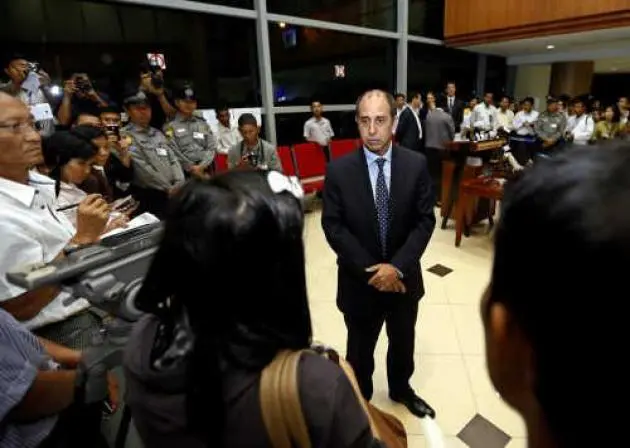
“One of the biggest challenges will be to provide them with long-term livelihood assistance, where their opportunities expand, which the management committee admitted it was struggling with and asked for support and fresh ideas,” Quintana said on Wednesday in a press conference at the Yangon International Airport.
He added that the international community should support the committee’s work so that it can ensure that Thilawa can help establish the precedence of large scale development projects being required to abide by human rights standards.
Sett Aung, who is also vice-president of the Central Bank of Myanmar, told Myanmar Eleven that the Thilawa project, with support from Japan International Cooperation Agency, has not faced protests yet despite some complaints about the land compensation rates.
“We managed to carry out our resettlement plan peacefully. There were no riots at the site. Most of the villagers were really satisfied with the plan because we arranged better accommodations for the local residents than their original ones. So I strongly believe there was no human rights violation in implementing the project,” said Sett Aung.
The committee chief also mentioned that the relocation area is just one mile from the villages.
Quintana also visited the copper mines in Monywa, Sagaing Region, including Letpadaung copper mine. He met with opponents of the mine, the state government and members Wanbao, the Chinese company active in developing the mine.
Commenting on the controversial mine project, Quintana said, “While I commend the earlier initiative of the government to set up a committee to help address the concerns of affected local communities, the government has not mustered the political will to implement many of its key recommendations.”
Subsequently, local grievances remain over compensation, forced relocation, livelihood and health problems.
“In Monywa, I also heard from two monks left scarred by the excessive use of force by authorities to remove protesters from the site in November 2012, who expressed their concerns over the moving and destruction of religious sites,” Quintana said in his address.
The concerns of the local community must be addressed with more systematic and sustained dialogue, and the political will needs to be found to address the human rights dimensions of the project, he said.
UN official added that the rights of land users in Myanmar are currently not secure. The absence of legally secure tenure means that people are vulnerable to forced evictions, which constitutes a gross violation of a range of human rights related to housing, health, education, livelihoods and security of the person.
“During my visit, I met with residents of a village in northern Yangon, who was recently evicted and their homes were demolished after being told they were living in a military zone. The operation reportedly involved about 2,000 government officials,” said Quintana.
Quntana said that the issue over land rights will be one of the major challenges over the years to come.
