
Actions needed to maintain reform momentum


Play
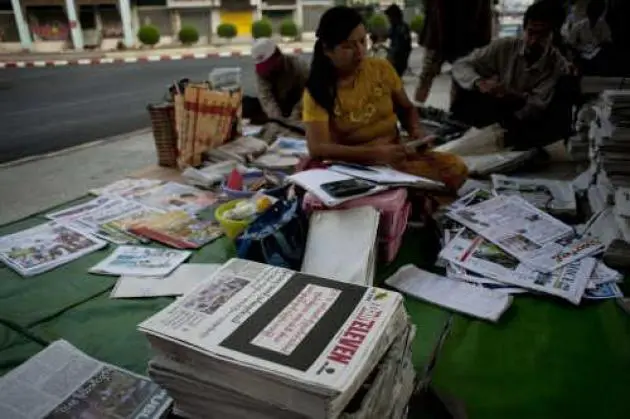
25391027 Newspapers with a black front page are displayed today after DVB reporter Zaw Pe was convicted, after attempt to interview an education official/AFP "There's always been mystery, what will happen there," said Tham Sai Choy, chairman of
The country was very central in the British empire and has a lot of wealth, he continued. Yet, it remains to be seen what part politicians and business will take after the 2015 elections.
“There is no shortcut in getting all 60 million people to be fully linked with the globalised economy,” he noted. Still, optimism remains, as “It used to take 100 years to go from agriculture to industry”. In one generation, he expects improvement in the education system, infrastructure and the stability in political environment.
Tham Sai Choy’s words just echoed what all politicians and businessmen elsewhere are thinking about. Ringing in their heads now are reports on internal conflicts, which may derail the reform momentum and the country’s re-integration with the world.
While the nation braces for the election next year, it is engulfed in conflicts ranging from the pressure for constitutional amendments and Rohingya issue to the abuse of human rights and press freedom.
Protests have been organised nearly on a weekly basis in the past two months, demanding for the amendments to the 2008 Constitution which safeguards the military’s controlling power and consequently bars the full rise of national heroin, Aung San Suu Kyi.
Believed to standardise data, necessary for the full integration with the world, the national census has been widely criticised as minority Muslims were not allowed to identify themselves as the Rohingya and will remain immigrants in the authorities’ eyes. This happens on the back of rising tensions between majority Buddhists and minority Muslims. President Thein Sein has so far shown no response, but he proposed four religious laws recently including one that bars the interfaith marriage.
Villagers in different parts of the country, including Yangon – the biggest commercial city, were evicted from their land. Parliament’s Land Investigation Commission’s report showed a number of 745 complaints involving 512,204 acres of land. They cover disputes involving the military, related to the city expansion and the industrial zones and stemming from the state and private businesses.
Rocking the country’s image is also a regional court’s verdict to Zaw Pe, a journalist of Democratic Voice of Burma (DVB). He was given a 1-year jail sentence for "disturbing a civil servant" and trespassing. He was jailed along with Win Myint Hlaing, the father of a student who accompanied him during a visit to the local education department about a story on a scholarship programme in 2012.
As this follows controversial cases against Daily Eleven’s reporter Ma Khine and Unity Journal’s CEO and reporters, several newspapers today presented black front pages in protest.
Joining them is Reporters Without Borders. Today, the organisation said it was "outraged" by the imprisonment of a Myanmar journalist for trying to interview an education official, as local newspapers ran black front pages in protest.
"It is unacceptable that local officials can obstruct a journalist's work and have him sentenced to imprisonment just because they feel he disturbed them," Reporters Without Borders (RSF) Asia-Pacific head Benjamin Ismail said in a statement.
"We call on the local authorities to release Zaw Pe and we ask the government to ensure that media freedom is respected equally everywhere."
Myanmar ranked 145th out of 180 countries in the latest RSF press freedom index, reflecting "substantial" improvements under the country's quasi-civilian regime. But the media watchdog warned that the reform process was beginning to "flag".
Upto this point, international politicians and business groups are pleased with the reform process, launched in 2011 to triple the country’s per-capita income to $2,400 by 2015. President Thein Sein has been welcomed in many countries and he will represent Asean at the Group of 20 meeting in Australia in November. Since last year, a long list of foreign companies – from the USA to Thailand - have unveiled plans to open offices in the country.
In his discussion with ANN editors, Singapore Prime Minister Lee Hsien Loong said “I think there’s a lot more work to be done, even on administration and economic management.” Yet, he added “But there’s even more work to be done in dealing with the political and nation-building issues of Myanmar, because it’s a very complicated country.”
