
Miss me yet? Suharto nostalgia mounts in Indonesia


The dust is still settling over last week's legislative elections in Indonesia. Pundits are still mulling over the "whys" and "how's" of the results.
We can all agree though that—the lack of a decisive winner aside—Indonesian democracy is still in rude health.
As we await the official results on 7 May (although it's fairly clear that the opposition PDI-P has won a plurality), I'd like to share some of the observations I gleaned when I—as always—hit the road to watch the campaign unfold.
One thing that particularly struck me was the undeniable nostalgia for the former President Suharto among certain ordinary Indonesians.
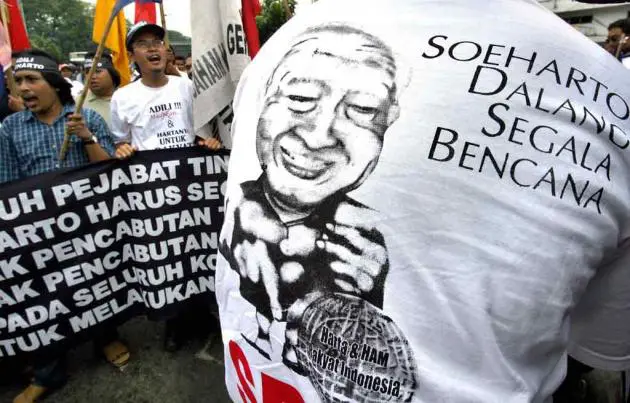
Indeed, you can't walk through a Jakarta street without being confronted with T-shirts bearing the image of the cheekily-smiling general with the caption: "Lebih enak jamanku kan?" ("Weren't things better when I was around?").
Foreigners may find this surprising: wasn't Suharto's "New Order" a quagmire of corruption and human rights abuses?
Didn't they rise up to get rid of him in 1998? How on earth could they miss him?
Well, for one thing, post-Reformasi Indonesia has not been great for everyone. Corruption has not abated. Red tape has worsened. Competition for jobs and resources has intensified.
Of course, civil liberties and political freedoms have improved dramatically. These are real achievements but the lack of economic social justice has made them somewhat hollow.
Furthermore, Indonesians are also yearning for what they think is "decisive leadership."
The last administration's multiple policy flip-flops suggested a weak decision-making process, something you could never accuse Suharto of.
His many failings aside (and there were many), Suharto's New Order gave Indonesia a veneer of stability and progress.
After assuming the presidency in 1967, Suharto managed to lower Indonesia's poverty rate from almost 60% to just 13% before the economic crisis hit in 1997. At the same, access to education and healthcare improved significantly.
Under him, the Indonesian economy enjoyed 6.5% annual economic growth in the three decades between late 1960s and 1997. Hyperinflation – at 660% in 1966 was reduced to 19% in 1969.
Suharto—through controls of the economy—protected Indonesians from the worst excesses of capitalism. This hasn't occurred with democracy and perhaps that is why Indonesians miss him, even though it was those controls which messed-up the republic's economy in the first place.
It's unsurprising therefore that Golkar, under the business magnate Aburizal Bakrie, tried hard to capitalize on this so-called "Sindrom Amat Rindu Suharto" ("SARS", or "Missing Suharto Syndrome").
The party used Suharto's image heavily in materials and even got his daughters, Siti Hardijanti Rukmana ("Tutut") and Siti Hediati Hariyadi ("Titiek") to campaign for them.
This didn't really pay off—Golkar is projected to win just 14% of the popular vote, which is more or less status quo for them.
To be fair though, it still puts them in second-place and its proof that Bakrie's controversial business history hasn't scared-off voters.
This nevertheless could be proof that Indonesians aren't backward-looking. Or rather, that urban dwellers aren't willing to forgive or forget the abuse of power and rigged elections of the Suharto days.
Of course, Indonesia isn’t the only Southeast Asian country ruminating about the nature of leadership.
Like Indonesia, Thailand too has had its share of strongmen—Thaksin Shinawatra being just the latest in a long line.
Such leaders often prioritized their brand of development and getting things done, but brooked little or no opposition.
Their legacies, for good or ill, have shaped modern Indonesia and Thailand. It’s unsurprising that some quarters still yearn for those simpler political times, although they may no longer be relevant or appropriate.
What shape will the future leadership of these two countries take? It's hard to say.
But would-be leaders and their followers alike would do well to remember a Javanese saying Suharto often quoted: "Ojo gumunan, ojo kagetan, ojo dumeh" which means; "Don't be easily impressed, nor easily shocked and certainly not arrogant."
Karim Raslan is a regional columnist and consultant
