
Thingyan participants enjoy water throwing, concerts, culture


Play
Large numbers of Thingyan revellers descended on Yangon this week to take part in the water-throwing festival that marks the traditional New Year of Myanmar.
The pandals on Kabaye pagoda and Pyay roads were filled to capacity, while the pandals on Kandawgyi lake circuit road and Kabaye Pagoda road experienced smaller crowds than previous years.
Kabaye Pagoda road, with 12 big pandals, was likely the most crowded at the festival, which ran from April 13 to April 16. Many areas also experienced peak crowd periods in the afternoon hours.
Traffic was jammed on Pyay Road, where musical concerts were staged. Many young revellers were eager to pay the Ks 1000 entrance fee for watching the Empire pandal inside Myaing Haywon Park, Mayangone Township, in which foreign artists and other young artists entertained.
The festival was opened at Yangon’s Mayor Pavilion, as Hla Myint, Yangon’s Mayor, extended Thingyan New Year greetings as he was joined by cultural and dancing troops. Audiences also saw Kachin and Chin ethnic cultural troops perform, which took part in the ceremony for the first time.
In this year’s Thingyan festival, security was also beefed up, with approximately 5,000 police officers on duty to help maintain the peace.
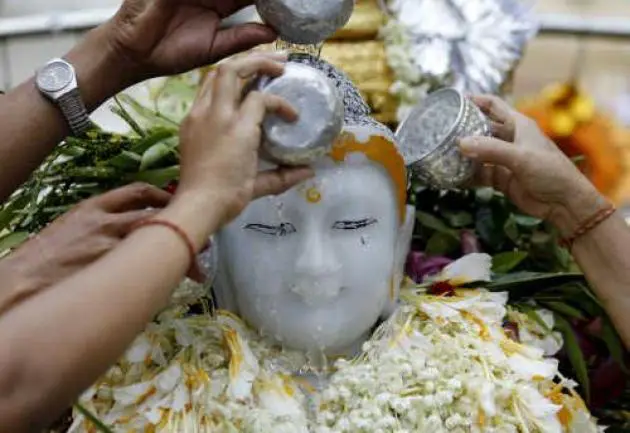
To celebrate the New Year of the Myanmar calendar, Buddhist devotees light a candle and pray at temples. People in Myanmar go to the pagoda, donate food, free birds or fish and pay respect to elderly persons on the New Year.
Myanmar joined several other countries in Indochina to celebrate the traditional New Year. From Mandalay to Bangkok, and from Phnom Penh to Chiang Mai, the people of Thailand, Cambodia, Laos and Myanmar sprayed water on each other, visited temples and were blessed by family elders.
But while revellers were enjoying the holiday break, an article in the Straits Times suggested the region faces a potentially turbulent year.
Cambodian Premier Hun Sen issued a rosy statement, making no reference to questions hanging over the July 2013 elections which nearly saw his 28-year rule upended; or to labour strikes where troops fired at workers; or to unrest over land grabs by the rich and well connected.
In Laos, a one-party state which rarely sees dissent, armed police had to be summoned this month when angry locals confronted surveyors from a Chinese company in the province of Bokeo.
Laos is coming under increasing scrutiny. Cambodians have protested against the proposed Don Sahong dam.
And referring to the Xayaburi dam, Vietnam’s minister of natural resources and environment Nguyen Minh Quang said on April 5: “We hoped Laos would also pay attention to the opinions of other countries.”
In Myanmar, while disputes over the control of land and natural resources abound - some of them legacies of the dictatorship years - most economic reforms have been praised.
On the political front, the first draft of a nationwide ceasefire agreement - being touted as a watershed after decades of civil war and insurgencies - was agreed on April 8. But days later, fresh clashes displaced hundreds of Kachin and Shan people.
A committee tasked to work on amending the military-drafted Constitution, which bars opposition leader Aung San Suu Kyi from the presidency, is due to resume work in May.
However, it is unknown how far will the army accommodate changes, which could be perceived as rolling back its interests and power.
Meanwhile in Rakhine State, tensions remain between the Muslim minority and Buddhist majority.
As for Thailand, surveys show many Thais are deeply worried about the political fight that has polarised the nation and stalled the economy.
The nation has been without a sitting legislature since December last year.
