
Fresh fighting erupts as ceasefire draft was approved


Play
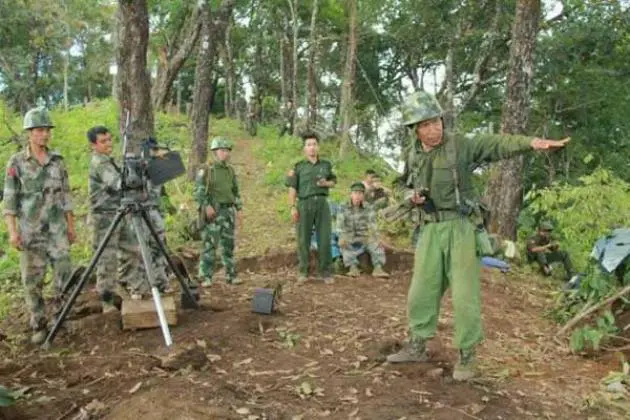
As the country awaits the nationwide ceasefire agreement - touted as a watershed after decades of civil war and insurgencies - fresh clashes in the North have displaced local people in Kachin and Shan states.
Fighting has intensified as government troops continue a week-long offensive against ethnic Kachin rebels, according to reports.
Clashes started on April 10, two days after a group of 16 ethnic groups reached a preliminary agreement on the nationwide ceasefire draft in Yangon.
The government’s troops have launched multiple offensives against the Kachin Independence Army (KIA).
Clashes continued up to April 16 in the Man Win Gyi area of Mansi Township, as well as northeastern areas of Moemauk Township, in northern Shan State, forcing hundreds of villagers to flee across the border into neighbouring China.
“[The skirmishes] only halted temporarily in the mornings of April 12 and April 13. They continued on the rest of the days,” said Daungkhar, a liaison officer with the Kachin Independence Organisation (KIO) based in Myitkyina.
Despite ongoing peace talks, skirmishes in northern Kachin State have broken out earlier this year over illegal logging. Tensions have remained high after a nationwide census was contested by ethnic armed groups who refused to participate.
Military infantry battalions launched attacks against KIA Battalion 27 in the Brigade-3 area on April 10, eventually capturing an administrative office at Bang Hkung Yang village as well as Ulampar base camp in Mansi Township, according to sources from the KIO headquarters.
Kachin rebels retaliated by attacking the Man Win Gyi Police Station, in Mansi Township, on April 11 but were forced back allowing Myanmar army troops to capture Bang Hkam gate camp, which is located near Naung Taung Bridge on the Myanmar-China border.
“Their camp is located at the Myanmar-China border. We have captured it because they have doing illegal activities,” said a senior official from the military’s Northern Command.
As attacks escalated, the KIA ambushed a military convoy carrying ammunition from Bhamo on April 13 killing two officers and injuring four others. Despite ongoing clashes, there has been no official disclosure of causalities by either side.
“There were seven vehicles in the convoy. A vehicle was destroyed due to the mine attack. The vehicle carrying ammunitions was destroyed after it caught on fire. Two officers have died while four officers have been injured,” added the senior army official.
The military reinforced its positions on April 13 and launched further attacks against the KIA, deploying infantry columns to hold control of captured areas in what appears to be pre-planned operation to control more territory in rebel held areas.
“They have wanted to control the territory. At first, the illegal timber issue was used as a reason. Then they use the census issue as a reason. The fighting resumed as they started military activities,” said KIO liaison officer Daungkhar.
The military continued to capture small base camps inside areas controlled by KIA Battalion 27 on April 14 and 15 and heavy fighting took place in the upper areas between Bhamo and Moemauk.
Fighting continued after army troops entered the area controlled by KIA Battalion 9, Brigade-4, in northern Shan State on April 15.
On April 16, fighting broke out near Maijayan, which is close to Myanmar-China border, forcing over 1,000 Shan villagers to flee over the China border.
John San Linn, an independent reporter covering frontline news from the battlefield, was contacted by Eleven Media on April 16.
“Heavy fighting has taken place in Maijayang area this morning,” he confirmed.
“The main reason is that the military wants to control the Moemauk area. They want to expand their camps. The KIA knew that they were going to expand their camps beforehand. When the military started entering their areas, the fighting broke out,” he added.
Despite ongoing negotiations between the military’s Northern Command and the KIA/KIO over previous skirmishes, there has been no contact between the two sides for over three months.
“The Northern Command cannot make any decisions. They have to follow the instructions from a higher authority. So negotiations have been unsuccessful,” added Daungkhar.
While tensions remain high, the KIA General Gwan Maw is visiting the United States at the invitation of the Department of State. He arrived in the US on April 13 and will be staying there for 12 days.
Voice of America reported that Presidential spokesman Ye Htut on Wednesday confirmed that several government troops, including a senior commander, have been killed in the fighting.
“We regret to learn about our soldiers’ sacrifices and displaced locals in front-line areas while taking care of security and public safety. As the president expressed, the loss of one Kachin soldier means losing one of us as well. That’s why I would like to urge KIA leaders to ask their ground forces for restraint in this situation to advance the implementation of the cease-fire agreement,” said Htut.
A report in Jane’s Defence Weekly, a military news journal, showed that heavy fighting that broke out between KIA and Myanmar army from mid-2011 until late 2012 killed 5,000 Myanmar army soldiers and destroyed two helicopters.
