
Asean chair mum on Thailand's coup


Play
Serving as Asean Chair in 2014, Myanmar has reserved its view on the political developments in the neighbouring country of Thailand.
Ye Htut, spokesperson in charge of Asean Affairs, told reporters recently that Asean has been paying close attention to the situation in Thailand following the May 22 coup and will not make a stand before consulting with all member countries.
Myanmar, in its capacity as Asean chair, has reaffirmed its position in accordance with the joint statement on Thailand issued at the Asean Summit in Yangon on May 11, he said.
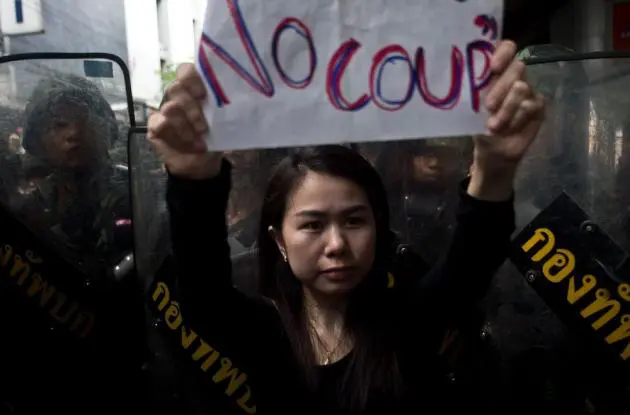
The Thai military’s takeover of the government Thursday drew criticism from many world leaders. While the United States a military aid, the United Kingdom also threatened to review relations. Strong criticisms came from France and Germany, while Australia and Japan urged for the quick restoration of democracy.
“There is no justification for this military coup,” US Secretary of State John Kerry said. “I urge the restoration of civilian government immediately, a return to democracy, and respect for human rights and fundamental freedoms, such as press freedoms.”
However, Asean nations look rather soft on this issue.
The Indonesian government has called on military and civilian elements in Thailand to work together to quickly restore the political situation following the takeover of the government by the military.
“Indonesia calls on the armed forces of Thailand and the various relevant civilian elements to work together in an atmosphere of reconciliation to quickly restore the political situation in Thailand,” Foreign Minister Marty Natalegawa said in a written statement on Thursday night.
In an interview with the Associated Press on the sidelines of The World Economic Forum on East Asia in Manila, Marty also said the situation was a setback and would be inconsistent with Asean’s collective support for democratic principles and constitutional government.
Urging its people to postpone travel to the country for security reasons, Malaysia’s foreign ministry issued a statement expressing hope that all parties would work toward a peaceful solution and that the situation would “return to a state of normalcy in the near-term.”
Observers in Myanmar, where military political and economic control remains huge, commented that the government appeared indecisive on key issues like Thai coup and the tension in South China Sea. The coup in Thailand is also a reminder that dark old days can return.
Aye Thar Aung of Rakhine National Party said Myanmar has been on the right track for democracy although he fears that Thai coup would set a precedent for the Myanmar military in seizing power as a reprisal to attempts to amend the 2008 Constitution.
He said he heard that the Myanmar armed forces might overthrow the government by citing the spread of mass rallies demanding for charter change. He also stated, however, he saw little chance for ousting the government since the Constitution was designed to serve and entrust the Myanmar Army with most power.
“I consider that the Myanmar Army has no need to seize power as the Commander-in-Chief of Defence Services has the control over the dispensing of power in accordance with Section 412m 417 and 418 of the 2008 Constitution,” said TheinNyunt, chairperson of New National Democratic Force Party.
Writer HtetMyet said he opposed the military intervention in democratic rule. Only political parties should be empowered to negotiate and handle a political crisis, he said.
Moe Kyaw Oo in Bangkok did not think so.
“The Thai Army has often seized power and I have been living here for 20 years. Unlike Myanmar Army, the Thai military would transfer power back to a civilian government after taking control for about one year. But presently, I do not know when the democratic rule would resume,” he said.
