
Celebrating 50 years of high-speed travel


Play
Efficient, superfast and comfortable, Japan's Shinkansen "bullet trains" give airlines a run for their money
On October 1, Japan will celebrate the 50th anniversary of the inauguration of the Shinkansen service, when a superexpress train first connected Tokyo and Osaka in four hours. Over the past half century, a number of quiet dramas have taken place around the Shinkansen. Here are some highlights of the era.
Fond memories of ‘restaurants on rails’
The first dining car debuted on the Tokaido Shinkansen line in 1975, 11 years after the bullet train line opened, but after an illustrious career of more than 20 years, the “restaurants on rails” disappeared, a casualty of the never-ending quest for speed.
The dining cars were the eighth car on 16-car trains and boasted the opportunity to gaze at Mount Fuji while having a meal.
A bastion of luxury, “the quality of our ingredients never suffered”, even amid the severe shortages during the second oil crisis of 1979, recalled Terunobu Utsunomiya, 64, who was a Shinkansen dining car chef for almost 20 years.
Dining cars became even grander in the 1980s when double-deck cars were introduced.
Bolstered by the bubble economy, the Tokaido Shinkansen logged 130 million passengers in 1991, swamping dining cars with customers.
Utsunomiya said the best-selling menu item in those days was also the most expensive: the sirloin steak meal for 2,100 yen (Bt642 today).
The kitchen’s rice cooker could feed 30 people, but it emptied so quickly they sometimes made rice 10 or more times per trip, he said.
More passengers on the Tokaido line was one reason for the demise of the dining car.
The arrival in 1992 of the Nozomi, whose maximum speed was 50 kilometres per hour faster than previous trains, greatly shortened travel times, but the eighth car was converted to a passenger car to make room for more people.
The age of the dining car ended in March 2000, though bento lunches and other items can still be bought from food carts. Vending machines were also removed.
After retiring, Utsunomiya took a job as assistant head of the Kyushu Railway History Museum in Kita-kyushu. “The top priority of the Shinkan-sen was always ‘Go faster’, so the disappearance of the dining car couldn’t be helped,” he added, looking a bit sad.
Songs, toys celebrate trains
The first children’s song about the Tokaido Shinkansen line was “Hashire, Chotokkyu” (Run, Super-express).
Appearing in 1967, the Shinkansen had already captured the hearts of children just three years after the bullet train line opened.
Bullet trains can make anybody feel like a child again.
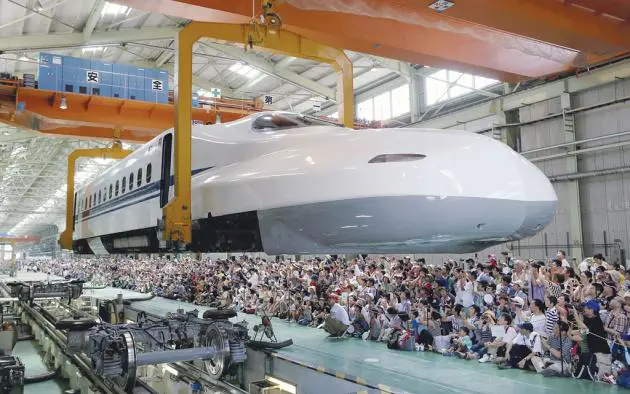
Crowds of parents with their children attended an event at Central Japan Railway’s Hamamatsu factory on the first weekend of summer vacation in July.
Everybody in the crowd got excited when a crane picked up a streamlined Shinkansen car. “Wow, that’s amazing!” people shouted.
Even the adults were wide-eyed.
“It’s simple why kids love Shinkansen. To be blunt, they’re fast and cool,” said Shinichiro Higaki, who manages Tomy’s Plarail line of toy trains.
This is epitomised by an episode that occurred when Tohoku Shinkan-sen toys first went on sale. In the toy industry, red, white and blue are known as the “champion colours”, since they reliably produce best sellers. But when the Tohoku Shinkansen appeared in unpopular green, some in the company worried it would hurt sales.
The fretting turned out to be for naught, as sales doubled the target. Shinkansen toys are now known in the industry for their reliability.
‘7-minute miracle’ of cleaning
Technological prowess is not the only thing supporting the speed of the Shinkansen.
Operating on an extremely tight schedule, Tokaido Shinkansen trains pulling into Tokyo Station head back to Shin-Osaka Station in 16 minutes on average. Cleaning the cars in such a short time frame requires “superexpress” efforts.
Once passengers have detrained, pink-clad cleaning staff rush in to wipe down tables and windows, and change the seat covers.
After politely excusing themselves with a bow to passengers and a “Thank you for waiting”, they are out the doors in less than 10 minutes.
East Japan Railway, which operates the Tohoku Shinkansen line, is three minutes faster.
The Shinkansen cleaning staff has been featured by overseas media outlets. US news broadcaster CNN said the crews perform “seven-minute miracles”.
A class on the cleaning of Shinkansen cars is to be a required subject at Harvard Business School starting this autumn.
The chairman of France’s SNCF, which runs the TGV high-speed railway that is increasingly in competition with the Shinkansen and has boasted of being its equal technologically, even tipped his hat to the Shinkansen’s cleaning staff.
“We have nothing on this. I want to bring the cleaning staff home with me,” he said after watching the team work during a visit to Japan.
But why does the “dream superexpress” need such dedication to speed, even down to the cleaning staff? The primary reason is competition from its main rival – the airlines.
The Tokyo-Osaka route, frequented heavily by business travellers, is a cash cow the two have tussled over for half a century.
A Shinkansen cannot match an airplane in terms of speed, but airports lie far from city centres while Shinkansen stations are usually right downtown, meaning there is little difference in time between them.
When the Tokaido Shinkansen opened in 1964, 1.3 million people travelled between Tokyo and Osaka by air. The very next year, that figure had dropped by 200,000.
The Shinkansen was given an extra boost in 1992 with the appearance of the “Nozomi” train, which reduced travel time from three hours to two-and-a-half hours, allowing the boast, “You can make 9am meetings in Osaka.”
The airlines fought back with short-interval “shuttle” flights, but the Shinkansen is taking about 80 per cent of customers.
The battle with the airlines that began with Tokyo-Osaka route has spread nationwide as the Shinkansen network has expanded. The current fight is over the “four-hour wall”.
The Shinkansen and airlines are focusing on the Tokyo to Okayama and Hiroshima route. They are about evenly matched in terms of market share, with the Shinkansen carrying about 60 per cent of the passengers and the airlines 40.
To compete with the Shinkansen, All Nippon Airways has dispatched state-of-the-art Boeing 787s on flights to Okayama and Hiroshima.
