
Kyat weakening against US dollar


Play
The kyat has weakened against US dollar in recent months, in light of the greenback's appreciation against other currencies as well as Myanmar's widening trade deficit.
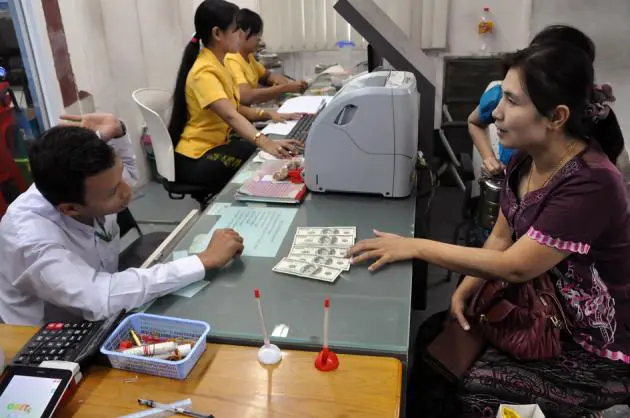
From 970 per dollar on September 10, the kyat has weakened to 988 today, according to the reference rates set by the Central Bank of Myanmar. On Monday, the buying/selling rates at the Theinbyu currency exchange centre stood at 983/990, close to the black market rate of 989/993. Foreign exchange centres normally quote the selling rate 0.8 per cent above the official reference rate, while authorised dealers charge an extra 0.3 per cent.
“We are concerned with the sudden change. In particular, this could pose problems to enterprises doing business in the foreign currency,” said a local businessman.
The dollar appreciated to 977 in September from 973 in August. The kyat averaged 935.81 from 2012 until 2014, reaching an all-time high of 989 in December of 2013 and a record low of 847.95 in October of 2012.
The greenback’s upward momentum started in July when the US Federal Reserve hinted that interest rates could rise further than expected when they are eventually hiked, probably in mid-2015. Last week, the dollar hit highs above 109 Japanese yen, a level unseen since August 2008.
Meanwhile, Myanmar has experienced a widening trade deficit. Though exports have risen in line with the pace of economic growth, imports have also advanced – prompting higher demand for the greenback and putting pressure on the local currency.
Myanmar’s trade deficit was at a record high at US$2.65 billion in the 2013/14 fiscal year, according to the Ministry of Commerce. Total exports amounted to $11.1 billion while imports were at $13.75 billion. In the previous fiscal year, the trade deficit was below $1 billion.
In the first four months of this fiscal year, starting from April, the trade deficit has amounted to $1 billion.
The pressure on the kyat is expected to continue as the economy still needs dollar to pay for imports, as the local manufacturing industry cannot satisfy growing domestic demand.
Following high demand for US dollars late last year, the central bank had to sell foreign reserves, pushing the reserves down to only $4.7 billion (or around 3.2 months of prospective imports) at end-2013.
In the second review released in March, the International Monetary Fund expected more foreign investment to offset the trade deficit.
Apparently to reduce the demand for dollar and cap the pressure on the local currency, Set Aung, vice governor of the central bank, said earlier this month that newly licensed foreign banks would be allowed to extend loans in kyat, aside from dollar-denominated loans.
In April 2012, the central bank adopted a managed float for its currency, scrapping a 35-year fixed exchange rate, to unify the multiple exchange rates which posed hindrances to economic development. Before this, businesses were subjected to multiple rates. While the official rate, pegged to the International Monetary Fund’s special drawing rights, was 6.4 kyat per dollar then, the black market rate was over 1,000 kyat.
At the start, the daily rate was quoted at 818 kyat per dollar, near the black-market level. The currency was about 1,055 in 2009, as markets welcomed positive political developments in the country, when Aung San Suu Kyi won a seat in the 2012 by-elections.
