
At least one political prisoner freed in 3,000-plus amnesty, groups say


Play
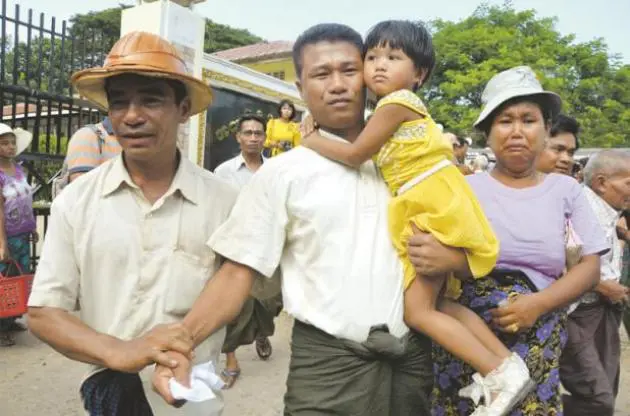
Associations working on to ensure the release of political prisoners say they are still assessing how many political prisoners were among the more than 3,000 released on Tuesday under a presidential amnesty.
Bo Kyi, joint secretary of the Assistance Association Political Prisoners (AAPP), said only one of those released was a political prisoner.
Myint Aung, of the Former Political Prisoners Association (FPPA), said the group was still trying to confirm how many were released. “Political prisoners were released, but only a few. We are still assessing how many,” he said.
More than 50 farmers from Kantbalu Township, in Sagaing Region’s Shwebo District, remain in prison for protests demanding the return of seized land, according to AAPP. None were included in the presidential amnesty.
Myanmar’s future hinges on the release of all political prisoners, said AAPP member Aung Myo Kyaw. “In this [political] context, we have a motto – ‘national reconciliation is not possible as long as political prisoners exist’,” he explained.
Ko Jimmy from 88 Generation Peace and Open Society said it was too early to confirm whether any political prisoners were included in the amnesty.
According to the data collected by the two associations of former political prisoners there are still more than 70 behind bars. However, the Political Prisoner Scrutiny Committee – which was formed by the President’s Office – claims there are no political prisoners in Myanmar. The former political prisoners say there is a dispute over the definition of “political prisoner”.
Of the two prisoners released on Tuesday at the request of ethnic armed groups, one is reported to be regarded as a political prisoner by FPPA.
The more than 70 people behind bars that it regards as political prisoners include people close to ethnic armed groups, activists and journalists.
Under the government of President Thein Sein about 1,500 political prisoners have been freed, including 350 with the assistance of the Political Prisoner Scrutiny Committee.
The release of political prisoners was one condition western governments placed on Myanmar in exchange for the lifting of sanctions and re-engagement.
On Tuesday, the United States on Tuesday called on Myanmar to release all remaining political prisoners, while welcoming reports that a large-scale amnesty was underway in the Southeast Asian nation.
"We urge the government to continue to work expeditiously through the political prisoner review committee to release all political prisoners unconditionally and to remove conditions placed on those already released," State Department spokeswoman Jen Psaki said.
Washington was seeking details about reports that President Thein Sein had pardoned some 3,073 people including former military intelligence figures, Psaki told reporters.
However, "an estimated 30 to 40 remain incarcerated," she said.
The reformist regime, which is preparing to host a landmark November meeting of international and regional leaders, has granted a series of amnesties as part of dramatic reforms since the end of outright military rule in 2011.
US President Barack Obama is to travel to Myanmar to attend the upcoming East Asia summit, which will happen alongside a meeting of the Association of Southeast Asian Nations (Asean) next month.
According to AAPP, 11 individuals were sentenced to prison terms last month for politically related activities. In its latest monthly update, AAPP also recorded the indictment of 13 individuals (including 2 detained), and the release of 2 political prisoners. At the end of September, it counted that there are 80 activists imprisoned in Myanmar, with 130 activists currently awaiting trial for political actions. Section 18 of the Peaceful Assembly and Peaceful Procession Act continues to account for a large number of these arrests and incarcerations, it said.
“Most disconcerting is the government’s continued reliance upon Section 18 of the Peaceful Assembly and Peaceful Procession Act as a means to indict and imprison political opponents. This month, an additional ten people were sentenced under Section 18, while twelve were charged under the broadly applied law. It should be strongly noted that one of those twelve was a solo protester, despite the fact that the law explicitly applies only to groups of more than one person. This clearly exemplifies the current government’s disregard for the rule of law when in pursuit of their own political objectives,” AAPP said in the update.
The report was released on October 8, a day after President Thein Sein announced the amnesty for more than 3,000 prisoners – including former military intelligence officers – to 7 to mark the end of Buddhist Lent.
AAPP also urged the government to sign on to the UN Convention against Torture (UNCAT) and fulfil Thein Sein’s promise to ensure the release of all political prisoners in the country.
According to the Former Political Prisoners Association (FPPA), no journalists or farmers jailed for protesting land grabs under the administration of President Thein Sein were among those released.
FPPA named two political prisoners among those released – Mar La Yein and Saw Mya Saw – both of whom had been jailed on charges of unlawful association with ethnic armed groups. Mar La Yein a member of the Kachin Independence Organisation was released from Myitkyina Prison in the Kachin State, while Saw Mya Saw – a member of the Karen National Union – was released from Myaungmya Prison in Aeyeywady Region.
Ye Aung, a member of FPPA, said it had expected at least 13 political prisoners to be released.
The Ministry of Information said the president had ordered the release of 3,073 prisoners, based on their good behaviour. Fifty-eight were foreign nationals who were subsequently deported.
Ye Aung said that eight former military intelligence officials were released: former Brig-General Thein Swe, former Major Aung Kyaw Moe, former Colonel Maung Than, former Lt- Colonels Myint Oo and Min Thu, and three other officers – Aung Zaw, Naing Htay and Hsan Aung.
Thein Swe thanked the president for his release, but declined to comment on why he was jailed. “I don’t want to comment on why I was punished,” he said. “I am glad be released and thank the president. I think the president will continue to pardon remaining prisoners as quickly as possible,” he added.
Thein Swe said had no plans to get back into politics and that he would devote himself to his family business and religion. His son is the CEO of Mizzima, a former exiled media group that is now partly owned by tycoon Serge Pun.
Aung Kyaw Moe said he had been jailed over his role in now-disbanded Nasaka border patrol in Rakhine State’s Maungdaw Township. He said that as a condition of his release he had to sign a document pledging not to commit any crime.
Win Naung Lin, deputy director of the Kachin State Correctional Department, said all of those released had to sign the same document, referred to as Section 401, which is a pledge not to commit “further crimes”. If the released prisoners are convicted of a crime they will be required to serve the remainder of the sentence suspended for their September 7 release.
