
Students protest against education law for fourth day


Play
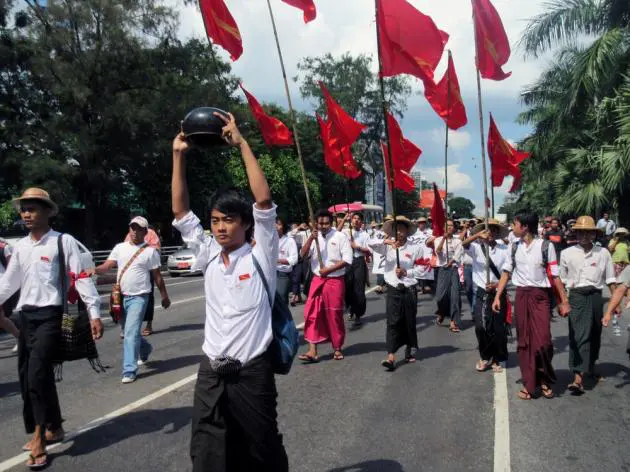
Hundreds of Myanmar university students marched through Yangon for a fourth day in a row on Monday, in a rare and illegal protest against a new education law they say will curb academic freedom.
On the first day, the organisers claimed that the number of participating students exceeded 500.
The protesters shouted the slogans: “We don’t want the National Education Law”, “Democratic education” and “Independent formation of students’ league”. They condemned the perceived weaknesses of the law and the Myanmar academic system.
The students criticised the law for centralising the education system, barring the students’ league, blocking independent university administration and limiting ethnic languages.
"Based on the emergency meeting of the student body, we will stage protests in various forms until a new national education bill is drafted in line with the students’ wishes," said Phyo Phyo Aung, secretary of the All Burma Federation of Student Unions (ABFSU).
"The student unions were invited to attend the meeting between US President Barack Obama and groups representing civil society. We informed the US Embassy that we would not be able to attend. They told me that they would report our decision to their superiors in accordance with their office rules. I believe President Obama will know about the protests of the student body," she said.
Students climbed perimeter fences after the authorities stopped them from entering Yangon University, while the Hlaing campus main entrance was also closed in advance.
"We are only taking shelter in our mother university. The school authorities didn't allow us to go inside so we had to climb the fence," said Paing Ye Thu from Dagon University Student Union.
Student unions held an emergency meeting at Free Funeral Service Society in North Dagon Township and protests began on Friday to demand a working committee be formed to draft a new education bill.
Although student unions across the country staged protests against the education bill, it was enacted without including the points the students demanded.
A student from the University for Development of National Races said: “Despite the weaknesses in the law, the government enacted it. We don’t believe the law can help educational progress. The people in the ethnic regions are experiencing the consequences of language difficulties and are being left uneducated.”
“We will continue staging our protest as long as the authorities have not amended the law. We want a law that can guarantee an education system equipped for democratic norms,” said Kyaw Ko Ko, a leader of the ABFSU.
