
Myanmar's landless: playthings of the powerful


Play
Left destitute after the army said they were squatting, hundreds of families have found themselves caught in a bizarre tug of war involving Myanmar's ruling party and an armed ethic group in a case that highlights the country's acute land challenges.
When military officials with loudhailers told Aye Aye Win and her neighbours that their village near the central Bago mountains was about to be razed, the bulldozers were already at their doors.
"We were so frightened," she told AFP, choking back tears as she recounted the day in March when the army declared the village of Thameelay illegal.
Land is among the most contentious issues in Myanmar as reforms and the end of most Western sanctions fuel a scramble for territory in the resource-rich nation.
The problem is widespread in the country, where the state legally owns all land and the army stands accused of rampant land grabbing.
A commission set up to deal with disputes has struggled to resolve even a small fraction of the tens of thousands of complaints that have flooded in.
Homeless and helpless, Aye Aye Win and over a thousand others from a cluster of 10 local hamlets soon found themselves buffeted between some of Myanmar's most powerful forces -- from the military to the clergy, political heavyweights and armed ethnic groups.
In the face of bureaucratic inertia, aggrieved ordinary people across the nation are taking matters into their own hands.
Farmers barge through barricades to plough their former fields, displaced villagers confront businessmen and placard-wielding protesters flock to towns and cities in rallies that flare across the country on a weekly basis.
Hundreds of protesters have been arrested this year alone.
But Aye Aye Win and her neighbours were afraid.
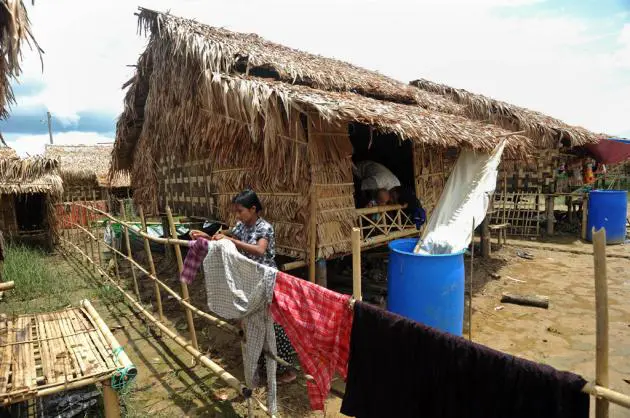
"They told us they would take legal action against us if we complained," said the 52-year-old as she sat surrounded by her extended family and a few salvaged possessions in her new home -- a one room bamboo hut in a field on the fringes of Yangon.
- Jungle ordeal -
=================
Many from Thameelay ended up in a monastery in the remote Bago countryside.
But they could not stay long.
Authorities again demanded they move on and it was then, as their plight filtered into national news, that two unlikely organisations stepped in to offer help -- the military-backed ruling party and the Democratic Karen Buddhist Association (DKBA) armed group.
The DKBA, former rebels in eastern Karen State who struck a deal to join forces with the previous-junta government, appeared eager to show their magnanimity.
They arrived in 12-wheeler trucks brandishing promises of lush land plots in the insurgency-wracked jungles near the Thai border.
Some 200 families took them up on the offer.
Villager Than Htwe told AFP that life with the fighters, who have never released a motive for their uncharacteristic act, was not quite as advertised.
After a gruelling four-day journey to the frontier region, the villagers were met with suspicion and restrictions.
"We were basically locked up as soon as we arrived," said Than Htwe, 42.
His family of three decided to cut their losses and return to central Myanmar where relatives, including Aye Aye Win, had chosen to throw their lot in with the ruling Union Solidarity and Development Party.
The USDP, the well-funded vehicle for Myanmar's former generals to relaunch themselves as civilian politicians, had bought 12 acres of barren farmland for around $200,000 and created new Thameelay village from the scrub along the lonely highway north of the commercial hub Yangon.
Around 200 stilted huts now stretch across the field in neat rows reminiscent of the country's many displacement camps.
"We gave them a lease saying that they can live here and pass it on to their children. But they cannot sell their plot," said USDP village leader Myint Myint San.
There are plans for a factory, promises of government loans and a new village hall has recently been completed.
During controversial 2010 elections the USDP was accused of various vote-winning tactics, including half-building roads and promising to finish the work only after they were elected.
In next year's crucial polls the party will face a greater test -- competition from Aung San Suu Kyi's opposition, which is running in its first general elections since its 1990 victory, which was ignored by the junta.
"People do not need to be USDP members to stay here," Myint Myint San told AFP when asked about the party's motivation for its largesse.
"But everyone here was already in the party before they came."
- Land disputes -
=================
Some 70 per cent of Myanmar's population -- mainly the rural poor -- rely on the land for their living.
The government is drawing up a new land use policy that will underpin fresh legislation as part of reforms since the end of outright military rule in 2011.
But researchers at the Transnational Institute think tank have warned that the proposals look to please large investors, potentially to the detriment of small farmers.
Khine Maung Yi, a member of a parliamentary commission on the issue said land appropriation remains a chronic problem, even as the government struggles to return property taken under the junta.
Of 26,371 letters of complaint received, only some 9,000 had been forwarded to the relevant departments as of September. But most of these have yet to be dealt with.
"The amount of seized land returned is still just tiny," he told AFP.
hla/klm/jta/apj/lto
Myanmar-housing-politics-land AFP 100724 GMT DEC 14
In Thailand, black plates are meant to be used for private vehicles but Uber's application has allowed individual fare-paying customers to connect with a registered private driver under their "UberX" brand.
A slightly more expensive option allows users to locate cars with green plates, which are used by taxi and limousine services and driven by people with licences to take passengers.
The ban does not apply to licensed cars, Teerapong said.
UberX is a significant part of the firm's Thailand business -- although the company would not be drawn on how much of its revenues come from regulated journeys.
Nonetheless the Uber smartphone app was still taking bookings for both green and black plate cars in Bangkok on Wednesday.
Uber is as adored by start-up watchers for its stellar rise as it is loathed by the established taxi industry for undercutting prices.
A company statement said Uber "respects the Department of Land Transportation and its important role as a key regulator" adding the firm would continue talking about the legal framework for its business.
"Over the past few months, more and more Thai people have been cruising the streets of Bangkok and Phuket, using (the) Uber platform and they are loving the experience," it added, without referencing the part-ban.
Uber is valued at around $40 billion despite facing a cascade of regulatory worries with authorities spanning the US, to Spain and India, mainly linked to possible breaches of competition law.
This week the city government in New Delhi banned Uber from operating in the Indian capital after a passenger accused one of its drivers of rape.
