
UN to support Myanmar's graduation from LDC status
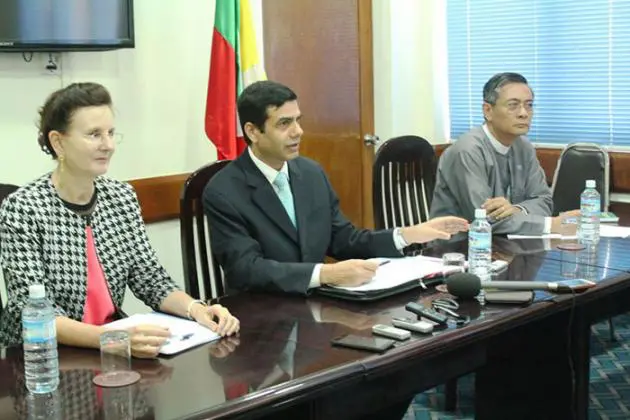


United Nations organisations will cooperate to support Myanmar in getting off the list of the Least Developed Countries, said a senior UN official.
The UN High Representative Gyan Chandra Acharya said at a press briefing on Wednesday that Myanmar’s graduation from the LDC category will be supported by a joint mission involving the Office of the High Representative for the Least Developed Countries, Landlocked Developing Countries and Small Island Developing States and the United Nations Development Programme in collaboration with UNDP’s Department of Economic and Social Affairs, United Nations Conference on Trade and Development and the Economic and Social Commission for Asia and the Pacific, in conjunction with the Myanmar government.
“For the last 3 years, Myanmar has undergone significant change in many areas, most notably its peaceful transformation from a military government to a multi-party democratic system, from conflict to peace negotiations, and an array of economic, administrative and private sector development reforms. However, there is a long way to go to achieve sustainable development and graduation,” said Acharya.
Myanmar will graduate based on the LDC graduation criteria established by the Committee of Development Policy (CDP), an independent expert body within the Economic and Social Council. Currently, the CDP identifies LDCs based on three criteria: per capita gross national income (GNI), human assets (HAI), and economic vulnerability to external shocks (EVI).
To be recommended for graduation, a country must be found eligible in two successive triennial reviews by the CDP. In order to meet the necessary criteria, LDCs need to overcome such challenges as abject poverty, undeveloped human assets, high vulnerability to various shocks and limited productive capacity. In this regard, a graduation strategy should focus on transformative changes. For graduation, LDCs will require strong national leadership together with appropriate strategies, accompanied by equally strong global support and partnership.
According to Acharya, the main trading and development partners of Myanmar need to mobilise to provide support for the nation’s graduation. Support through regional and global financial institutions like the Asian Development Bank and the World Bank Group also need to be fully mobilised for graduation purposes, and regional cooperation in Asean and Bimstec also plays a crucial role.
Myanmar has established a high-level committee on graduation headed by a Vice-President, and specific sub-committees for each of the graduation criteria. The government is also preparing a national comprehensive development plan to graduate through an alignment of priorities with the sectors that are key drivers for graduation.
“Myanmar met one criterion–HAI–in the 2012 triennial review. Preliminary assessments by the CDP Secretariat reveal that Myanmar is likely to meet the HAI criterion in 2015 as well. It is unknown whether it will meet GNI or EVI, as critical data is not yet available,” he said.
The UN representative said that the mission will work with the government on the identification of key milestones for Myanmar’s graduation from the LDC category and prepare a roadmap for graduation that would guide all stakeholders in the management of the transition.
The mission’s tasks also involve providing information, sharing experiences, carrying out an analysis of the current situation and development trends, and discussing current development challenges with representatives of the Myanmar government and other stakeholders, such as private sector representatives, civil society and donor communities present in the country.
