
Instability may lead to army's control: UEC Chairman


Play
The military was not guaranteed of 25 per cent of the seats in parliament to enable it to seize power back, but it can if the country is not stable and tranquil, warned Tin Aye, chairman of the Union Election Commission (UEC).
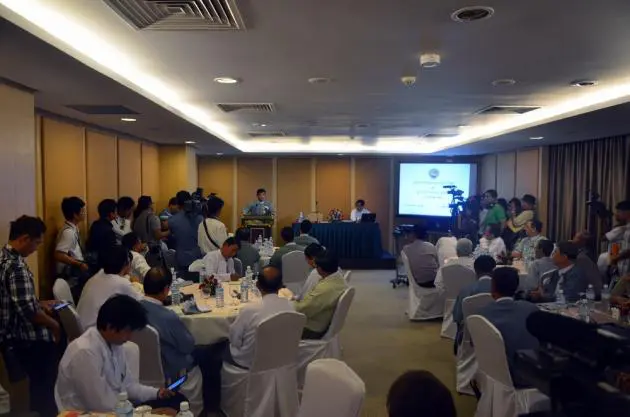
“The Revolutionary Council seized power in 1962 to prevent secession, and this act was protected by the 1947 constitution. This was one of the flaws of that constitution,” Tin Aye said at a meeting with artists at Micasa Hotel in Yangon on December 16.
“The army governed the country by military rule from 1962 to 1974. Another constitution emerged in 1974. It was approved by a referendum. The leaders sought to establish a socialist society in Myanmar. Socialism is a good political system, but it failed here because of the weaknesses of those implementing it. The country suffered deteriorations in all aspects, which led to the 1988 uprising.”
“At that time, decapitations occurred in the country. The country did not have any administration. There was no rule of law. The Tatmadaw (Armed Forces) was threatened, so it seized power over the state. The Tatmadaw calmed the country down by shooting people and seized power in 1988. When the Tatmadaw held general elections in 1990, the National League for Democracy (NLD) won. The Tatmadaw would not transfer power to the NLD, claiming there must be a constitution in order to transfer power. They formed the National Convention to draft the constitution. The National Convention began in 1993, and then stopped in 1996. It resumed in 2006 and concluded in 2008. The constitution was ultimately approved by a referendum.”
“We knew right away that the constitution would have to be amended. The country was still not fully democratic. We were marching toward democracy phase by phase. The government eased some restrictions and kept others in place. The military rulers feared that the unity of the country would unravel if there was too much freedom. Between Myanmar’s independence in 1948 and the completion of the 2008 constitution, the country was governed by the public for only 14 years. Eventually, the Tatmadaw decided to abandon the one-party system and began the process of designing a guided democracy. The constitution must be amended in light of the differences between Myanmar’s old government and its new one.”
“We don’t want any more bitter experiences. We don’t want the power to be seized again; and the Tatmadaw won’t need to seize power as long as the country is stable and tranquil. However, if the country sees unrests, the army will be ready to seize power back. If so, the army will control the country. Our parties must try to develop the country. When the momentum behind the democracy movement is high, the military’s seats will have to leave the parliament,” the UEC chairman concluded.
“These comments go against reform process. I don’t think they are a good sign for the future of the country,” said MP Aung Kyi Nyunt, a member of the National League for Democracy (NLD).
The army seized the power in Myanmar in 1962 and implemented a one-party system. A second military coup took place in 1988. During military rule, the country faced huge losses of natural resources due to poor management.
In 1962, between 65 and 70 per cent of the country’s total area was forested. Today, that number is down to 25 per cent. Before the military coup in 1962, the potential of Myanmar’s economy and democratic government were recognised by the international community. After the coup, these deteriorated, and Myanmar is now one of the poorest countries in Southeast Asian region. There have been widespread rumours that the military will seize power once again. Myanmar’s current government is often described as quasi-military.
