
NCCT proposes additional observers to ceasefire talks


Play
A proposal for the inclusion of more observers in the next ceasefire talks is aimed at further cementing agreements, said Naing Han Thar, leader of the Nationwide Ceasefire Coordination Team (NCCT).
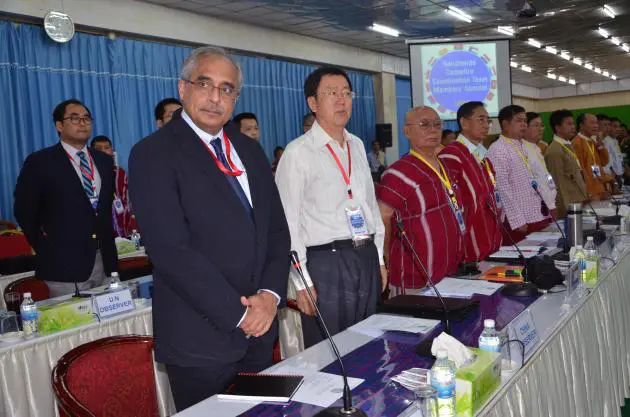
The work coordination meeting between the Union Peacemaking Working Committee (UPWC) and the NCCT which was held in Yangon during December 22-23 and mainly focused on resolving outstanding points of contention in the draft of the ceasefire deal. Both sides also discussed future plans, such as those for constructive talks to avoid the future fights during the ceasefire talks and the formation of a working group for joint monitoring of both sides' adherence to military rules and regulations. The NCCT has also suggested the inclusion of more observers at the next ceasefire talks.
“The NCCT has proposed to include more international observers in the 7th ceasefire talks. We [the UPWC] have already agreed with the NCCT in principle to invite other foreign observers in addition to the UN and the current observers. We don’t know which countries the NCCT will propose. Observers can be invited to the talks only once both sides have agreed,” said Hla Maung Shwe of the UPWC.
The next meeting between the UPWC and the NCCT is scheduled for January 15-17. Both sides expect to finalise the ceasefire deal at this meeting.
“Recent events have caused a decrease in trust between both sides. We believe that future agreements will be valid only when there are observers. Both sides should be transparent," the NCCT leader said.
The NCCT wants neighbouring countries, the US, the UK, Japan and Norway to serve as observers when the nation-wide ceasefire deal is signed.
The seventh round of talk took place despite several clashes of ethnic groups’ armed forces and the union military. The talk was postponed from November when the army shelled a Kachinrebel training camp in the north of the country, killing 23.
Notably, military representatives failed to attend the latest meeting.
Also missing were Naing Han Tha, NCCT’s leader, and second leader-2 Maj Gen Guan Maw didn’t attend the discussion and only a delegation accompanied by first leader-1 Pha Do Saw Kwe Htoo Win, Dr Sali Hlang Hmone and Col Khun Oakker.
Attending the meeting were the Union ministers from the government’s side Aung Min, Khin Yi, Khin Maung Soe as well as Lt-Gen Thet Naing Win and MP Thein Zaw.
“I’d attended the meeting for fifth time as No-4 Special Military Operation Officer and Union Minister of Border Affairs. Now, I’m here as the Union minister because I’ve transferred the duty of No-4 Special Military Operation Officer to Lt-Gen Khin Zaw Oo,” said Lt-Gen Thet Naing Win.
Some ethnic leaders show doubt on the talk.
“Unless there is a good explanation for the attack, it might be very difficult to move forwards on the peace talks," said Khun Okka, a member of NCCT.
Yet, after the two-day talks are finished, peace negotiators from both sides announced that the nationwide ceasefire accord between the government and ethnic armed groups is expected to be signed on February 12 (Union Day) next year. If that happens, political talks will follow in May.
They issued a joint statement saying that those points will be brought to the attention of respective leaders for further approval. In the statement, they also agreed to prevent unnecessary problems during the run-up to the signing of nationwide ceasefire deal and to hold the next meeting in mid-January.
During the meeting, UPWC leader Aung Min said that the ceasefire is important for 2015 since there are many priorities in the year including the election.
“We have to discuss not only the internal peace but also the Constitution. It will be like the modern Panglon Assembly.” Both parties are eager for peace. However, we have limited time. Peace process is not only the case to do in 2015 since there will be a general election which has to be free and fair.”
The ceasefire agreement, if really clinched, would be the fourth.
