
Mining activities getting more dangerous


Play
Criticisms run high following the crackdown of protesters against Myanmar Wanbao Mining Copper Co's Letpadaungtaung copper mine project last week.
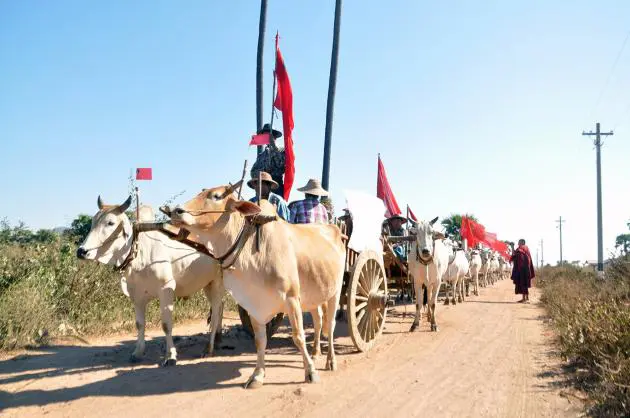
The commotion started on December 22, when villagers near the mine in Sagaing Region boarded their oxen-pulled carts to the site, protesting against the company’s fencing. Some complained against the company’s failure to pay compensation for their land confiscated for the project, others cried foul over possible environmental impacts from mining activities, despite the company's insistence of compliance to international standards.
Police officers were at the scene while some Wanbao staff were seen wearing bulletproof vests. The commotion left one protester dead and several people including Wanbao staff injured, sparking protests in Yangon on later days against the government and China.
Over twenty political and social organisations including ethnic parties have released statements denouncing the crackdown. The fencing was suspended on December 24 and it remains unclear how this tragedy would affect the future of the controversial copper mine and other mining projects across the country.
Long history
Wanbao has run the Lepadaung copper mine since 2010. The mining project is being developed by a subsidiary of the Chinese mining company Wanbao Mining Ltd and the Union of Myanmar Economic Holdings Ltd(UMEHL), the economic arm of the Myanmar military.
According to the report released last year by a government-established investigation committee Wanbao invested US$997 million to produce about 100,000 tonnes of copper a year. According to the production-sharing contract, the government is to receive 16.8 per cent of the profit, UMEHL 1.8 per cent and Wanbao 13.3 per cent. However, Wanbao is exempted from paying 8 per cent.
To make room for the mine, four villages, made up of 441 households, were supposed to be relocated for the Letpadaung mining project. According to Amnesty International, of these, 245 have been moved to resettlement sites, while the remaining 196 have refused to leave their homes.
The investigation committee was established following a crackdown on November 29, 2012 when police used white phosphorous munitions in their attack on a peaceful protest against the copper mine, injuring at least 99 monks and nine other protesters.
In a statement released last month, Amnesty International criticised the government for its inability to hold anyone accountable for the incident.
“Two years after this brutal attack, it is completely unacceptable that the scores of people injured while protesting are still waiting for justice and reparations. White phosphorus munitions should never be used by the police, the use of such weapons against peaceful protesters is a flagrant violation of international law,” said Audrey Gaughran, Director of Global Issues at Amnesty International. No police officer or official who was involved in the attack has been investigated, prosecuted or sanctioned, while the government has failed to provide victims with effective remedies and adequate reparation.”
Chain protests
On December 25, about 1,000 people reportedly attended the funeral of Khin Win, who was shot dead in the recent incident.
Following a solo protest on December 23 in front of the Chinese Embassy in Yangon, about 20 gathered there again on December 25. The police, who received the protest information in advance, blocked the University Avenue Road where the embassy is located since 2pm.
The protest vinyl says “Stop Letpadaungtaung Project which distorts the sovereignty,” “Protect public security in line with law,” “It impacts our sovereignty. What shall the government, Union Parliament and Military do for that?"
A protester Myat Kyaw said: “What I want to point out is the selfish business policy of China. Because of their selfishness, our citizens are facing a lot of problems. Their actions undermine our country’s sovereignty. We (citizens) are not protected by laws.”
The protesters said that a female farmer Khin Win was killed during the clash while accusing the government of protecting the interest of the Chinese company and undermining the country’s sovereignty. Against protesters' demand that officials from Chinese Embassy come out and hold a face-to-face dialogue, none came out.
Denounced act
The latest crackdown has brought about wide criticisms against the government and China, which has been the top foreign investor in Myanmar.
On December 25, National League for Democracy (NLD) MP Khin San Hlaing said that the party would submit a proposal to the parliament to investigate the recent Letpadaungtaung clashes and ascertain whether the government's response has been appropriate.
Khin San Hlaing said although the president formed the Letpadaungtaung investigation committee to submit a report about the project, she will cooperate with authorities to solve the outstanding problems in the area. She said she met with regional chief minister Thar Aye and other officials on December 24 to discuss possible solutions to the conflict over the Letpadungtaung mine project.
She said the chief minister promised that Wanbao would suspend the project fencing.
“He said an investigation committee will inquire about it (the death) and submit a report within two weeks. He promised that he would take action based on the report. But I don’t know exactly what accounts are true, who to blame or how to take action yet. The committee includes three government officials. We need to wait and see their report. We need to see how much truth is in it. If the government cannot give a satisfactory explanation, I will submit a proposal or raise the issue in parliament,” she said.
She said she will cooperate with locals to urge the regional government to deal promptly with the violence.
On December 24, the United Nationalities Alliance (UNA), made up of the 1990 elections-winning parties, released a statement, blaming the government for failing to resolve the previous clash in 2012. UMEHL and Wanbao have also failed to follow the suggestions given by the Letpadaungtaung investigation committee, though they promised to do so, it said. The UNA also called on the government to take responsibility for those killed and injured in the clashes in line with the law.
The government committee's report then stated that the company had taken too much of the villagers’ lands and recommended a review to establish how much land should be restored to the villagers, plus compensation at market rates. It also noted that the project had been launched without an environmental impact assessment, a social impact assessment or a health impact assessment, or an environmental management plan, and recommended that those requirements be fulfilled before the project continued.
Future of mining
The Letpadaungtaung project is not alone to face local resistance.
However, local villagers in Dawei took their case against Heinda tin mine - operated by Myanmar Pongpipat Co - to court. The Thai firm Pongpipat signed a production-sharing contract with Mining Enterprise 2 in 1999 and reportedly holds rights to 65 percent of the tin and tungsten produced at Heinda, which is transported to neighbouring Thailand for processing.
Myanmar is rich in mineral resources and it does not hide the ambition in making greater use of the resources.
On its website, the Ministry of Mines showed its plan to draw more foreign investment into the mining sector, either through production sharing or profit sharing arrangements. It also made public that new areas or deposits for new projects or to provide raw materials would be offered.
“Mineral wise, the government would emphasize more on the production of copper, gold, lead, zinc, iron and steel and would welcome foreign participation in these prospects. Privatization of the tin and tungsten mines and mines and industrial mines is also being planned and will be put into effect in the very near future,” it said.
The ministry is yet to react to the latest crackdown. In the latest statement by Wanbao released on December 23, the company insisted that not all villagers were against the project. It also urged peaceful talks.
“The commencement of construction, will allow Wanbao to continue maximising the developmental returns for the community and Myanmar as a whole,” it said. “We reiterate our belief that it is only through peaceful dialogue can peace and sustainable development be achieved.”
It also lamented at the circulating of a “false” account on social networks that Wanbao staff allegedly beating up villagers and carrying knives.
Farmland disputes
The Letpaduangtuang is just a tiny part of the big picture. Residents and farmers have been subjected to land grabs perpetrated by government departments, organisations, companies and business persons who ignore existing laws, claims the report of the Farmland Investigation Commission (FIC), which was recently submitted to the parliament.
Land disputes have become a worsening problem in Myanmar in 2014, affecting a larger number of local farmers, said Khine Maung Yi, a member of the government committee. There are about 700 ongoing lawsuits throughout the country. Some 300 farmers have been imprisoned, said Min Thu, another FIC member.
Last week, Union Parliament Speaker Thura Shwe Mann said that if the current government and parliament fail to address the much-criticised farmland issues during the remaining presidential and parliamentary tenure, they will certainly face widespread condemnation.
“The farmland disputes have been going on in the country for more than 50 years. Different places have different types of issue. If the farmland issues of today can’t be addressed, the people will criticise the government and parliament of turning a blind eye on them. As a result, the current government and parliament will have to take the blame for these farmland issues during the rest of their tenure,” Thura Shwe Mann said at a meeting on farmers’ issues held in Sintgaing, Mandalay Region on December 24.
He said that the land management central committee has already assigned duties to the respective committees at the different levels of village, quarter, township, district, region and state. The village and the quarter committees are the most responsible organisations and need to take appropriate action in a particular situation.
According to the FIC report, various ministries and companies will have to return 204,088.95 acres of land to the residents and farmers. The Ministry of Defence alone must return 104,074.75 acres of land the original owners, the Land Use Central Committee announced.
“The members of parliament repetitively complained that confiscated farmlands have not been given back to the rightful owners. The region and state governments need to take effective measures against the land grabs,” Thura Shwe Mann said.
Some governmental departments took hold of the lands more than they required, seeking self-interests on the pretext of staff welfare by leasing unnecessary lands.
