
Worsening plight of farmers


Play
Some 300 farmers were imprisoned in 2014, according to the Farmland Investigation Commission (FIC). The number could only grow.
Land disputes became a worsening problem in Myanmar, affecting a larger number of local farmers, admitted Khine Maung Yi, a member of the Farmland Investigation Commission (FIC).
There are about 700 ongoing lawsuits throughout the country. Residents and farmers have been subjected to land grabs perpetrated by government departments, organisations, companies and business persons who ignore existing laws, claims the report of the FIC, which has been submitted to the parliament.
The report was completed at the time when villagers in Sagaing Region protested against the fencing around the Letpadaungtaung copper mine, which left one woman killed. The copper mine belongs to Myanmar Wanbao Mining Copper, a joint venture of China’s Wanbao Mining.
According to the FIC report, various ministries and companies will have to return 204,088.95 acres of land to the residents and farmers. The Ministry of Defence alone must return 104,074.75 acres of land the original owners, the Land Use Central Committee announced.
“Generally speaking, farmers in disputes with the government can expect up to 50 or 60 court appearances. The handling of these situations goes slowly,” Khine Maung Yi said.
The Land Use Management Central Committee led by the vice president was formed so as to solve the farmland issues. Region/State, district, township, ward and villagelevel land management committee are making efforts to tackle land issues.
Last week, 14 Michaungkan protesters were brought to Kyaukdata Court in Yangon, facing charges of illegally opening 11-day protest camp in front of Yangon City hall on December 12. That was the second hearing. The third will be held on January 16.
The police raided the Michaungkan protest camp in front of the City Hall in the early morning of December 23. 14 protesters were detained and the West District court charged them with Sections 18, 431 and 143.
In the second hearing, according to Rawbert San Aung, defendants’ lawyer, Police Deputy Superintendent Tin Hla and Maung Maung Zaw, an officer from the Administration Department of the City Development Affairs, said the protesters were getting a bit noisy. “But they didn’t know how the protesters made a noisy protest,” he said.
Disputes could only worsen. On December 22, villagers in Sagaing Region protested against Myanmar Wanbao Copper Mining Co’s fencing of their farmland. They said the company had not yet properly compensated the cost of their crops and land. One protester, Khin Win, was shot dead during the protest against the in Letpadaungtaung copper mine and that sparked a series of protests. Resentment was also expressed against China.
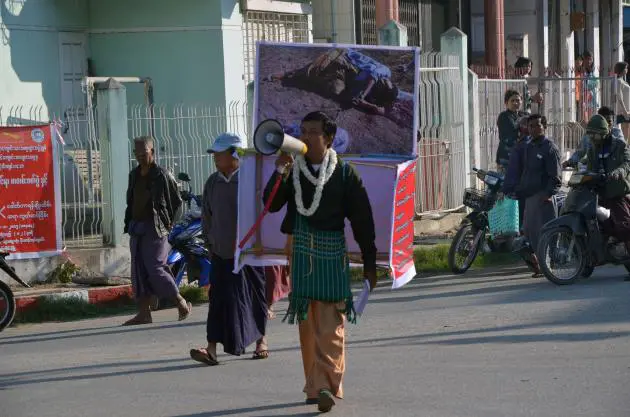
Last week, Than Htaik Oo staged a solo protest to oust the chief minister of Sagaing Region who is supposed to be responsible for the death of Khin Win.
The solo demonstrator, after receiving an official permission from the local authorities, started his protest in front of the Bawa Alin Private Clinic in Tagaung Quarter and then proceeded to Myoma Market on January 8. After that he headed to the town hall and the township administrator’s office, shouting slogans against the chief minister.
“Chief Minister Tha Aye is responsible for the death of Khin Win. I demand an immediate ouster of the chief minister in accordance with the 2008 Constitution.
“Sagaing Region has not seen any development under the Chief Minister Tha Aye. Buddhist monks were arrested by the police who used smoke bombs in Letpadaungtaung area for the first time. Khin Win was shot to death on December 23. The lack of management by the chief minister brought about such unpleasant incidents,” Than Htaik Oo said.
In another development, the deputy medical superintendent of Magway’s Medicine University filed a complaint against local farmers in Hsar Taing Kn and Dhahet Kan villages for trespassing on the university’s land with Magway Myoma police station.
About 200 acres of farmland in the villages were bought by the university at the price of Ks15,000 (about US$15) per acre in 2001 to build academic hospital and Medicine University (Magway).
After the academic hospital and staff quarters were built, local farmers decided to grow crops in the vacant farmland. They paid Ks 35,000 ($35) per acre for land rent to the hospital until 2012.
In 2013, they continued to grow the crops without paying land rental fees. The university then decided to put up fences around the farmland.
Dr Myo Min Thein, deputy medical superintendent, filed a complaint with the police on January 7, accusing the farmers of trespassing on the university’s land.
Likewise, the farmers also filed a complaint against the university officials for trespassing on their farmland.
Lower House MP Khaing Maung Yi admitted that the impact of land conflicts on political trend may grow larger this year.
“Anyone with ill intention can easily make the circumstances bitter. The situation of our country is that fragile,” Khaing Maung Yi said.
It is hard to identify the instigator of a conflict, and without cautious moves, it will produce a greater clash especially in times of 2015 general election, the MP added.
The government has already given back 302,201 acres of land but about half of them are not yet received by their owners, according to proclamation of Land Utilization Management Central Committee in December 2014. Complaints flied to the Parliament as these lands have not been returned straight to their sole owners.
The parliamentary speaker Thura Shwe Mann said the land conflicts should be resolved during the tenure of ruling government.
