
FDI to become 'key driver' of economy, expert says


Play
Myanmar will attract more foreign direct investment (FDI) in the years to come, despite political risks, said a renowned economist.
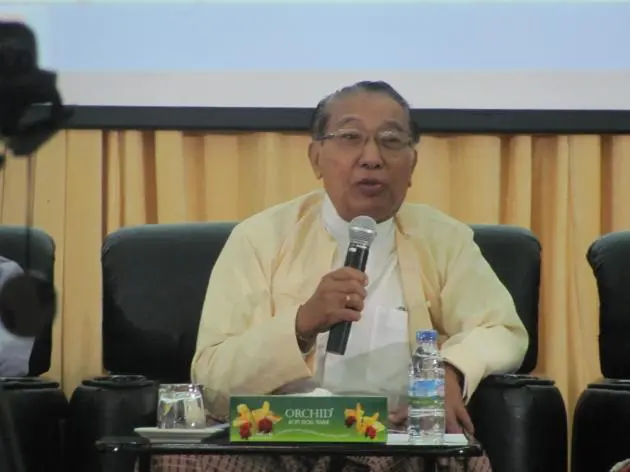
Maw Than, a director of the Central Bank of Myanmar and retired rector of the Yangon Institute of Economics, also underscored the importance of the open market policy, which he said is in line with Myanmar’s newly democratic political system.
“If we hope to adopt true democracy here, we should open our market,” he said in an interview.
Mow Than is convinced that most of the future FDI will go to the energy and service sectors.
“Yet, we also need foreign investments in agriculture and forestry. Anyhow, FDI is instrumental for sustainable growth. It will also play a vital role in increasing the real GDP growth rate,” he said.
Myanmar is expected to receive about US$5 billion in foreign investments this fiscal year. During the first six months of the 2014-15 fiscal year, FDI inflows reached about $4 billion. The Directorate of Investment and Company Administration has estimated that FDI inflows will reach $6 billion in the 2015-16 fiscal year.
Most of the foreign investors considering investing in Myanmar are mainly concerned about infrastructure and regulatory conditions. According to Maw Than, the Myanmar government has been making efforts to improve the regulatory framework in order to attract more FDI. But he said citing infrastructure as an impediment to investing seems to be an “art of bargaining”.
Maw Than added that the nation’s economic outlook beyond 2015 will mainly depend on the policies pursued by the next government.
“The ruling government has undertaken a lot of reforms. Even if the major opposition party wins the elections and can form the next government, I believe they will continue the reforms. As a result, the outlook beyond 2015 will be favourable,” he said.
As important as opening up the domestic market, Myanmar also needs to expand its presence in the global markets, he noted.
“The country needs to increase exports to other countries including the United States and Europe, to amass more foreign currencies. Relevant organisations should also conduct market studies and surveys with the support of the government and Union of Myanmar Federation of Chambers of Commerce and Industry before entering new markets,” he said.
The economic outlook is bright, despite the depreciation of the kyat against US dollar, he said. The issue here is how the central bank should control money in circulation.
“There are some factors beyond the central bank’s control; for example, an increase in the salary of parliamentarians and civil servants,” he said.
“Salary increases may lead to a greater money supplies. Higher interest rates could absorb the excess liquidity while higher taxes and other fiscal policies can also help. While the central bank works through monetary policies, it is important that other related ministries and departments should focus more on fiscal policies.”
Maw Than also emphasised the importance of private sector development, calling for cooperation from all industries. To him, private sector development should not depend only on the government’s support.
“It should depend on the efforts of respective sectors. In reality, we have found out that some of the government policies on this flopped. The private sector itself should try to develop,” he said, adding that stronger small and medium enterprises would ensure long-term development.
“The main obstacle facing SMEs lies with financing. Most of them want to borrow money without collateral. Yet, if the government lends money without collateral and they cannot pay it backeveryone loses. We need to find a good solution,” he said.
He suggested that loans should be offered based on business plans, the outlook of the business and expected returns on investment.
“All companies need feasible plans to ensure lenders of their ability to repay,” he noted.
