
Unfruitful political talks
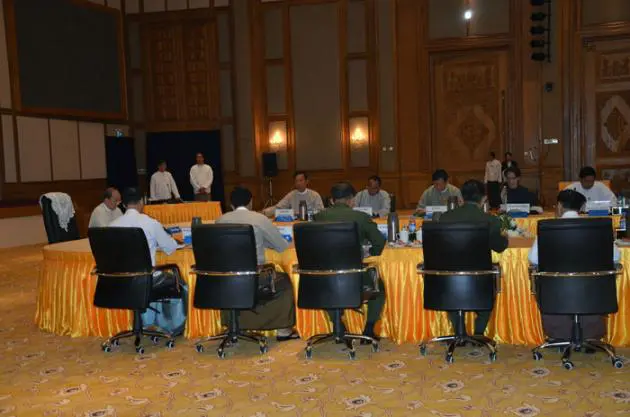


Not all the invitees to the recent political talks found the meeting productive
When as many as 48 people gather in a single room, not all can have the time to divulge their thoughts, let along reach a solution to long-standing conflicts.
That is the case of the political talks on January 12, which was participated by 48 individuals including 28 ethnic ministers from various regions and states.
Some were optimistic about the meeting's outcome.
"We have reached a very important stage for political reforms. The general elections will be held by the end of this year. Everyone knows that the president wishes to sign the nation-wide ceasefire agreement and start the political dialogue during his term. So there is not much time. In the middle of this month, the NCCT will meet the UPWC. I suppose this meeting is meaningful as it was meant to produce good ideas and information from the participants," said Dr Tu Jar of the Kachin State Democracy Party.
Others viewed it unproductive.
"It makes no difference. We just talked and talked. Some even dozed off, as there were only three subjects to discuss.The talk wasn’t very different from the previous one. My view is that the peace process is the most important. But it seems there will be no four-party talks, no six-party talks and no 12-party talks. That's why they invited so many people to the meeting," said United Nationalities Alliance leader Khun Htun Oo.
The talks took place in Nay Pyi Taw. Organised by the government, it was designed for discussions on key domestic issues, such as the successful completion of the 2015 general election, the national peace process and democratisation.
The meeting started at 9.30am and ended at around 4pm at the Presidential Palace. Participants included President Thein Sein, opposition leader Aung San Suu Kyi, Senior General Min Aung Hlaing, Deputy Commander-in-Chief Soe Win, Union Parliament Speaker Thura Shwe Mann, Nationalities Brotherhood Federation leader Sai Aik Pao, Federal Democratic Alliance leader Khin Maung Swe, United Nationalities Alliance leader Khun Htun Oo. This was the first meeting of the 14 participants since the last high-level political meeting on October 31, 2014.
New participants included Aye Thar Aung of the Rakhine National Party, Dr Tu Jar of the Kachin State Democracy Party, Karen People's Party chairman Saw Tun Aung Myint, Chin National Party chairman Zo Zan and Dr Min Nwe Soe of the All Mon Region Democracy Party.
The October 31 meeting produced little substantive change. Each of the 14 participants spoke for about 10 minutes. Many accused President Thein Sein of organising it in order to send a positive image of his government to US president Barack Obama, who arrived in Myanmar just over a week later.
The government has so far ignored Suu Kyi’s call for a four-party talk, to involve only the president, the commander-in-chief and union parliament speaker.
Upper House MP Myint Tun of the ruling Union Solidarity and Development Party submitted an urgent proposal on November 25 calling for a six-party talk to parliament. At this week's meeting, President Thein Sein made no comment on the proposal for a six-party talk, which would include himself, Suu Kyi, two parliamentary leaders, the commander-in-chief and a MP who represents ethnic groups. The idea was proposed and approved by the parliament.
"We are considering all the possibilities. We didn’t say [a six-party talk is] impossible. When I talked about it in Yangon on behalf of the government, I said it's not possible for the time being, as there are many different views on the six-party talk. Therefore, we arranged his meeting to include the six ethnic groups that want to participate. We also invited ethnic affairs ministers and ethnic parties. We were also recommended to invite senior-level executive members of some regions and autonomous states," said presidential spokesman Ye Htut.
Before the end of last year, Saw Tun Aung Myint, minister for Kayin ethnic affairs for Yangon Region, submitted an urgent proposal to hold a twelve-party meeting including seven ethnic groups instead of a six-party meeting on December 9, which was later approved.
Questions have arisen as to why individuals were invited to the meeting on January 12 personally rather than through their party offices.
For example, Aye Thar Aung, a member of the central committee for the Rakhine National Party, was invited directly, while his superiors, including the party's chairman and vice- chairman, were not invited. Furthermore, the party's chairman, Dr Aye Maung, was secretly voted in as ethnic representative for the six-party talk.
