
Agribusiness, skills, financial resources 'key' to economic transformation- OECD report
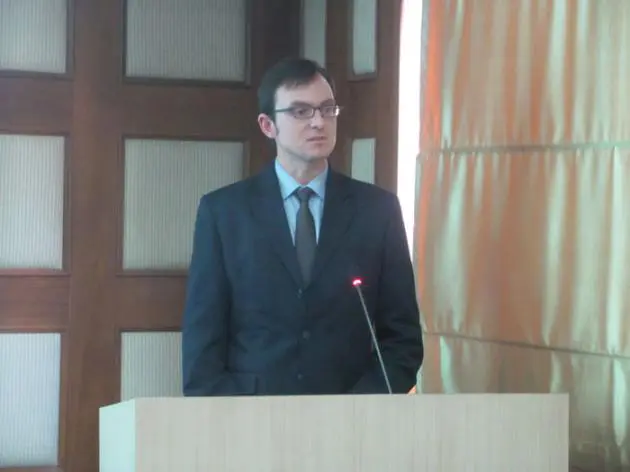


As Myanmar continues its reforms, the government needs to emphasise on three main things - agricultural development, filling the skills gap, and providing financial resources, said the Organisation for Economic Co-operation and Development (OECD).
OECD launched its Multi-dimensional Review of Myanmar Volume II on Wednesday afternoon. According to the report, Myanmar needs to put more emphasis on upgrading agriculture, manufacturing and services; provide more vocational training programmes to solve out the skills shortage; and allocate financial resources to support its development needs.
“In this report, we mainly focused on three key points. Firstly, modernising the agribusiness and agriculture sector is necessary to support manufacturing and servicing sectors because if your farmers become rich thanks to higher productivity, they will consume more industrial goods and investments. It will also free up labour for industrial jobs and savings for investments,” OECD’s deputy secretary-general Rintaro Tamaki told Myanmar Eleven in an exclusive interview.
“Secondly, we focused on how to fill the skills gap in the country and labour development. Thirdly, we emphasised on domestic financing. We are not discussing about ODA [Official Development Assistance]. OECD is not a financial institution. So we are not providing bank loans. Our aim to study the potential and obstacles in detail and then to provide policy recommendations on what the government should do,” he said.
Tamaki added that the report provides the insights and recommendations on land rights, expending rural financing, increasing productivity, consulting with farmers associations to improve the agriculture sector, and regulating the safety standards.
“Safety is very important. For example, if Japan wants to import mangoes from Myanmar, they want to ensure that Myanmar mango is safe and delicious. The government should undertake the inspection process by putting intellectual standards into the Myanmar market,” he said.
The report follows the Initial Assessment published in July 2013 which identified the key
challenges to development in Myanmar through a broad diagnostic assessment
across a wide range of policy areas. It provides an in-depth analysis of those key challenges and develops a series of policy recommendations to overcome them. The recommendations were developed through an inclusive process which involved extensive consultations with Myanmar government officials and with the academic, business and international donor communities based in Myanmar.
” The first volume mainly focused on facts finding and diagnostic analysis, e.g. what the opportunities are, what can be vital to the future growth of Myanmar. The second volume is based on these findings, we made in-depth analysis and tried to make policy recommendations on how to solve out the obstacles,” said Tamaki.
To him, Myanmar's transformation to a modern economy could be kick-started through a strong focus on the agricultural sector where most people currently work. Increasing access to finance in rural areas and improving farmer skills will be crucial to boosting farm productivity, freeing up workers for manufacturing and services.
According to the report, Myanmar needs to address poor rural infrastructure, inadequate farmer skills, insufficient government services to promote exports, and lack of access to finance in the agricultural sector. Only 2.5 per cent of loans in Myanmar go to the rural sector despite the fact the sector accounts for 30 per cent of gross domestic product and two-thirds of jobs, the report says.
Jan Rielander, OECD Development Centre’s head of multi-dimensional country reviews, said that the agricultural sector holds the key to transformation. He said that Myanmar’s agricultural income per worker is only US$134, which is very much lower than other Asean countries. In Malaysia, agricultural income per worker is $6,680, while that of Indonesia and Thailand are nearly the same, with $730 and $706 respectively. Cambodia’s agricultural income per worker is $434 while that of Vietnam is $367. South Korea’s agricultural income per worker is $19,807, which is the highest in Asia.
“We have learnt that the key constraints in the agricultural sector are small holder structure, low productivity and quality, inadequate infrastructure, lack of access to finance, inadequate agronomic skills and R&D [Research and Development], and insufficient government services. Research and innovation as well as extension services can help overcome the outdated methods of farming that are holding Myanmar’s agriculture back,” said Rielander.
During his presentation of the findings and recommendations, Rielander said the government should provide continual training for extension professionals; change from top-down to village-based approaches for farmer training; promote public-private partnership with government oversight; and deliver technical information and training through internet, radio, and smart phones.
He also noted that the constraints of the manufacturing sector are corruption, lack of technology, and poor access to land and office space. Resolving ambiguity over land rights, improving infrastructure and reforming the financial system would help create the right conditions for the wider economy to flourish. More government support to promote Myanmar’s exports abroad, and to strengthen health and safety regulatory systems so that products meet export standards would also have a positive impact, the report says.
Building up the right skills in the workforce will be essential to support Myanmar’s structural transformation. Realisation of Myanmar’s transformation will also depend upon how effectively the country can mobilise and allocate the vast financial resources needed to support its development targets. In all these areas, the institutions and policy frameworks need to be strengthened, it says.
The report also underscores the importance of providing financial resources.
Achieving the government’s growth targets could require investment of between 21 per cent and 28 per cent of GDP annually over the next two decades and as much as 30-40 per cent of GDP by 2035. To meet its funding needs, Myanmar should consider all available sources of finance. External sources -- including Official Development Aid, Foreign Direct Investment and remittances from the country’s large diaspora -- could meet as much as one third of financing needs for the rest of the decade. However, the bulk of financial resources, especially for the medium to long term, will need to come from domestic sources, including government revenues and household savings, which are currently very low, the report says.
Government revenues from natural resources need to be effectively gathered and managed. Tax revenues could be raised through reforms to the tax system and tax structure and improved tax compliance. Currently, there are only 200,000 registered taxpayers in the entire country, amounting to only 0.4 per cent of the population.
Liberalisation of the banking sector is vital to providing financial services to the rural sector in the medium term, and financial regulatory responsibilities will need to be clarified. Financial and capital market development needs to focus first on interbank and bond markets. Stock market development in Myanmar should be regarded as a longer-term project whose benefits will be manifest gradually, the report says.
